
Sagebrush violet: complete guide
Viola vallicola
¿Quieres ver Sagebrush violet: complete guide en tu jardín?
1 minuto, sin tarjeta de crédito
Overview
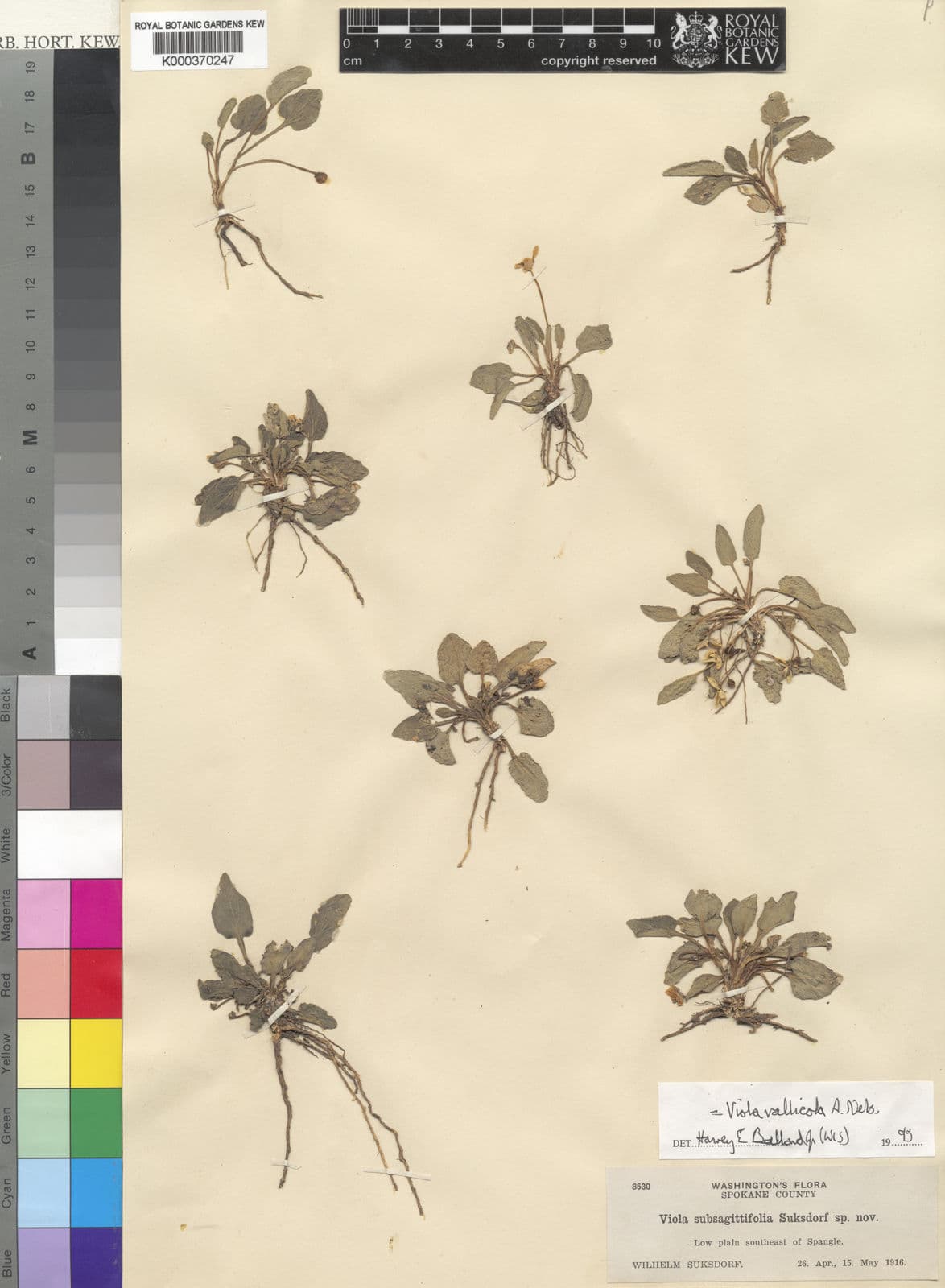
The sagebrush violet (Viola vallicola) is a compact violet from the Violaceae family, native to the dry grasslands and sagebrush country of western Canada and the northwestern United States. It occurs naturally in British Columbia, Saskatchewan, Montana, Wyoming, Colorado, Kansas and both Dakotas, where it grows on rocky slopes and high-elevation shortgrass prairie. It is a close relative of the well-known yellow prairie violet Viola nuttallii, sharing the same bright yellow flowers with fine purple-brown veining.
Unlike the moisture-loving woodland violets most gardeners are familiar with, this is a true drought plant: low, tough and adapted to lean, fast-draining ground. For rock gardens, steppe beds and gravel gardens it is a surprising addition, though in Europe it is mostly found through specialist alpine and steppe plant nurseries. Anyone who loves early spring colour without much fuss will find a rewarding candidate in this little violet.
Appearance and bloom
The sagebrush violet forms a low, dense rosette 5 to 15 cm tall, with grey-green, oblong to egg-shaped leaves that feel slightly leathery, an adaptation to dry, windswept steppe conditions. The plant spreads slowly by short rhizomes, forming a loose mat after a few seasons.
Flowers appear early in the season, typically April to May in western European gardens, and are bright yellow with fine brownish-purple veining on the three lower petals, a pattern that guides pollinators to the nectar. Each flower measures 1.5 to 2 cm across on a thin, upright stalk held above the foliage. After flowering, small seed capsules form that split open at maturity and fling the seeds a short distance.
In hot, dry summers the plant may retreat and enter a rest period, similar to the summer dormancy many prairie species undergo. This is normal behaviour, not a sign of disease.
Ideal location
Choose a spot in full sun: at least 6 hours of direct light a day is needed for good flowering. The sagebrush violet is excellent for rock gardens, troughs, gravel beds and steppe plantings where the soil dries out quickly. In an ordinary border with rich, moisture-retentive soil, the plant essentially drowns in its own success: too much food and moisture leads to soft, short-lived growth.
A south-facing slope, a raised bed or a gravel garden with an underlying drainage layer is ideal. The plant tolerates wind and cold extremely well but is sensitive to standing water around the roots, especially in winter.
Soil
The soil should be lean, coarse-textured and extremely well-drained. A mix of garden soil with at least 40% coarse sand or fine grit best mimics the rocky steppe ground of its origin. The ideal pH is between 6.5 and 7.8, so neutral to slightly alkaline; lime-rich soil is tolerated well.
Avoid heavy clay or soil that holds moisture: this is the main cause of death in cultivation. When planting in an ordinary border, it is worth building a raised bed or heavily amending the spot with grit and coarse sand from a garden centre. Fertiliser is rarely needed; an annual top-dressing of fine grit keeps the plant's neck dry and prevents rot.
Watering
After planting, in the first season, water regularly so the young roots can establish: roughly once a week during dry spells. After that, the sagebrush violet is remarkably drought-tolerant and needs almost no supplemental watering except during extreme, prolonged dry periods.
Overwatering is the fastest way to lose this plant. In winter, when the plant is largely at rest, watering is almost never needed in Dutch, Belgian or German climates; rainfall is more than sufficient. Make sure the soil dries out quickly between showers.
Diseño gratis
¿Quieres ver Sagebrush violet: complete guide en tu jardín? Crea un diseño gratis ahora.
Pruning
Pruning is minimal. Remove spent flower stalks after blooming to keep the appearance tidy and limit self-seeding, unless you actually want the plant to spread. At the end of winter, trim away dead foliage to make room for new rosettes.
Because the plant naturally stays low and compact, no shape-pruning is required beyond that. A light annual tidy-up in March, just before growth resumes, keeps the mat looking fresh.
Maintenance calendar
March: remove old foliage, refresh the grit layer, check drainage after winter.
April-May: main bloom period; enjoy the yellow flowers and watch for pollinators.
June-July: flowering tapers off; seed capsules ripen and split open.
August: possible summer dormancy during heat; minimal intervention, avoid overwatering.
September-October: possible new growth; a good time to divide older clumps.
November-February: winter rest; just check for standing water after rain or snowmelt.
Winter hardiness
Thanks to its origin in Saskatchewan, Montana and the Dakotas, Viola vallicola is remarkably winter-hardy: USDA zone 3 to 7, meaning it tolerates temperatures down to -35°C to -40°C. For gardens in the Netherlands, Belgium and Germany (typically zone 7-8), winter cold is never an issue.
The greatest winter threat is not frost but moisture: wet, poorly drained soil combined with freeze-thaw cycles causes damage far faster than severe cold on its own. Good drainage therefore matters more than winter protection against cold.
Companion plants
The sagebrush violet pairs naturally with other drought-loving steppe plants: Pulsatilla species, ornamental grasses such as Bouteloua gracilis, Penstemon species, Eriogonum and Antennaria. In a rock garden it looks good alongside Sempervivum and low-growing sedums.
For a prairie-style border, combine it with Echinacea, Liatris and low ornamental grasses like Festuca glauca. The early, bright yellow bloom nicely fills the gap before most other steppe plants get going.
Propagation
Propagation is by seed or division. Seed typically needs a cold period of 8 to 10 weeks (cold stratification) before it germinates: sow outdoors in autumn, or store the seed in the refrigerator for several weeks before sowing in spring. Germination takes 3 to 6 weeks at 10-15°C. Specialist alpine and steppe plant nurseries, including those that trade through seed exchanges, are the best source for reliable seed of this uncommon species.
Dividing established clumps is the fastest route to an identical plant. Do this in early spring or early autumn, carefully dig up the clump and separate the rhizomes by hand. Replant immediately at the same depth in well-drained soil.
Pests and diseases
The sagebrush violet suffers little from pests and diseases as long as the soil stays well-drained. Root rot from standing water is by far the biggest risk. In wet springs, powdery mildew can occasionally appear on the foliage; improve air circulation if this happens.
Slugs may nibble young spring shoots, especially after rain; check in the evening and remove by hand. Aphids are rare. Grit and coarse sand from a garden centre help improve drainage at planting time.
Closing
The sagebrush violet is a lovely, low-maintenance addition for anyone who wants an early yellow flowering accent in a rock garden, gravel bed or steppe border. As long as drainage is right, this North American prairie plant asks for almost nothing in return. GardenWorld can help you design a rock garden or steppe planting suited to species like this. Visit GardenWorld for garden design and the GardenWorld plant database for more species.
¿Quieres ver Sagebrush violet: complete guide en tu jardín? Crea un diseño gratis ahora.
Sube una foto, elige un estilo y obtén un diseño fotorrealista con lista de plantas en menos de un minuto.
Más de 10.000 jardines diseñados
Sin tarjeta de crédito


Plantas similares
Woodland white violet: complete guide
Viola blanda
Discover the woodland white violet (Viola blanda), a fragrant North American groundcover for shady gardens. Site, soil, and care covered in full.
Canada violet: complete guide
Viola canadensis
Learn to grow the Canada violet (Viola canadensis), a tall, fragrant woodland violet for shade borders. Site, soil, pruning, and hardiness explained.
Mont Cenis violet: complete guide
Viola cenisia
Grow the Mont Cenis violet (Viola cenisia), an alpine cushion plant from the Alps for rock gardens and troughs. Site, soil, and hardiness explained.