
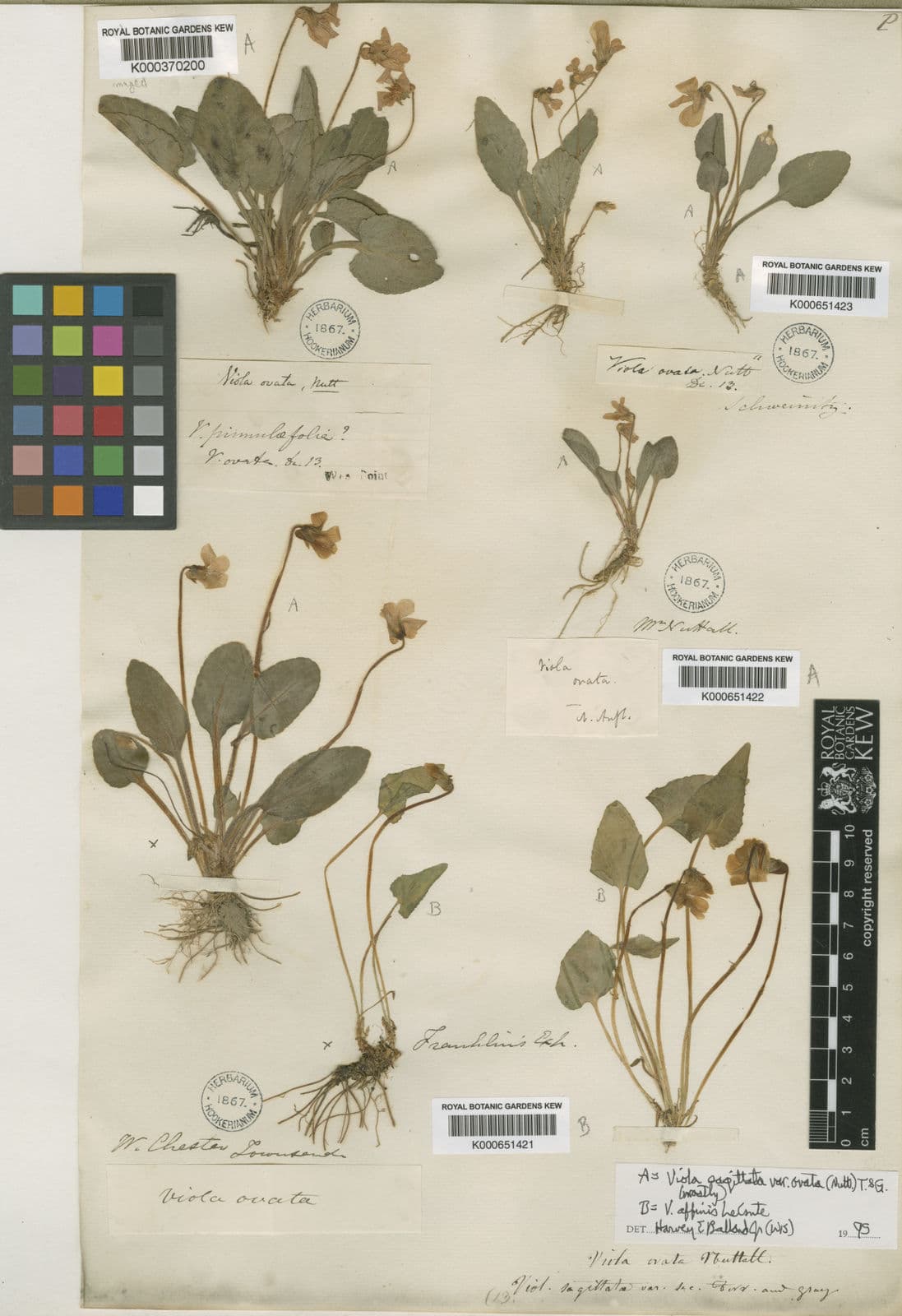
Primrose-leaf violet: complete guide
Viola primulifolia L.
¿Quieres ver Primrose-leaf violet: complete guide en tu jardín?
1 minuto, sin tarjeta de crédito
Overview
Primrose-leaf violet (Viola primulifolia) is a moisture-loving perennial in the violet family (Violaceae), native to central and eastern North America, from Florida and Texas up to Wisconsin and New Hampshire. Unlike most heart-leaved violets, this species has oblong, oval leaves reminiscent of primrose foliage, which is exactly what its species name primulifolia refers to. The plant forms low mats 8 to 15 centimeters tall that spread by above-ground runners into a dense groundcover, making it especially valuable for damp sites where many other groundcovers struggle.
For gardeners browsing gardenworld.app, primrose-leaf violet is an excellent choice for pond edges, rain gardens, or a damp border in partial shade. The crisp white flowers with purple veining look fresh and tidy, and the plant asks for very little once it is settled into the right, consistently moist spot. Unlike prairie violet, which actually tolerates drought, this species is a true moisture lover, and in the wild its presence often signals marshy or boggy ground.
European garden centers rarely stock the pure species; specialist bog-plant nurseries and growers of North American wetland plants increasingly offer it, especially as rain gardens and naturalistic pond margins grow in popularity.
Appearance and bloom
The leaves of Viola primulifolia are oblong to lance-shaped, hairless and glossy green, with a heart-shaped to rounded base that narrows into a winged leaf stalk. That shape sets it clearly apart from the broad, heart-shaped leaves of most other violets and gives the plant a refined, almost grass-like texture in the border.
Flowers appear from April through June and are pure white with a striking network of purple veins on the lower petal that guide bees and hoverflies to the nectar. The outer petals can carry a faint lavender tinge at the base. Each flower measures roughly 1.5 to 2 centimeters across and sits on a slender stalk just above the foliage.
After the spring bloom, the plant sends out above-ground runners that root quickly in moist soil, forming a dense, continuous mat within a couple of seasons. Later in the year, closed, self-fertilizing flowers appear as well, setting additional seed without needing any pollinators.
Ideal location
Choose a spot in partial shade to full sun, provided the soil stays consistently moist; in full sun the plant needs more water, while light shade beneath trees or shrubs helps it cope better with drier air. Pond margins, rain garden edges and damp ditches are all ideal settings.
Thanks to its creeping habit, the plant forms a closed groundcover 30 to 50 centimeters wide per plant within two to three years, suppressing weeds in spots where grass struggles due to wet soil. Avoid dry, sun-baked locations without supplemental irrigation, where the plant wilts quickly.
Soil
Primrose-leaf violet thrives in humus-rich, moisture-retentive soil with a slightly acidic to neutral pH. Clay soil that holds moisture well is ideal, provided it does not form long-lasting, stagnant puddles that starve the root zone of oxygen. Sandy soil is less suitable unless heavily amended with compost or peat-like soil conditioners to boost water retention.
An annual mulch layer of composted leaves or wood chips around the plant keeps the soil moist and adds organic matter. Avoid chalky, strongly alkaline soil: this species performs best in a slightly acidic environment, similar to the woodland floors and marsh edges of its native habitat.
Diseño gratis
¿Quieres ver Primrose-leaf violet: complete guide en tu jardín? Crea un diseño gratis ahora.
Watering
Consistent moisture is the key to success with this species. Water regularly during the first two growing seasons after planting, especially during dry spells longer than a week, until the runners establish well. A layer of mulch helps limit evaporation and keeps the soil evenly moist.
Along pond margins or rain gardens with natural water storage, supplemental watering is rarely needed; the plant actually benefits from the natural, fluctuating moisture. In dry summers, especially on sandy soil, weekly watering can be the difference between a lush mat and a wilted, sulking plant.
Pruning
Pruning primrose-leaf violet is mostly about keeping it in bounds. Because the plant spreads readily via above-ground runners, it is wise to trim back the edges of the mat after flowering if it starts creeping beyond the intended area. Use sharp shears and remove the runners along with their rooting tip.
Spent flower stalks can be removed to keep the plant looking tidy, though this is not strictly necessary for its health. In autumn, clearing away withered leaves helps prevent fungal buildup over winter, especially in damp, sheltered spots where leaves tend to accumulate.
Maintenance calendar
March: clear winter debris; apply a fresh mulch layer to support soil moisture. April to June: main bloom period; keep the soil evenly moist, particularly for newly planted specimens. July to August: check the spread of the mat and trim back where needed; water extra during dry spells. September: light rebloom possible; remove spent flower stalks. October to November: clear fallen leaves to prevent fungal buildup. December through February: dormant period; the plant overwinters well under a thin layer of leaf or mulch cover.
Winter hardiness
Viola primulifolia is well suited to winter cold, thriving across USDA zones 4 to 8, which matches the climate of the Netherlands and Belgium closely. The species comes from a range that includes cold winters in its northern reach, up into New Hampshire and Wisconsin, and tolerates frost well below -25 degrees Celsius without trouble.
More important than the cold itself is soil moisture over winter: consistently damp but not waterlogged soil protects the rootstock best. A thin layer of leaf mulch after the first frost helps insulate the roots during harsh winters, especially in spots without reliable snow cover.
Companion plants
Primrose-leaf violet pairs naturally with other moisture-loving species at a pond edge or in a rain garden. Marsh marigold (Caltha palustris) offers a bright yellow spring bloom in the same damp conditions, blue flag or yellow flag iris (Iris versicolor or Iris pseudacorus) adds vertical structure, and various sedges (Carex) provide a grassy texture around the water's margin.
For a shady, damp border, the plant combines well with royal fern (Osmunda regalis) and cardinal flower (Lobelia cardinalis), which blooms later in summer for a striking color contrast. Mainstream garden centers rarely stock the wild species, but they do carry related, cultivated wetland plants and moisture-loving groundcovers that give a similar effect in a damp border.
Closing
Primrose-leaf violet is an elegant, underrated groundcover for damp, partly shaded spots where many other plants struggle. Its crisp white and purple spring flowers, glossy oval leaves and rapid, natural spread by runners make it ideal for pond margins, rain gardens and damp woodland edges. With consistent moisture as its only real requirement, Viola primulifolia rewards gardeners with a dependable annual spring bloom and a dense, weed-suppressing carpet.
Anyone looking for more native moisture-loving plants for a rain garden or pond edge will find detailed plant guides and design tips on gardenworld.app to build a cohesive, moisture-loving planting scheme around species like primrose-leaf violet.
¿Quieres ver Primrose-leaf violet: complete guide en tu jardín? Crea un diseño gratis ahora.
Sube una foto, elige un estilo y obtén un diseño fotorrealista con lista de plantas en menos de un minuto.
Más de 10.000 jardines diseñados
Sin tarjeta de crédito


Plantas similares
Prairie violet: complete guide
Viola pedatifida G.Don
Discover prairie violet (Viola pedatifida): bird's-foot leaves, blue-violet spring blooms, drought tolerance and care tips for prairie borders.
Northern white violet: complete guide
Viola renifolia A.Gray
Discover northern white violet (Viola renifolia): purple-veined white flowers, kidney-shaped leaves and care for cool woodland shade gardens.
Downy yellow violet: complete guide
Viola pubescens Aiton
Discover downy yellow violet (Viola pubescens): dark-veined yellow flowers, upright habit and care tips for woodland shade gardens.