
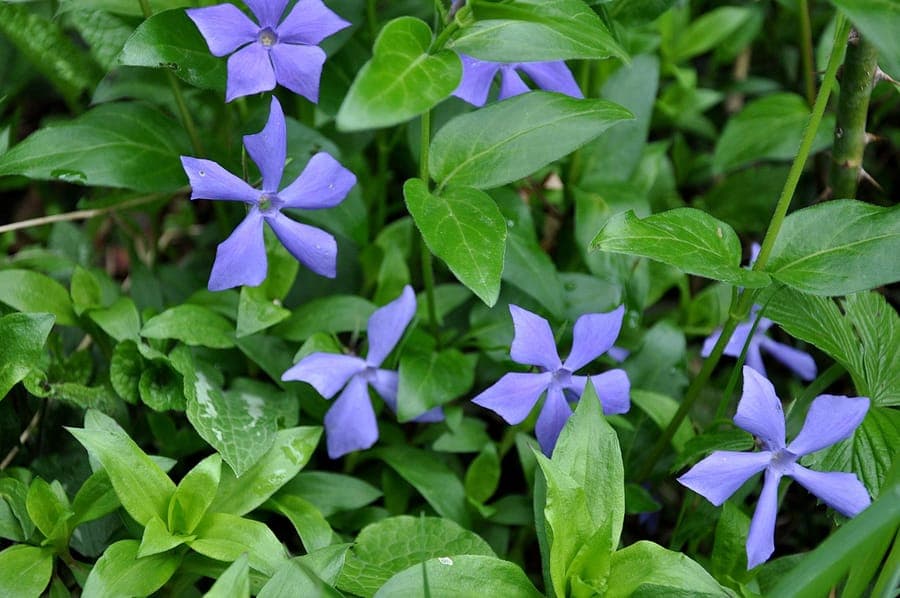
Lazaregagnidze / CC BY-SA 3.0, via Wikimedia Commons
Herbaceous periwinkle: complete guide
Vinca herbacea
¿Quieres ver Herbaceous periwinkle: complete guide en tu jardín?
1 minuto, sin tarjeta de crédito
Overview
Vinca herbacea, commonly known as Herbaceous periwinkle, Creeping myrtle, or Garland flower, is an elegant groundcover plant from Central and Eastern Europe. This plant belongs to the Apocynaceae family (the same family as Catharanthus and Nerium). Vinca herbacea is native to the Alps, Carpathians, and Balkan regions, where it grows in mountain forests and slopes.
Unlike its cousin Vinca minor (Common periwinkle), Vinca herbacea is a true herbaceous plant (not a subshrub) and disappears underground in winter, only to regrow in spring. This makes it suitable for many climates, including temperate regions. The plant is highly valued for its early flowering (April-May), elegant blue flowers, and easy maintenance.
Appearance & bloom cycle
Vinca herbacea grows as a densely-matted, low groundcover, typically 15-30 cm tall. The plant forms slow vegetative mats through underground runners (rhizomes). The leaves are small, lance-shaped, 2-4 cm long, with bright green colour. In autumn and winter the above-ground parts disappear completely, but the underground parts remain alive.
The flowers are the highlight: elegant, five-lobed flowers in a bright periwinkle-blue or grey-white-blue colour, approximately 1-1.5 cm in diameter. The flowers grow on slender, upright stalks from the leaf rosettes. Flowering occurs from April through June in temperate climates, with occasional rebloom in summer. Bees and butterflies adore the flowers.
Ideal location
Vinca herbacea grows best in bright, indirect light conditions. In the garden, place the plant where it receives part-sun to part-shade - at least 2-3 hours of direct sunlight daily, or brightness all day without direct sunlight. Under deciduous trees it flourishes spectacularly, since it flowers early before the tree leaves fully emerge.
The plant can also grow in full shade, though flowering is then less abundant. Avoid full summer sun, especially in warm climates, as this can cause leaf scorch. Protect from strong north winds in open positions.
Soil requirements
Vinca herbacea is not particular about soil composition. It grows well in lightly acidic to neutral soil. Heavy clay must be improved with sand and organic matter for better drainage. A mixture of garden soil, peat, and sand works well.
The plant grows even in poor soil. Addition of nutrient-rich compost helps, however, to encourage better growth and fuller flowers. Regular feeding with balanced fertiliser in early summer promotes abundant flowering.
Watering
Vinca herbacea prefers consistently moist (not waterlogged) soil, especially during the growing season. Water regularly in spring and summer when the soil feels dry. Once established, the plant can tolerate dry spells without water for limited periods.
In winter, the plant disappears and requires no water. After frost, the soil can remain dry. In spring, when growth begins, resume regular watering. Ensure good drainage to prevent root rot.
Pruning
Vinca herbacea requires minimal active pruning. The plant never becomes too large. Optionally, light trimming of excess growth after flowering (June-July) keeps the plant more compact. Remove dead leaves as they appear.
In autumn, as the plant begins withdrawing, allow it to disappear naturally without pruning. In spring no pruning is needed.
Maintenance calendar
Spring (March-April): Plant in March-April or divide existing plants. Start feeding with balanced fertiliser. Water regularly.
Summer (May-July): Enjoy flowering April-June. Continue watering as needed. Light trimming after flowering. Continue feeding until late June.
Autumn (August-October): Stop feeding. Gradually reduce watering. Allow plant to gradually withdraw.
Winter: Plant remains underground. No work. Mulch the ground area in very cold climates.
Diseño gratis
¿Quieres ver Herbaceous periwinkle: complete guide en tu jardín? Crea un diseño gratis ahora.
Winter hardiness
Vinca herbacea is extremely frost-hardy to about -15 to -20°C, making it suitable for all temperate regions. In fact, it thrives better in colder climates, as it prefers dormancy and drought-stress absence. In very warm climates the plant may show stress.
Companion plants
Vinca herbacea pairs spectacularly with other spring-flowering perennials: Helleborus, Bergenia, Brunnera, Pulmonaria, and Anemone. Also excellent with foliage plants such as Hostas, Heuchera, and Tiarella. Under deciduous trees, it's a classic companion for Bluebells and Erythronium.
Harvesting and use
For fruit-bearing species, harvest when fully ripe and gently detach from the plant. For herbs, snip the top 5-10 cm of branches for fresh use. For flowers, gather just before they fully open for maximum colour and fragrance. Many species can be dried for winter use. Store dried material in airtight containers away from direct sunlight for best preservation.
Vegetative Ausbreitungsmuster
Vinca herbacea verbreitet sich durch unterirdische Rhizome, die wahrend der Wachstumssaison neue Blattrosetten auslosen. Dies ist langsamer als andere Vinca-Arten, aber zuverlassig. Die Pflanzen konnen leicht durch Graben und Teilung von etablierten Kolonien vermehrt werden. Der beste Zeitpunkt fur die Teilung ist das Fruhj ahr nach dem Erbluh oder der Herbst nach der Wachstumssaison. Jedes Stuck sollte mindestens 2-3 Blattrosetten mit etwas Rhizom haben.
Shade garden benefits
Vinca herbacea is ideal for garden areas where other plants struggle. Place it under large deciduous trees, along shady north-facing walls or beneath hedges. The early April-May flowering occurs before tree leaves fully emerge, so the plant receives full sun at that critical time. In summer, when other parts of the garden are dry and hot, shade ensures Vinca remains healthy and lush. This makes it essential for three-season interest in difficult shady spots. Combine with Hostas for contrasting foliage shapes. The reliable carpet of blue flowers returns year after year without fail.
Once established the plant spreads slowly but surely, covering more ground each year. This means your initial investment in plant material pays back for many years. The early season flowering makes this plant indispensable for gardens with spring interest needs. Use this plant under large trees where almost nothing else grows. It transforms difficult shade into a landscape feature.
Growth progression: Vinca herbacea expands slowly each year, creating a increasingly dense carpet. After three to four years a very full, thick mat-like cover is achieved. This is not rapid ground coverage, but the patience pays off. The slow, measured growth means the plant doesn't become invasive and won't overwhelm neighboring plants in a mixed planting.
Closing
Vinca herbacea is a valuable addition to shaded gardens in temperate climates. The plant requires minimal maintenance, provides early flowering when other plants are still sleeping, and is extremely frost-hardy. Use it as a groundcover under deciduous trees, as edging in borders, or in groups on sloping ground. Find plants at quality garden centres or specialist nurseries. For more shade-garden designs with frost-hardy perennials, visit gardenworld.app. Add this elegant Vinca to your garden and enjoy years of reliable growth!
Visit gardenworld.app for complete garden designs with shade-loving perennial plants.
¿Quieres ver Herbaceous periwinkle: complete guide en tu jardín? Crea un diseño gratis ahora.
Sube una foto, elige un estilo y obtén un diseño fotorrealista con lista de plantas en menos de un minuto.
Más de 10.000 jardines diseñados
Sin tarjeta de crédito


Plantas similares
Asclepias speciosa: complete guide
Asclepias speciosa
Showy milkweed: striking pink-white flowers, fragrant blooms. Essential monarch butterfly host plant.
Plumeria obtusa: complete guide
Plumeria obtusa
Discover the Singapore graveyard flower: an exotic evergreen with mesmerizing white blooms and exquisite fragrance. Expert cultivation, care, and maintenance tips.
Wrightia arborea: complete guide
Wrightia arborea
Wrightia arborea, known as doodhi, is an elegant tree from South Asia with delicate white flowers. Discover how to cultivate this exotic plant.