
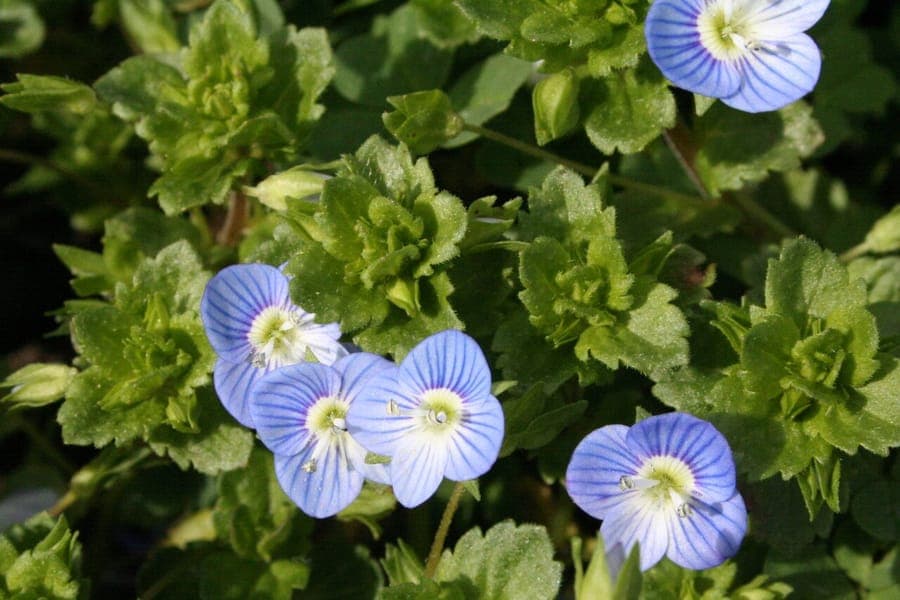
Strobilomyces / CC BY-SA 3.0, via Wikimedia Commons
Persian speedwell: complete guide
Veronica persica
¿Quieres ver Persian speedwell: complete guide en tu jardín?
1 minuto, sin tarjeta de crédito
Overview
Persian speedwell (Veronica persica) is a distinctive plant from the Caucasus and northern Iran, known for its frost hardiness and early blue flowers. This plant is unique because it blooms in cold seasons, making it valuable for winter gardens. In garden design, this species serves as a frost-hardy addition to early-season borders and winter bloomers.
Appearance and bloom
Persian speedwell grows as a low, creeping plant with soft, hairy stems. The plant typically reaches 10 to 25 centimeters in height. The leaves are small, oval, and hairy. Most notable are the lovely blue flowers with white and dark blue markings, appearing from very early spring through autumn. In very mild winters, blooming can even occur in January. This makes it one of the earliest bloomers in the garden.
Ideal location
Persian speedwell thrives best in sunny to half-shade locations. The plant flourishes in moist to moderate soils. It works well in early borders, under shrubs, along pathways, and at the edges of water gardens. In warm regions, afternoon shade may be beneficial to avoid excessive heat.
Soil
This plant thrives in well-drained, moist soils. A pH of 6.0 to 7.5 is preferred. The plant grows without issue in sandy loam to moderate clay-based soils. Organic matter improvement helps moisture retention. Excessive drainage or consistently waterlogged soils are not ideal.
Diseño gratis
¿Quieres ver Persian speedwell: complete guide en tu jardín? Crea un diseño gratis ahora.
Watering
Always provide regular watering during the growing season. During frost periods, careful watering is required, as excessive ice formation can damage the plant. In milder winters, regular watering can promote growth and bloom.
Pruning
Persian speedwell requires minimal pruning. Remove damaged or dead parts in early spring. After very cold winters, many parts may decline and can be completely removed in spring.
Maintenance calendar
Spring: Inspect for winter damage; add compost. Summer: Monitor moisture use; remove dead parts. Autumn: Prepare for winter; reduce watering. Winter: Protect against extreme frosts with mulch.
Winter hardiness
Persian speedwell is winter hardy to approximately minus 15 degrees Celsius and very suitable for cold, temperate European climates. They can survive extremely cold winters if protected under mulch.
Companion plants
Persian speedwell plants well with other winter bloomers such as snowdrops, winter heather, and other frost-hardy bloomers. Avoid aggressive growers that may overtake it.
Closing
Persian speedwell is a valuable winter-blooming plant for temperate gardens with early color. Available at many European garden centers. Learn more about winter bloomers at gardenworld.app/en and gardenworld.app/nl.
¿Quieres ver Persian speedwell: complete guide en tu jardín? Crea un diseño gratis ahora.
Sube una foto, elige un estilo y obtén un diseño fotorrealista con lista de plantas en menos de un minuto.
Más de 10.000 jardines diseñados
Sin tarjeta de crédito


Plantas similares
White Beardtongue: complete guide
Penstemon albidus
Discover white beardtongue (Penstemon albidus) - elegant perennial with white to cream flowers. Drought-resistant, perfect for prairie and dry gardens.
Longsepal Beardtongue: complete guide
Penstemon calycosus
Discover longsepal beardtongue (Penstemon calycosus) - beautiful perennial with lilac-blue flowers. For partial shade and moist soil. Ideal for naturalized.
Penstemon cusickii: complete guide
Penstemon cusickii
Discover Cusick's beardtongue, a compact alpine flowering plant with violet-pink blooms. Perfect choice for rock gardens and water-wise landscaping.