
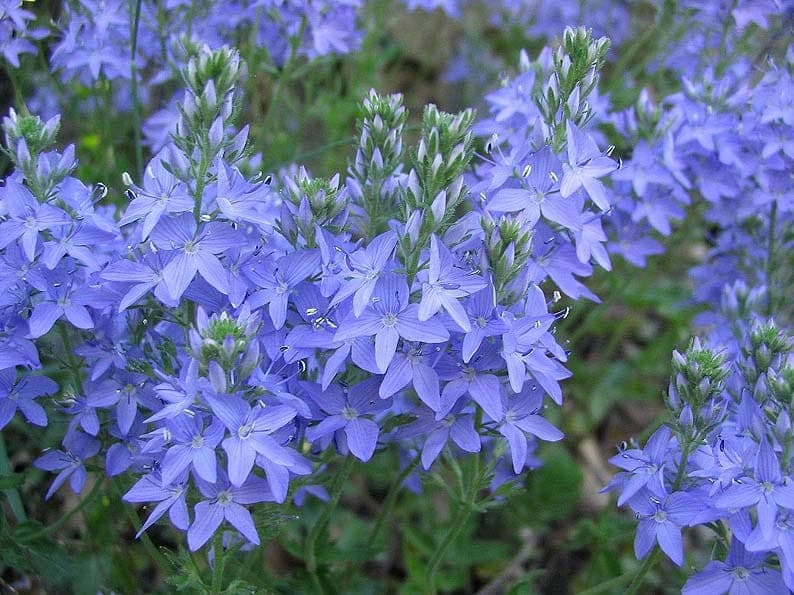
Wikimedia Commons / CC BY-SA 3.0, via Wikimedia Commons
Austrian Speedwell: complete guide
Veronica austriaca
¿Quieres ver Austrian Speedwell: complete guide en tu jardín?
1 minuto, sin tarjeta de crédito
Overview
Austrian speedwell (Veronica austriaca) is a beautiful groundcover to semi-tall perennial plant belonging to the Plantaginaceae family, naturally occurring from Poland through Croatia to North Caucasus regions. This robust plant grows to 60 centimeters and spreads easily over nutrient-poor soils.
With its broad green foliage and bright blue flowers, it remains a classic border plant. Throughout the UK and northern Europe, it's widely used in flower borders, cottage gardens, and alpine troughs. Its extended flowering season from May through August and maintenance-free nature make it indispensable for gardeners.
Appearance & Bloom Time
Austrian speedwell distinguishes itself through strongly branched growth and lengthy flowering. Stems are sturdy, regularly branched, and green, sometimes slightly purple-tinted. Leaves are oval-lanceolate, green, and usually dense, with slightly rough texture.
Flowers are small (6-8 mm), bright blue or occasionally white, appearing in dense, long flower spikes along stem terminals. Flowering occurs from May through August, peaking in June-July. Flowers attract numerous bees and butterflies.
Following bloom, small, flattened seed capsules develop and disperse easily.
Ideal Location
Austrian speedwell performs best in sunny to partially-shaded positions with moisture-balanced soils. Full sun is preferred, though it tolerates light shade. Placement in border plantings, rock gardens, cottage gardens, or along garden paths proves ideal.
It thrives in windy locations and tolerates any sun exposure. Wind protection isn't needed; this plant is remarkably tough. Ensure the plant never sits in standing water, as this causes root rot.
Soil Requirements
Austrian speedwell grows on virtually any soil but performs best on nutrient-poor, well-drained ground. Heavy clay must be improved with sand, gravel, and organic compost. Ideal pH ranges from 6.0 to 7.5.
A mixture of garden soil, sand, and compost (2:1:1) yields excellent results. Fertilizing isn't necessary; moderate feeding prevents overgrowth. After several years, a layer of gravel mulch helps suppress weeds and retain moisture.
Diseño gratis
¿Quieres ver Austrian Speedwell: complete guide en tu jardín? Crea un diseño gratis ahora.
Watering
Watering is moderate. Newly planted specimens require regular watering until well-established (first 3-4 weeks). Subsequently, water is needed only during dry periods. In the UK and northern regions, summer watering is needed only in exceptionally dry years.
Once established, the plant tolerates dry feet better than wet. Water early morning directly at soil level to prevent fungal diseases.
Pruning
Regular pruning improves form. Deadhead spent flowers regularly throughout bloom to stimulate additional flowering. After bloom (August-September), the plant can be lightly cut back to 15-20 centimeters for more compact growth.
Leave dead foliage in autumn for protection; remove it in spring.
Maintenance Calendar
April: Check young plantings, apply feeding, remove old material
May-June: Flowering begins, start deadheading, water regularly
July-August: Peak flowering period, continue deadheading, monitor watering
September-October: Cut back, remove dead leaves, prepare for winter
November-March: Minimal maintenance, frost protection if needed
March: Spring inspection, stimulate new growth
Winter Hardiness
Austrian speedwell is extremely hardy, surviving temperatures down to -25 degrees Celsius. Throughout the UK and northern Europe, it overwinters without protection. Heavy snow damage is unlikely, though frost crack of young twigs can occur. During severe frost, you can protect the plant with evergreen branches.
Companion Plants
Perfect border partners include:
- Lavender (Lavandula angustifolia) for contrast
- Rose varieties for classic combination
- Dusty Miller (Senecio candicans) for silver accent
- Blanketflower (Gaillardia x grandiflora) for yellow-red contrast
Conclusion
Austrian speedwell is a must-have for borders and flower beds. Its robust nature and extended blooming period make it valuable. Find quality plants at specialist nurseries and garden centers. For classic border planting, this Veronica is essential. Start designing your ideal border today on gardenworld.app, your complete garden design resource.
¿Quieres ver Austrian Speedwell: complete guide en tu jardín? Crea un diseño gratis ahora.
Sube una foto, elige un estilo y obtén un diseño fotorrealista con lista de plantas en menos de un minuto.
Sin tarjeta de crédito


Plantas similares
White Beardtongue: complete guide
Penstemon albidus
Discover white beardtongue (Penstemon albidus) - elegant perennial with white to cream flowers. Drought-resistant, perfect for prairie and dry gardens.
Longsepal Beardtongue: complete guide
Penstemon calycosus
Discover longsepal beardtongue (Penstemon calycosus) - beautiful perennial with lilac-blue flowers. For partial shade and moist soil. Ideal for naturalized.
Penstemon cusickii: complete guide
Penstemon cusickii
Discover Cusick's beardtongue, a compact alpine flowering plant with violet-pink blooms. Perfect choice for rock gardens and water-wise landscaping.