
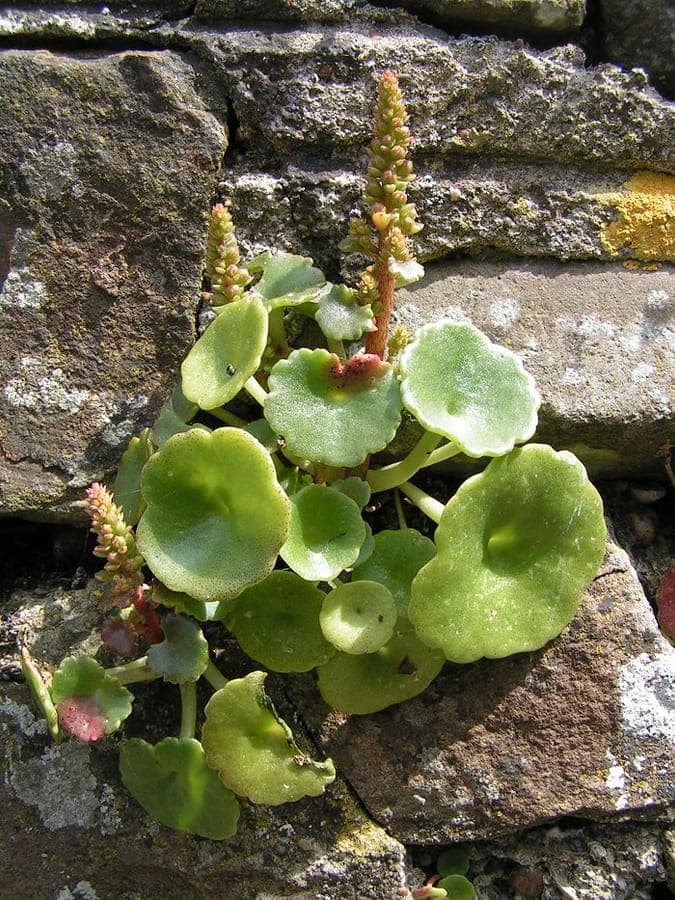
Photo by sannse / CC BY-SA 3.0, via Wikimedia Commons
Umbilicus rupestris: complete guide
Umbilicus rupestris
¿Quieres ver Umbilicus rupestris: complete guide en tu jardín?
1 minuto, sin tarjeta de crédito
Umbilicus rupestris, better known as navelwort or wall pennywort, is a captivating succulent plant that makes its home on rock faces, aged walls, and natural stone features. This succulent is renowned for its unique, disc-shaped leaves and its ability to thrive even in the most inhospitable locations.
Overview
Umbilicus rupestris belongs to the family Crassulaceae and is a succulent plant that naturally occurs in Western Europe, Macaronesia, and the Mediterranean region extending to the Arabian Peninsula. This remarkable species is specialized in surviving on steep rocky slopes, weathered walls, and slate rock faces where few other plants flourish.
The plant is far less known than other succulents but deserves much more attention due to its unusual morphology and fascinating habitat preference. Gardeners seeking unique, low-maintenance decorative plants will find in Umbilicus rupestris a valuable and interesting focal point.
Appearance and bloom
The most striking feature of Umbilicus rupestris is the round, disc-shaped leaves that grow radially from the stem. These green, fleshy leaves can reach diameters of up to 8 centimeters and have a typical navel in the center - hence the name navelwort. The leaves form attractive rosettes that cluster together.
Blooming occurs from May through July and produces delicate, white to pink flowers that form loose clusters at the top of the stem. After blooming, the flowering rosette dies off, but new rosettes appear along the sides of the plant, ensuring continuous growth and regeneration.
Ideal location
Umbilicus rupestris flourishes best in locations with plenty of brightness, although excessive summer sunlight can lead to less attractive reddish coloration of leaves. A brilliant middle ground is light dappled shade from deciduous trees or a position on a north or west-facing surface.
This is a plant designed for wall growth. Plant this succulent in crevices of aged stone walls, on rock faces, or in special hanging containers on a sheltered balcony. Vertical growth is characteristic of this plant and emphasizes its natural habitat preference.
Soil composition
Umbilicus rupestris thrives in very well-draining soils with minimal nutritional requirements. A mixture of 60% coarse sand or gravel, 30% garden peat, and 10% compost provides ideal growing conditions. The plant also tolerates growth in pure sand with minimal nutrients.
Use terra cotta or porous pots with abundant drainage holes. Do not use standard potting soil - this will certainly lead to root rot. For wall planting, add a mixture of fine gravel and peat into crevices, mixing minimally.
Diseño gratis
¿Quieres ver Umbilicus rupestris: complete guide en tu jardín? Crea un diseño gratis ahora.
Watering and moisture management
This is a true dry lover. Water very sparingly, only when soil is completely dry, and then only during the growing season. In autumn and winter, provide practically no water; the plant largely lives on moisture stored in its leaves.
Excessive water is the deadliest enemy of this plant. Ensure perfect drainage and allow the substrate to dry completely between waterings. During rainy periods outdoors, further watering can be completely omitted.
Pruning and shaping
Pruning is hardly necessary. Remove only dead or diseased leaves at the base. After blooming and dying off of weakened rosettes, natural rejuvenation growth emerges.
If the plant grows excessively, side offshoots can be carefully removed or replanted. This plant self-shapes as the characteristic cascading growth naturally unfolds.
Maintenance calendar
March to April: Cleaning of dead foliage and preparation for growth. May to July: Blooming period; observation of flower formation. August: Avoid all watering; place outside and let dry. September to February: Minimal maintenance; keep plant in cooler conditions.
Winter hardiness
Umbilicus rupestris is moderately cold hardy to approximately -5 to -10 degrees Celsius, though this depends heavily on moisture conditions. In continental climates, the plant should be overwintered in a cool, dry space, such as an unheated greenhouse. In milder coastal areas, the plant can remain outdoors as long as the soil remains well-draining.
Companion plants
Umbilicus rupestris grows beautifully together with other succulent wall plants such as Sempervivum, Sedum species, and small Jovibarba rosettes. For contrast, low gray-leaved Artemisia species and dwarf silver sage can be used.
On walls, combine this plant well with other Mediterranean climate plants such as dwarf Box and small lavender cultivars. Natural growth occurs when you plant it alongside moss and mat-forming plants.
Closing thoughts
Umbilicus rupestris is a perfect specimen for gardeners seeking something unique and low-maintenance. The fascinating morphology, the ability to grow in difficult places, and the pristine flowers make this species a treasure for any succulent collection.
Available from many specialized succulent suppliers and also from larger retailers. Invest in this special plant and enjoy years of low-maintenance pleasure. Visit gardenworld.app for more plant inspiration.
¿Quieres ver Umbilicus rupestris: complete guide en tu jardín? Crea un diseño gratis ahora.
Sube una foto, elige un estilo y obtén un diseño fotorrealista con lista de plantas en menos de un minuto.
Más de 10.000 jardines diseñados
Sin tarjeta de crédito


Plantas similares
Sedum nevadense: complete guide
Sedum nevadense
Discover Sedum nevadense, the stunning alpine stonecrop from the Pyrenees. Expert care tips, growing requirements, and design ideas for rock gardens.
Aizoon stonecrop: complete guide
Phedimus aizoon
Everything about Phedimus aizoon - the frost-tolerant aizoon stonecrop from Siberia with bright yellow flowers. Planting, care and garden use.
Roseroot: complete guide
Rhodiola rosea
Everything about roseroot (Rhodiola rosea): a tough hardy succulent ideal for rock gardens, green roofs, and dry sunny positions.