
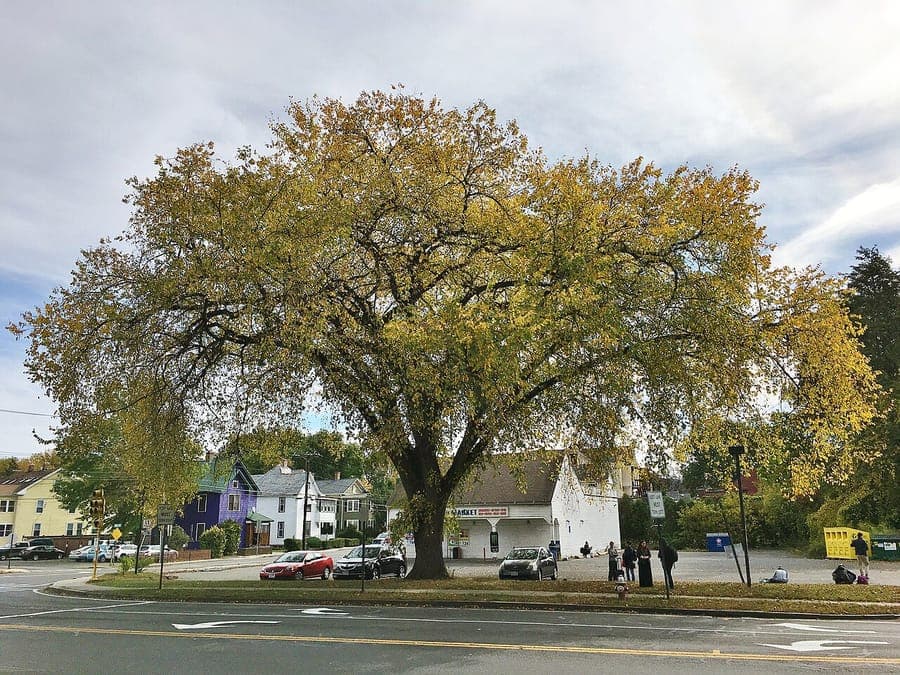
Marty Aligata / CC BY-SA 4.0, via Wikimedia Commons
Ulmus americana: complete guide
Ulmus americana
¿Quieres ver Ulmus americana: complete guide en tu jardín?
1 minuto, sin tarjeta de crédito
Overview
Ulmus americana, known as American elm, water elm or white elm, is an imposing, fast-growing deciduous tree from North America. This species from the Ulmaceae family can reach heights of 20 to 30 meters and is known for its distinctive ivory-tinted canopy, especially in autumn. Due to its rapid growth and large growth range, it is widely used as a landscape tree in parks, along streets and for shade in large gardens.
Appearance and growth
The American elm reaches a height of 20 to 30 meters or more with a crown span of 15 to 20 meters. The tree grows rapidly, about 60 centimeters per year in optimal conditions. The leaves are two-sided, dark green in summer, and turn yellow to ivory in autumn. The bark is rough, gray to brown, with deep grooves. The tree produces small flowers in spring (March-April) that are group-like arranged.
Ideal location
The American elm prefers full sun to partial shade, at least four to six hours of direct sunlight. The tree grows best in temperate climates with normal winter periods. It tolerates a wide range of soil types but prefers moist, well-drained soils. Plant in locations with sufficient space for full growth without shrubs or cables in the way. Suitable for large gardens, parks and street trees.
Soil
The American elm is very well adapted to different soil types. It grows well in sandy, clay, loamy and peaty soils, with a pH between 5.0 and 8.0. Preference is for moist, well-drained soils. In very dry environments, extra watering is needed. Adding compost when planting promotes strong root development. The tree also tolerates nutrient-poor soils well.
Watering
After the first year, the American elm needs minimal support as it develops deep roots. Water regularly in the first season (3 to 4 times per week) to promote good root development. After establishment, rainfall usually provides sufficient water. In extreme dry periods, water deeply. Young trees are better with careful watering than too much watering.
Diseño gratis
¿Quieres ver Ulmus americana: complete guide en tu jardín? Crea un diseño gratis ahora.
Pruning and maintenance
Pruning is minimal in the first year; only remove broken branches. After a few years, light shaping in dormant season (December-January) promotes good shape and structure. Remove water shoots and crossing branches. Avoid heavy pruning as this can damage tree structure. The tree recovers quickly from light pruning.
Maintenance calendar
- March to April: Flowering, lower pruning
- May to September: Growing period, regular watering
- October to November: Autumn color, leaf fall
- December to February: Dormancy, pruning possible
- February to March: Preparation for new season
Disease resistance
The American elm is susceptible to Dutch elm disease (DED), a serious disease transmitted by elm bark beetles. Healthy trees without damage tolerate disease better. Regular inspection for pests and diseases is important. Avoid damage and stress to the tree. Some resistant cultivars are available. Fungicide treatment is possible but not always effective.
Winter hardiness
The American elm is very winter hardy throughout North America, to at least -30 degrees Celsius in some regions. No protection needed in normal winter conditions. Young trees benefit from mulching around the base for protection against direct frost in the first season.
Guidance and support
In the first two years, support may be needed for young trees. Plant stakes prevent top-heaviness. Use soft binding material and check regularly. After two years, support can be removed. The tree grows rapidly and stronger without support once well established.
Closing
Ulmus americana is a beautiful, fast-growing tree for large landscape areas. With good watering in the first season and minimal maintenance, you grow an imposing shade tree for generations. Plant this classic North American tree via gardenworld.app and create clean shade for the future!
¿Quieres ver Ulmus americana: complete guide en tu jardín? Crea un diseño gratis ahora.
Sube una foto, elige un estilo y obtén un diseño fotorrealista con lista de plantas en menos de un minuto.
Más de 10.000 jardines diseñados
Sin tarjeta de crédito


Plantas similares
Dutch elm: complete guide
Ulmus × hollandica
Full guide to Ulmus x hollandica: siting, soil, watering, pruning, Dutch elm disease management, and companion plants for this majestic hybrid elm.
Ulmus thomasii: complete guide
Ulmus thomasii
The cork elm is a North American deciduous tree with distinctive corky branches and elegant leaves. Discover how to cultivate and maintain this durable tree.
Caucasian zelkova: complete guide
Zelkova carpinifolia
Discover Zelkova carpinifolia, the elegant Caucasian elm. Growing guide and care tips for landscapers.