
Andreas Trepte / CC BY-SA 2.5, via Wikimedia Commons
Tussilago farfara: complete guide
Tussilago farfara
¿Quieres ver Tussilago farfara: complete guide en tu jardín?
1 minuto, sin tarjeta de crédito
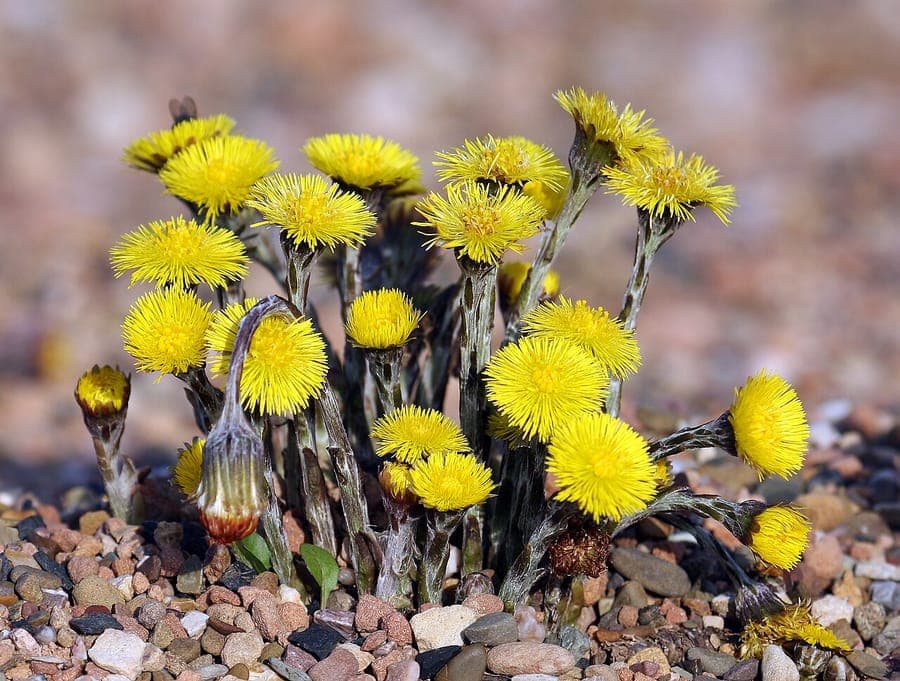
Coltsfoot (Tussilago farfara) is one of the earliest blooming plants in Europe and justly carries its English name. This plant from the aster family (Asteraceae) is known for its yellow flowers that appear before the leaves fully emerge. It is a traditional medicinal herb with a long history in European gardens.
Overview
Tussilago farfara is native to much of Eurasia, from the Atlantic Ocean to North Africa and Nepal. This plant has also spread to North America as a naturalized species. In many European countries it is regarded as a common weed, but it also has valuable properties as a bird plant and food for early-flying insects.
Appearance and Bloom
Coltsfoot is famous for its very early flowering, sometimes as early as January or February in milder climates. The golden-yellow, powder-like flowers appear in dense clusters on short, scaly stems before the leaves fully grow. These flowers are very attractive to early-flying bees and butterflies.
The leaves are large, heart-shaped, and have prominent veins. The underside of the leaves is whitish-hairy, giving the whole plant an interesting two-toned appearance. The leaves can reach 15 to 30 centimeters in diameter and grow from underground rhizomes after flowering.
Ideal Location
Tussilago farfara is not fussy about location, but grows best in full sun to partial shade. The plant can even survive in dense shade, though flowering abundance decreases. Place the plant in areas where you want to see early blooms: along garden paths, in borders, or in groups under shrubs.
The plant grows wild along roadsides, on waste ground, and in wet areas. In the garden you harness this tendency: Tussilago's preference for wet spots is clear.
Soil
Tussilago farfara grows in almost every soil type, from heavy clay to sand, from acidic to alkaline. However, the plant grows most vigorously on moist soils. This makes it ideal for wet corners of the garden and groups along ditches. Also tolerates compacted soils without problems.
Optimal growth is achieved on moisture-retaining, humus-rich soils. Overly dry soils result in more compact plants with smaller leaves.
Watering
Tussilago is remarkably drought-tolerant once established. In the first year, water regularly until the system of underground rhizomes is well developed. After that, the plant can go long without water, even under dry conditions.
In very dry summers, supplemental water may be beneficial for better leaf development. In normal years, rainwater is usually sufficient.
Pruning
Pruning is not essential, though some gardeners remove the leaves after they become worn (usually in autumn). This can give the plant a neater appearance. Remove dead leaves regularly.
Maintenance Calendar
Winter (December-February): Plant may flower under snow. Enjoy the early bloom!
Spring (March-May): Leaves grow profusely after flowering is over. Check for spread in wet areas.
Summer (June-August): Plant spreads via underground rhizomes. Keep in check if you want to limit spread.
Autumn (September-November): Leaves turn yellow and die off. Remove dead material.
Winter Hardiness
Tussilago farfara is fully hardy throughout Europe. The plant can tolerate temperatures down to minus 20 degrees Celsius without protection and regrows from roots, even after very harsh winters.
Companion Plants
Tussilago farfara combines well with other moisture-loving plants such as various willow species, maples, and birches. In groups it grows well with sedges, reeds, and other aquatic plants. Also grows well under flowering backdrops such as water violets and water plantains.
For garden designers who want to work interactively with different plant combinations, gardenworld.app offers practical tools for visualization.
Closing
Tussilago farfara or coltsfoot is a common plant in many traditional gardens and bird gardens. With its unusually early flowering, tolerance for difficult growing conditions, and applications as a traditional medicinal herb, it deserves more recognition. While it self-seeds prolifically in some situations, thoughtful placement can make it a valuable part of your garden. Give it a try and experience the joy of early spring color!
Available at major garden centers across Europe.
¿Quieres ver Tussilago farfara: complete guide en tu jardín? Crea un diseño gratis ahora.
Sube una foto, elige un estilo y obtén un diseño fotorrealista con lista de plantas en menos de un minuto.
Más de 10.000 jardines diseñados
Sin tarjeta de crédito


Plantas similares
Calendula stellata: complete guide
Calendula stellata
Complete guide to Calendula stellata, the star-flowered marigold from Sicily: location, soil, watering and companion planting tips.
Korean chrysanthemum: complete guide
Chrysanthemum x rubellum
Chrysanthemum x rubellum is a hardy autumn perennial with single pink to copper flowers from August to November. Care and combinations.
Helianthus divaricatus: complete guide
Helianthus divaricatus
Helianthus divaricatus is a North American woodland sunflower with yellow summer blooms, ideal for naturalistic borders and shady edges.