
KENPEI / CC BY-SA 3.0, via Wikimedia Commons
Cretan Tulip: complete guide
Tulipa saxatilis
¿Quieres ver Cretan Tulip: complete guide en tu jardín?
1 minuto, sin tarjeta de crédito
Overview
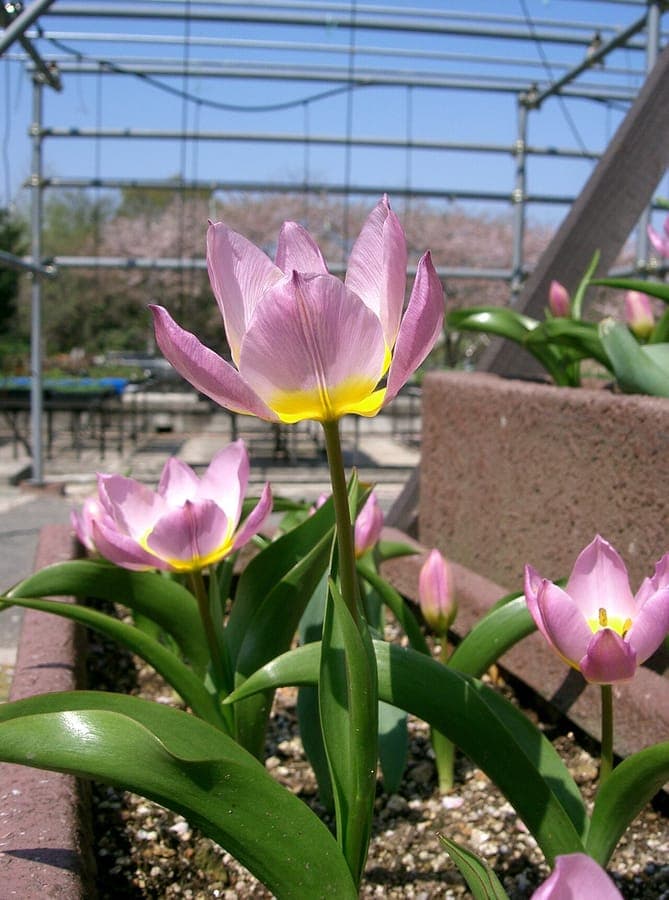
The Cretan Tulip (Tulipa saxatilis), also known as Bakertulip, is a charming alpine tulip native to rocky slopes of Crete and southwestern Turkey. This species belongs to the lily family (Liliaceae) and is celebrated for its elegant, pale pink flowers with yellow base. At just 8-12 inches tall, this tulip is perfect for rock gardens, borders, and naturalization programs. Thanks to its ability to naturalize, this tulip returns year after year with minimal intervention.
The Cretan Tulip offers years of pleasure with minimal effort once planted and established. This makes it ideal for natural gardens and ecologically responsible landscapes.
Appearance & Bloom
The Cretan Tulip grows compactly with narrow, bluish-green leaves that are elegant and fine-textured. The flowers are beautiful: approximately 1-1.2 inches long, cup-shaped with six tepals. The color is deep yellow with white and pale pink tints that blend delicately with the yellow base. This combination creates a very elegant and refined appearance.
The flowers appear in March-April depending on local conditions. Each bulb can produce multiple flower stems, resulting in a profuse display. This is one of this tulip's advantages: it blooms far more abundantly than many other small tulip varieties.
Ideal Location
The Cretan Tulip grows best in sunny locations with well-draining soil. At least 4-5 hours of direct sun daily is needed for optimal flowering. The plant is ideal for:
- Rock gardens and alpine troughs
- Stone walls and edging
- Sunny grass patches
- Pots and containers
- Borders where it can naturalize
This is an extremely cold-hardy species tolerating down to -4F (-20C). Because it originates from mountainous regions, it feels at home in colder climates.
Soil
Sandy, well-draining soil is essential. Waterlogging is deadly; bulbs rot easily in wet conditions. A pH of 6.0-7.5 (neutral to slightly alkaline) is ideal.
Work sand, perlite, and gravel into heavy clay soils. In containers use a mix of potting soil and sand in 1:1 ratio. The Cretan Tulip is not nutrient-demanding and grows fine in poor soils.
Diseño gratis
¿Quieres ver Cretan Tulip: complete guide en tu jardín? Crea un diseño gratis ahora.
Watering
Water management is crucial for this tulip. Very well-draining soil prevents water accumulation. During the growing season (October-May in Europe), the plant needs moderate moisture, but the soil must never become wet.
Once flowering ends and foliage yellows, largely discontinue watering. The soil should become almost dry in summer; this supports the rest period needed for next season's bloom.
Pruning
Deadhead spent flower stems after blooming to prevent seed set, unless you want to save seed. However, leave the foliage intact until it yellows completely and dries. This foliage feeds the bulb for next season.
Remove yellowed foliage in May-June when it comes away naturally.
Maintenance Calendar
- October: Plant bulbs; water after planting
- November-December: Winter rest; no attention needed
- January-February: Watch for first shoots
- March-April: Bloom; enjoy flowers
- May: Foliage yellows; stop watering
- June-August: Completely dry; rest period
- September: Bulbs dormant underground; preparation
Winter Hardiness
The Cretan Tulip is extremely cold-hardy to at least -4F (-20C), many strains even to -13F (-25C). This makes it suitable for all temperate climates in Europe. Severe frost does not harm the bulbs. The greatest threat is waterlogging, not cold.
Companion Plants
The Cretan Tulip combines beautifully with:
- Other small spring-flowering bulbs: Crocus, Chionodoxa, Muscari
- Low-growing perennials: Sedum, Saxifrage
- Grasses: Fine-leaved grasses add texture
- Alpine plants: Alpine varieties of Phlox, Draba
Keep the tulip free from tall competitors; it thrives among small, similar plants.
Conclusion
The Cretan Tulip is a jewel for those seeking elegant, reliable spring-flowering bulbs. With its compact growth, delicate flowers, and naturalization ability, it offers years of pleasure. Once planted in suitable conditions, it grows with minimal attention. Plant this enchanting tulip and enjoy spring after spring of its delicate beauty.
¿Quieres ver Cretan Tulip: complete guide en tu jardín? Crea un diseño gratis ahora.
Sube una foto, elige un estilo y obtén un diseño fotorrealista con lista de plantas en menos de un minuto.
Más de 10.000 jardines diseñados
Sin tarjeta de crédito


Plantas similares
Reverchon's gagea: complete guide
Gagea reverchonii
Full guide to Gagea reverchonii, Reverchon's gagea: rare Pyrenean bulb with bright yellow spring flowers, soil needs and companion planting.
Leafy gagea: complete guide
Gagea foliosa
Gagea foliosa is a rare Mediterranean bulb with bright yellow star-shaped flowers blooming February to March in well-drained rocky settings.
Tubular gagea: complete guide
Gagea fragifera
Gagea fragifera is a mountain bulb with golden-yellow star flowers blooming May to July on subalpine slopes from Europe to the Himalaya.