
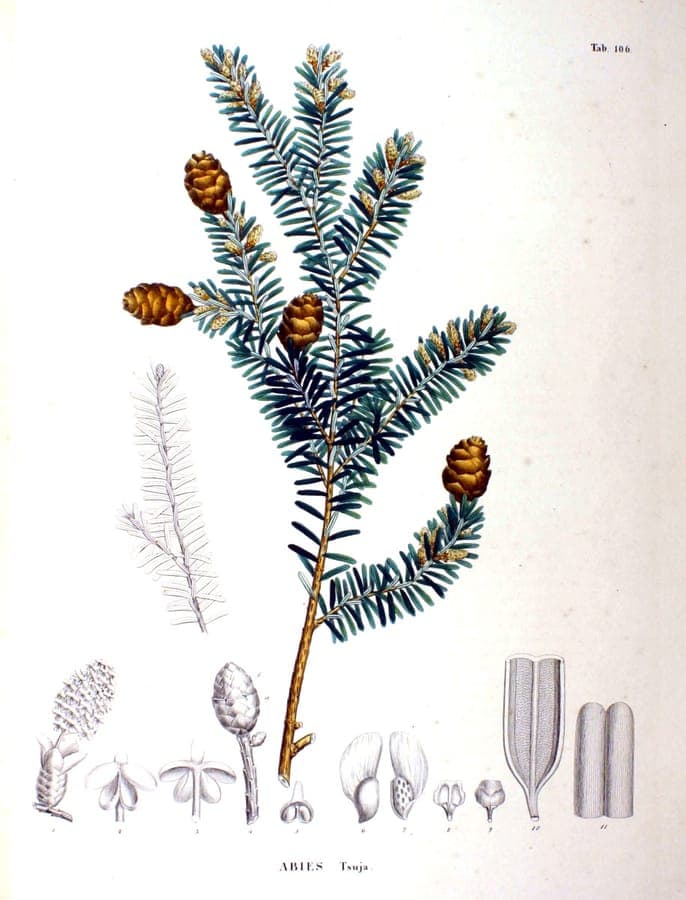
Philipp Franz von Siebold and Joseph Gerhard Zuccarini / Public domain, via Wikimedia Commons
Japanese hemlock: complete guide
Tsuga sieboldii
¿Quieres ver Japanese hemlock: complete guide en tu jardín?
1 minuto, sin tarjeta de crédito
Overview
Tsuga sieboldii, the Japanese or Southern Japanese hemlock, is an elegant conifer native to the mountainous regions of Japan. This evergreen is renowned for its fine, delicate needles and slender growth habit. The plant creates a perfect background element for shaded garden spaces and offers year-round beauty.
Appearance and growth
The Japanese hemlock grows into a slender tree or shrub with a regular pyramidal form. The plant features extremely fine, small needles that create a dense, soft texture. The bark is dark gray to greenish, adding textural interest to the plant. As an evergreen, this plant retains its foliage throughout the year, adding value to the winter garden. Growth is relatively slow but steady, meaning the plant lasts for many years.
Ideal location
Tsuga sieboldii thrives in part shade to full shade, with at least 4 hours of indirect sunlight being ideal. The plant tolerates shaded locations better than many other conifers. Plant where it is protected from strong winds, especially during winter. This ensures healthier growth. In full sun, the plant may experience leaf scorch.
Soil
The Japanese hemlock prefers well-draining, humus-rich soil. Acidic soils are better tolerated than neutral or alkaline soils. The plant grows well in nutrient-rich soil with abundant organic matter. Avoid wet, waterlogged soils that can lead to root rot. Adding compost helps improve soil structure.
Diseño gratis
¿Quieres ver Japanese hemlock: complete guide en tu jardín? Crea un diseño gratis ahora.
Watering
Once established, Tsuga sieboldii has moderate watering needs. Keep soil moist but not waterlogged, especially during growing periods. Provide extra water during dry spells. Young plants deserve more attention with regular watering in their first growing year. Mulching helps retain moisture and maintains soil temperature.
Pruning
Pruning is usually unnecessary as this tree naturally maintains an attractive form. Minor corrections can be made in early spring. Remove only dead or damaged branches. Careful pruning helps maintain compact growth.
Maintenance calendar
April-June: Growing season with regular watering. July-August: Growth slows, reduce watering. September-October: Preparation for winter. November-March: Dormant period with minimal maintenance. December-February the plant may be beautifully snow-covered.
Winter hardiness
Tsuga sieboldii is fairly hardy in temperate regions, especially in milder coastal areas. In very cold winters, branch tips may freeze. The plant tolerates light frost damage well and recovers in spring. Providing protection helps in very cold winters.
Companion plants
The Japanese hemlock pairs well with other shade-loving plants such as Japanese maples, astilbes, and ferns. It creates an elegant vertical accent in borders. This is valuable specimen for Japanese-style gardens. It also works well in Japanese gardens with stone and water features.
Closing
Tsuga sieboldii is a refined conifer that radiates calm and elegance. With its fine texture and graceful growth habit, it is a valuable addition to any modern garden design. Explore more plant combinations on gardenworld.app.
¿Quieres ver Japanese hemlock: complete guide en tu jardín? Crea un diseño gratis ahora.
Sube una foto, elige un estilo y obtén un diseño fotorrealista con lista de plantas en menos de un minuto.
Más de 10.000 jardines diseñados
Sin tarjeta de crédito


Plantas similares
Abies delavayi: complete guide
Abies delavayi
Delavayi fir is an elegant, medium-sized coniferous tree from the Pinaceae family with dark green needles. This Asian evergreen is perfect for alpine gardens and large landscapes.
Taiwan fir: complete guide
Abies kawakamii
Discover the magnificent Taiwan fir, a rare evergreen conifer from Taiwan's mountain regions. Learn growth requirements, care tips, and why this beautiful tree is perfect for collectors of unique garden specimens.
Farges fir: complete guide
Abies fargesii
Discover the majestic Farges fir, an impressive conifer from China's mountains with elegant foliage and columnar form. Ideal for large gardens.