
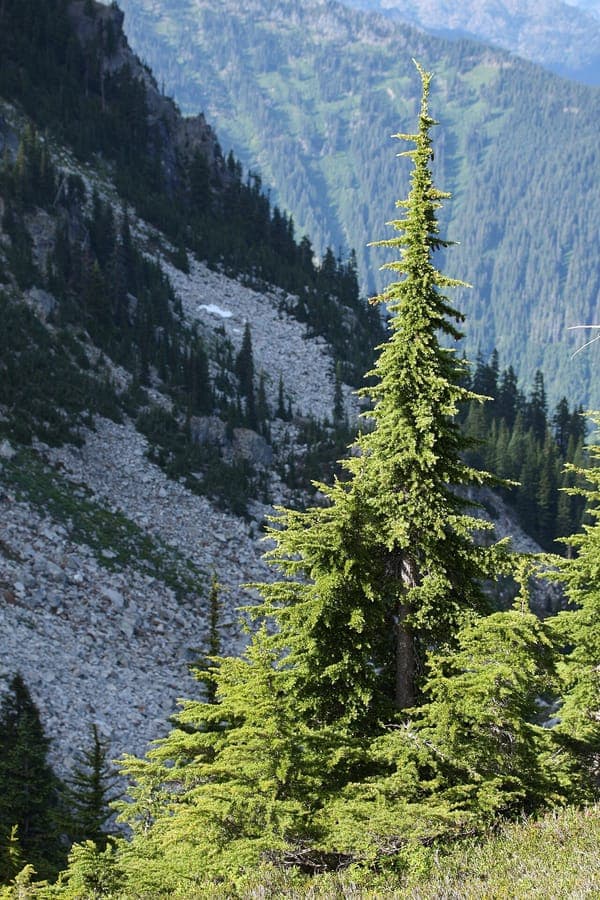
Walter Siegmund (talk) / CC BY-SA 3.0, via Wikimedia Commons
Mountain hemlock: complete guide
Tsuga mertensiana
¿Quieres ver Mountain hemlock: complete guide en tu jardín?
1 minuto, sin tarjeta de crédito
Overview
Mountain hemlock (Tsuga mertensiana), also called alpine hemlock or black hemlock, is a fascinating conifer found in mountain ranges from Alaska to California. This tree is unique as a sub-alpine species thriving at high elevations, typically between 600-3000 meters. Mountain hemlock is the only North American hemlock species that primarily inhabits mountains, making it exceptional for gardeners in cold mountainous regions or those recreating alpine conditions.
Appearance and Bloom
Mountain hemlock grows into a compact, conical form, usually 15-25 meters tall in natural landscapes but remaining smaller in cultivated settings. The needles are extremely fine, flat, and dark green with two white bands underneath. They measure 10-18 mm, slightly longer than some other hemlock species. The very small, brown cones measure just 12-20 mm and hang elegantly from twig tips. The bark is gray to grayish-brown. Various bird species and small mammals benefit from the seed-containing cones. Young trees often display very dense, dark green foliage, making them highly ornamental.
Ideal Location
Mountain hemlock grows best in cold, sheltered locations with full to partial sun. Unlike many other hemlocks, mountain hemlock is not dependent on full shade and tolerates considerably more sun. A northwestern exposure or location beneath larger trees works well. The tree requires highly moist conditions, with much moisture coming from mist and low-lying clouds. Protection from strong winds is essential, as in natural settings the tree is bent by snow and ice.
Soil
Mountain hemlock thrives in acidic to neutral terrain, preferring pH 5.0 to 6.5. The tree prefers well-draining, humus-rich soil. Heavy clay must be amended with compost, peat, or other organic matter. The tree performs better in rocky or stony soils with excellent drainage, such as those found in mountain regions. A loose, mulch-like soil composition supports seedlings and young trees.
Watering
Mountain hemlock requires consistent moisture, especially during growing seasons in spring and summer. In mountain regions, mist and fog provide substantial water. In gardens, misting in warm periods and deep watering during drought stress help significantly. Well-draining soil prevents waterlogging.
Pruning
Mountain hemlock naturally develops an attractive, compact form requiring minimal pruning. Remove only dead or damaged branches. Young trees can be lightly pruned to encourage denser growth, but heavy pruning disrupts the elegant form.
Maintenance Calendar
Spring: Check for winter damage. Begin gentle watering as soil thaws. Summer: Water regularly during dry periods. Misting helps in hot, dry conditions. Fall: No special attention needed. Trees prepare for dormancy. Winter: Protect from heavy snow and ice. Burlap wrapping helps young trees.
Winter Hardiness
Mountain hemlock is extremely hardy to USDA zone 4 (-30 degrees Celsius) and even zone 3 in protected conditions. This makes it the perfect hemlock for very cold regions. The tree tolerates snow and ice much better than other hemlock species.
Companion Plants
Pair mountain hemlock with other alpine and sub-alpine plants. Other conifers like mountain spruce, subalpine fir, and dwarf spruces make perfect partners. Low-growing alpine shrubs such as bearberry, lingonberry, and wintergreen fit well. These combinations create authentic alpine meadow or mountain landscape effects.
Final Thoughts
Mountain hemlock is an excellent choice for gardens in cold, mountainous regions. Its extreme winter hardiness, dense foliage, and refined beauty make it valuable for alpine gardeners. With consistent moisture and protection from heavy winds, this tree thrives and provides decades of elegance. For gardeners wishing to recreate alpine forests in their gardens, mountain hemlock is indispensable.
¿Quieres ver Mountain hemlock: complete guide en tu jardín? Crea un diseño gratis ahora.
Sube una foto, elige un estilo y obtén un diseño fotorrealista con lista de plantas en menos de un minuto.
Más de 10.000 jardines diseñados
Sin tarjeta de crédito


Plantas similares
Abies delavayi: complete guide
Abies delavayi
Delavayi fir is an elegant, medium-sized coniferous tree from the Pinaceae family with dark green needles. This Asian evergreen is perfect for alpine gardens and large landscapes.
Taiwan fir: complete guide
Abies kawakamii
Discover the magnificent Taiwan fir, a rare evergreen conifer from Taiwan's mountain regions. Learn growth requirements, care tips, and why this beautiful tree is perfect for collectors of unique garden specimens.
Farges fir: complete guide
Abies fargesii
Discover the majestic Farges fir, an impressive conifer from China's mountains with elegant foliage and columnar form. Ideal for large gardens.