
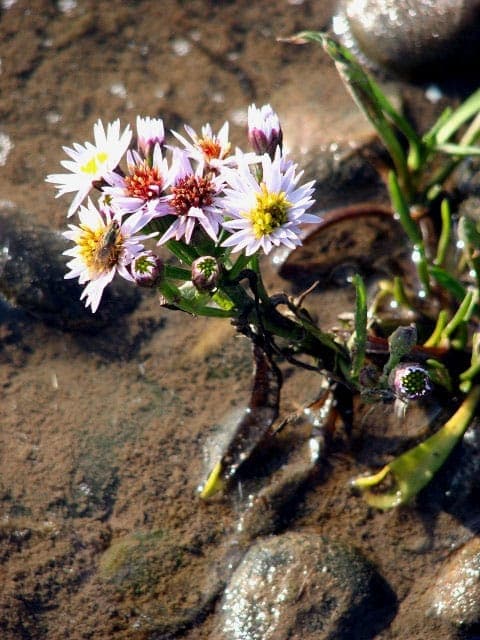
Evelyn Simak / CC BY-SA 2.0, via Wikimedia Commons
Tripolium pannonicum: complete guide
Tripolium pannonicum
¿Quieres ver Tripolium pannonicum: complete guide en tu jardín?
1 minuto, sin tarjeta de crédito
Overview
Tripolium pannonicum, known as sea aster or alkali marsh plant, is an elegant coastal plant thriving in saline and salt-rich environments. This plant naturally grows in temperate Eurasian coasts and salt marshes. With succulent, bluish-green foliage and beautiful purple to pink flowers, Tripolium pannonicum forms a compact, bird-attractive shrublet. Reaching 30-60 cm height, it is best from September through October. This hardy plant tolerates sea wind, salt spray, and challenging wet soils effortlessly.
Appearance and Bloom
Sea aster presents itself as a compact shrublet with succulent, greenish-blue foliage remaining green year-round. The plant reaches 30-60 cm height and blooms September through October with beautiful purple to pink composite flowers. Each flowerhead consists of a yellow disk surrounded by fine violet to pink ray florets. Flowers appear abundantly and attract many insects. Small seeds develop after flowering, dispersed by wind.
Ideal Location
Tripolium pannonicum grows best in full sun in salt-bearing environments near the sea. The plant tolerates sea wind and salt spray extremely well, making it popular in coastal gardens and beach plantings. Choose an open location with good ventilation. The plant needs no shade and actually thrives better in full sun.
Soil
Sea aster grows happily in salt-rich, wet soils avoided by other plants. The plant accepts clay, sand, or silt soils without issue. pH may range from neutral to slightly alkaline (pH 7.0-8.5). Add minimal organic material; the plant actually grows better in poor, salt-bearing soils. Well-draining soil is less important than for many plants.
Watering
Sea aster is extremely drought-resistant and needs virtually no watering once established. Only during the initial growing period should water be provided to accelerate establishment. The plant extracts moisture from seawater and rainwater. Overwatering is not preferred.
Diseño gratis
¿Quieres ver Tripolium pannonicum: complete guide en tu jardín? Crea un diseño gratis ahora.
Pruning
Pruning is not strictly necessary for Tripolium pannonicum. You may remove spent flowers to encourage more blooming. After flowering, old stems can be cut back close to ground in spring to stimulate compact regrowth.
Maintenance Calendar
Spring (March-May): Plant seedlings in wet, saline soils. Provide light watering. No further care. Summer (June-August): Plant grows but does not bloom yet. No watering. Monitor weeds. Autumn (September-October): Full bloom! Enjoy purple flowers. No watering needed. Winter (November-February): Plant sleeps. Only in severe winters is some protection needed.
Winter Hardiness
Tripolium pannonicum is hardy to approximately -10 degrees Celsius in dry conditions. In wet conditions, frost can be more damaging. In severe winters, shoot tips may die back but the plant regrows from the base. In mild climates, the plant remains green year-round.
Companion Plants
Sea aster grows beautifully with other halophytes such as sea holly (Eryngium maritimum) and sea kale (Crambe maritima). It also combines well with salt-loving grasses like sheep's fescue (Festuca ovina). Avoid non-salt-tolerant species that may deteriorate in the salt-rich environment.
Conclusion
Tripolium pannonicum is the perfect plant for salt-rich coasts, salt marshes, and other halophytic habitats. With its elegant purple flowers and extensive salt tolerance, it is indispensable for coastal gardens. Purchase seeds or plants from specialized nurseries. Find more inspiration at gardenworld.app/en.
With its minimal care requirements and extended blooming, you are assured of success in coastal situations. Discover more at gardenworld.app/en.
¿Quieres ver Tripolium pannonicum: complete guide en tu jardín? Crea un diseño gratis ahora.
Sube una foto, elige un estilo y obtén un diseño fotorrealista con lista de plantas en menos de un minuto.
Más de 10.000 jardines diseñados
Sin tarjeta de crédito


Plantas similares
Calendula stellata: complete guide
Calendula stellata
Complete guide to Calendula stellata, the star-flowered marigold from Sicily: location, soil, watering and companion planting tips.
Korean chrysanthemum: complete guide
Chrysanthemum x rubellum
Chrysanthemum x rubellum is a hardy autumn perennial with single pink to copper flowers from August to November. Care and combinations.
Helianthus divaricatus: complete guide
Helianthus divaricatus
Helianthus divaricatus is a North American woodland sunflower with yellow summer blooms, ideal for naturalistic borders and shady edges.