
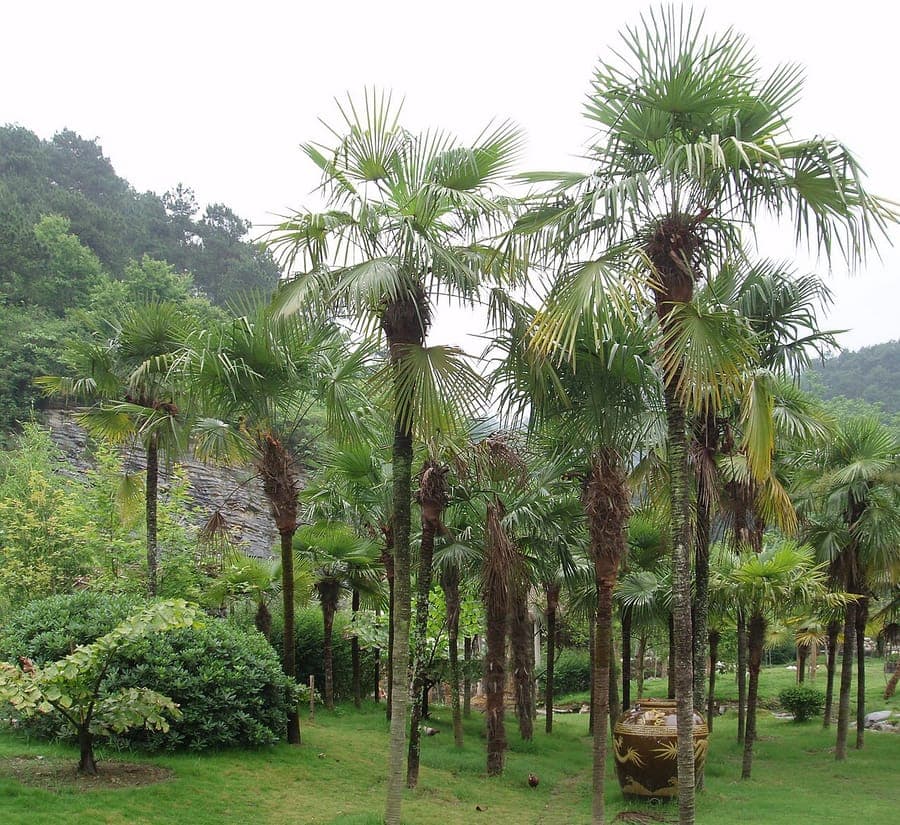
Taken by Fanghong / CC BY-SA 3.0, via Wikimedia Commons
Chinese windmill palm: complete guide
Trachycarpus fortunei
¿Quieres ver Chinese windmill palm: complete guide en tu jardín?
1 minuto, sin tarjeta de crédito
Overview
Chinese windmill palm (Trachycarpus fortunei) is a unique, cold-hardy palm belonging to the arecaceae family (palm family). The plant originates from south-central China and Myanmar, growing naturally in mountain regions at 1000-2000 meters elevation. Despite its exotic appearance, this palm is surprisingly winter-hardy in temperate climates.
This is ideal for gardeners wanting to add tropical feel to their garden without worrying about frost damage. The plant grows slowly but steadily to an impressive height, and is equally suitable for large containers in colder regions.
Appearance and bloom cycle
Chinese windmill palm grows into an elegant palm with a distinct trunk and a crown of large, fan-shaped leaves. The leaves are deeply divided into many segments, bright green in color, and can reach up to 60 cm in width. In early years, the plant grows relatively slowly (5-10 cm per year), accelerating with age.
The plant ultimately reaches 8-12 meters height under favorable conditions. During bloom time (May-June), yellow flowers appear in large, drooping clusters. While not showy, these flowers do attract bees. Following pollination, small blue berries form, approximately pea-sized.
The characteristic brown fiber surrounding the trunk gives the palm a distinctly exotic appearance.
Ideal location
Chinese windmill palm grows best in full sun to partial shade positions. The plant tolerates full shade, though growth becomes slow. For optimal development, sunlight is advantageous.
Use the palm as a specimen tree in the center of a perennial bed, or position it as a background element in borders. The plant also makes impact in large containers. In colder regions, it can remain outdoors during summer and autumn, but requires indoor overwintering.
Soil requirements
Chinese windmill palm has moderate soil requirements. The plant grows best on well-drained, moderately fertile soil. The ideal pH range is 6.0-7.5. The plant tolerates both slightly acidic and slightly alkaline soils.
Ensure good drainage; the palm does not tolerate waterlogging over prolonged periods. If planting in heavy clay soil, incorporate sandy material and compost to improve drainage.
Diseño gratis
¿Quieres ver Chinese windmill palm: complete guide en tu jardín? Crea un diseño gratis ahora.
Watering
Chinese windmill palm has moderate water needs. Young plants should receive regular water until good root systems develop. Once established, the plant can tolerate dry periods, though consistent moisture promotes growth.
In containers, moisture levels must be managed more carefully. Ensure adequate drainage holes. Steady watering without stagnation is key. During very hot summers, mulching helps keep soil cool.
Pruning
Chinese windmill palm requires minimal pruning. Remove only yellowed or dead leaves. Pruning of green foliage should be avoided, as this slows plant growth.
Dead lower leaves can be removed when they turn brownish, but this is optional. Over years of cultivation, the palm will naturally develop an elegant silhouette.
Maintenance calendar
March-April: Plant in open ground or large container after frost danger passes. May-June: Growth period; water regularly. Flowering occurs. July-October: Continued growth; water during dry periods. October-November: Leaf drop of older foliage may occur. Protection needed for temperatures below 0 degrees. December-February: Winter dormancy; minimal watering. Protection against frost. February: Apply slow-release fertilizer.
Winter hardiness
Chinese windmill palm is remarkably winter-hardy and can tolerate temperatures down to minus 15 to minus 17 degrees Celsius. This makes it suitable for many parts of temperate Europe, though severe frosts may damage foliage.
In very cold areas (below minus 20 degrees), winter protection with burlap wrap around the palm crown may be needed. Young plants are more frost-sensitive than established specimens.
Companion plants
Chinese windmill palm combines well with other fine-leaved structural plants such as bamboo, Fatshedera or native shrubs. Position it as a background element behind lower-growing shrubs or flowers. The strong form of the palm makes it a visual anchor in the garden.
It also pairs well with saxifrage, bergenia and other stately perennials.
Closing thoughts
Chinese windmill palm brings unmistakable tropical character to temperate gardens. With its winter hardiness, slow growth and minimal maintenance requirements, it is perfect for those seeking something different from traditional plants. Young specimens are available from many tree nurseries or specialized garden centers. Visit gardenworld.app/en for more exotic choices. Design your own garden plan via gardenworld.app.
¿Quieres ver Chinese windmill palm: complete guide en tu jardín? Crea un diseño gratis ahora.
Sube una foto, elige un estilo y obtén un diseño fotorrealista con lista de plantas en menos de un minuto.
Más de 10.000 jardines diseñados
Sin tarjeta de crédito


Plantas similares
Needle palm: complete guide
Rhapidophyllum hystrix
Everything about the needle palm: the world's hardiest palm, suitable for gardens in temperate climates down to USDA zone 7b.
Saw palmetto: complete guide
Serenoa repens
A complete guide to saw palmetto (Serenoa repens), the iconic fan palm from Florida and the southeastern United States, prized for its toughness.
Puerto Rican hat palm: complete guide
Sabal causiarum
Grow Puerto Rican hat palm successfully. A majestic fan palm with tropical presence suited to sheltered Mediterranean-style gardens.