
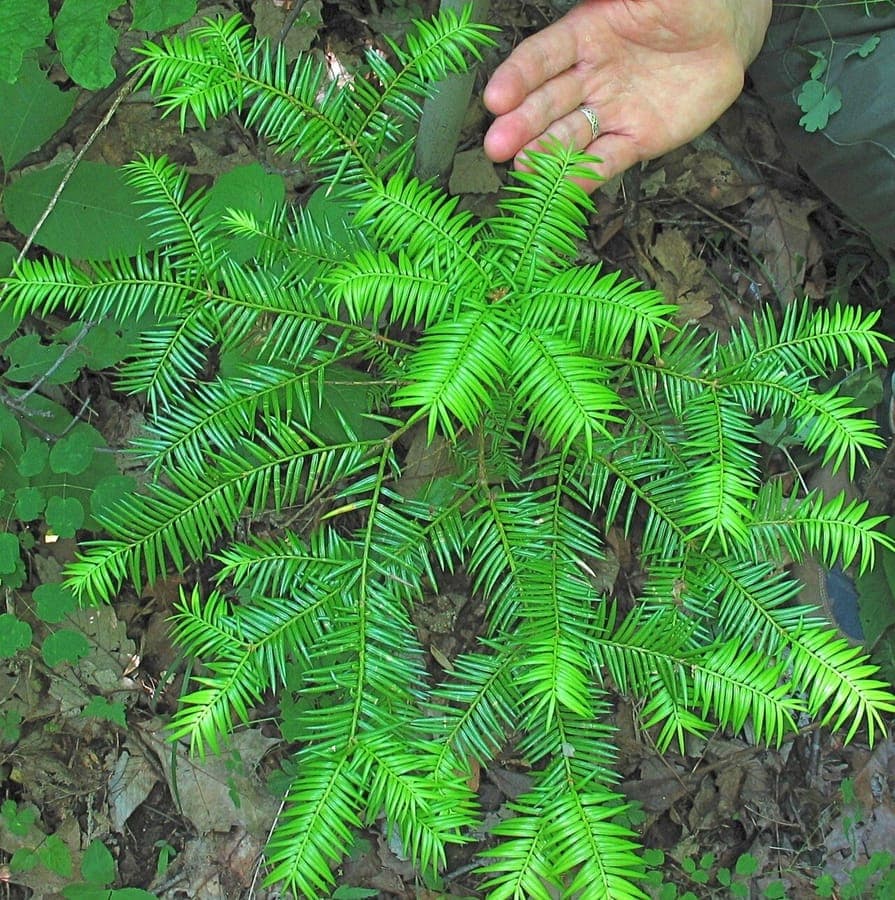
Cbarlow / CC BY-SA 4.0, via Wikimedia Commons
Florida Torreya: Complete Guide to This Endangered Evergreen
Torreya taxifolia
¿Quieres ver Florida Torreya: Complete Guide to This Endangered Evergreen en tu jardín?
1 minuto, sin tarjeta de crédito
Overview
The Florida torreya (Torreya taxifolia), also called Florida nutmeg or Stinking cedar, is an endangered, fine-foliaged evergreen from the Taxaceae family (yew family). This beautiful conifer is naturally endemic to a small area in northwestern Florida and southwestern Georgia, where only a few hundred wild specimens remain.
This plant deserves special attention due to its conservation status. Cultivation in gardens helps keep this species alive. The plant offers year-round green beauty, attractive blue seeds, and unique aromas.
Appearance and Growth
The Florida torreya grows as a compact tree or large shrub, typically 5-10 meters tall in cultivation. The tree displays a dense, pyramidal form with thin, deep-green needles similar to yew (Taxus), from which the species epithet 'taxifolia' (yew-like) is derived.
The needles are fine-textured and aromatic - when rubbed, they release a characteristic, strong scent (hence the name 'Stinking cedar' - though not everyone finds this aroma unpleasant).
The fruits are the most striking feature: large, oval, blue to blue-green stone seeds approximately 3-4 centimeters long. These seeds attract birds.
Ideal Location
The Florida torreya thrives in part-shade to dappled shade - full sun can damage the plant, especially in hot climates. In more northern regions, more sunlight may be tolerated.
Protection from strong wind and cold winds is important. Plant in sheltered corners, against walls, or among taller trees.
Avoid low, wet spots; elevated, well-drained locations are better. The plant appreciates some structural shelter.
Soil
The Florida torreya prefers well-drained, acidic to slightly acidic soil. A pH between 5.5 and 6.5 is ideal. Add peat or leaf mold to heavy soils to promote acidity and improve drainage.
Nutrient-rich, organic-rich soil is appreciated, but not heavily fertilized. For container culture: use ericaceae potting soil (for azaleas/rhododendrons).
Depth: ensure at least 40-50 centimeters of root depth for young trees.
Watering
The Florida torreya loves consistently moist, but not waterlogged soil. Regular watering during the growing season (March-October) is essential. In dry periods, deep water 1-2 times weekly.
Mulching around the plant helps retain moisture and keeps roots cool.
In winter, watering can be reduced substantially, though dry air (e.g., in heated homes) may cause needle drop.
Diseño gratis
¿Quieres ver Florida Torreya: Complete Guide to This Endangered Evergreen en tu jardín? Crea un diseño gratis ahora.
Pruning
Minimal pruning is needed. The plant grows naturally into an attractive pyramidal form. Pruning is needed only to remove dead or damaged branches.
Formative pruning can be done in spring (March-April) if a more compact form is desired. Avoid heavy pruning, which can weaken the plant.
The plant is frost-sensitive after heavy pruning.
Maintenance Calendar
Spring (March-May): Mulching to promote growth, possible light formative pruning, increase watering.
Summer (June-August): Consistent moisture essential, monthly feeding with balanced slow-release fertilizer.
Autumn (September-October): Gradually reduce watering, final feeding in September.
Winter (November-February): Minimal watering, no pruning, no feeding. In very cold climates, consider winter protection.
Winter Hardiness
The Florida torreya is not fully winter-hardy in Northern Europe. Temperatures below -10 degrees Celsius can be fatal to foliage; below -15 degrees usually causes death.
In southern Europe (USDA 7-8, between -10 and -18 degrees), it can grow outdoors with protection. In colder zones, container cultivation with relocation to greenhouse/conservatory in winter is essential.
Protection measures: mulch around the base, wrap the crown in burlap in winter.
Companion Plants
The Florida torreya works well in dappled-shade environments with other acid-loving plants:
- Azaleas (Rhododendron) - similar preference
- Camellia (Camellia) - elegant contrast
- Yew (Taxus baccata) - related evergreen
- Boxwood (Buxus sempervirens) - structural outline
- Hellebores (Helleborus) - foot interest
Conservation Notes
The Florida torreya is critically endangered in the wild, with only a few hundred individuals remaining. Cultivation in gardens plays an important role in species preservation. Seed growing, seedling propagation, and cutting reproduction all help the population.
Seed exchange between gardeners and plant institutions promotes genetic diversity.
Conclusion
The Florida torreya is more than a decorative plant - it is a living monument to endangered nature. With its elegant needles, blue seeds, and aromatic qualities, this tree brings beauty and meaning to your garden.
Specialist nurseries in Southern Europe occasionally stock seedlings. Online plant retailers can be specifically consulted. Gardenworld.app helps you integrate this rare specimen appropriately into your shade garden plan.
The Florida torreya: green heritage in your hands.
¿Quieres ver Florida Torreya: Complete Guide to This Endangered Evergreen en tu jardín? Crea un diseño gratis ahora.
Sube una foto, elige un estilo y obtén un diseño fotorrealista con lista de plantas en menos de un minuto.
Más de 10.000 jardines diseñados
Sin tarjeta de crédito


Plantas similares
Taxus chinensis: complete guide
Taxus chinensis
The Chinese yew is an elegant evergreen conifer with dense dark foliage. Discover cultivation tips, hardiness, and how it differs from other yew species for your garden.
Chinese Nutmeg Tree: complete guide
Torreya grandis
Learn everything about Torreya grandis, the Chinese nutmeg tree. Discover cultivation methods, care, and special characteristics of this rare tree.
Japanese nutmeg tree: complete guide
Torreya nucifera
Discover the Japanese nutmeg tree (Torreya nucifera). A rare conifer with elegant growth and interesting fruits. Perfect garden addition.