
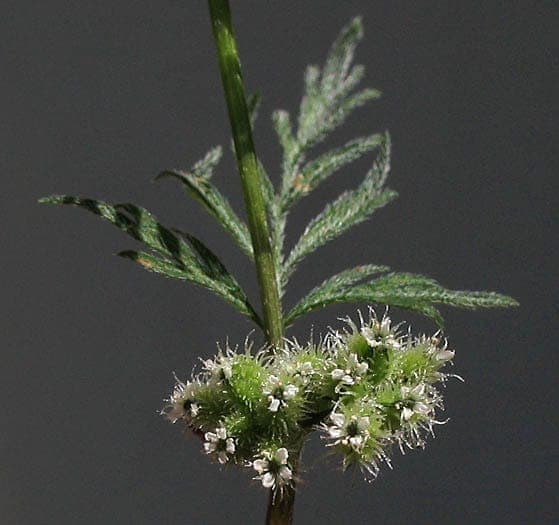
Anthony Valois and the National Park Service / Public domain, via Wikimedia Commons
Knotted hedge-parsley: complete guide
Torilis nodosa
¿Quieres ver Knotted hedge-parsley: complete guide en tu jardín?
1 minuto, sin tarjeta de crédito
Overview
Knotted hedge-parsley (Torilis nodosa) is a delicate annual herb belonging to the carrot family, Apiaceae. This modest plant occurs naturally across southwestern Europe, around the Mediterranean region, and extending to the western Himalayas. The plant takes its common name from the characteristic bumpy seed heads that develop after flowering.
The plant thrives in relatively dry conditions and prefers nutrient-poor soils, making it an excellent choice for naturalistic gardening and low-maintenance landscapes. Torilis nodosa grows readily along hedgerows and waysides, where it flowers quietly and sets seed with minimal care.
Appearance and bloom cycle
This is a tender, branching plant with finely divided, feathery foliage reminiscent of dill or fennel. Plants typically reach heights of 30-50 cm. The flowers are extremely small and white, borne in very loose, delicate umbels. These flower clusters are far less pronounced than in many other apiaceae family members.
The truly distinctive feature appears after flowering: the fruits develop a characteristically bumpy, nearly spherical appearance. These seeds are equipped with small hooked spines that readily attach to clothing and animal fur, facilitating dispersal across distances.
The flowering period extends from May to July, followed by seed set in August and September, after which the plant dies back.
Ideal location
Knotted hedge-parsley grows best in full sun to partial shade positions. The plant requires abundant light for robust growth and flowering. In full shade it will survive but flowering diminishes considerably.
This species fits perfectly into wild corners of gardens, along perennial bed edges, or beneath hedgerows. It thrives in gravel gardens and rocky areas. As a self-seeding annual, you need not sow fresh seed annually if you allow plants to complete their seed cycle.
Soil requirements
The soil can be quite poor. Torilis nodosa actually performs better on nutrient-poor, well-drained soils with pH between 7.0 and 7.5. This is a plant that dislikes excessive fertility; rich, manure-amended soils promote excessive foliage at the expense of flowers.
In waterlogged winter soils this plant struggles, so ensure good drainage, particularly during rainy seasons. The plant makes fewer demands than many conventional garden plants.
Diseño gratis
¿Quieres ver Knotted hedge-parsley: complete guide en tu jardín? Crea un diseño gratis ahora.
Watering
Thank its deep-growing root system, this plant is quite drought-tolerant once established. Beyond the growing season, little supplementary water is needed except during very hot, dry summers. Young plants during their first weeks should be kept evenly moist until well-established.
Better moisture management in garden soil is usually unnecessary. Container-grown specimens require more frequent watering, especially during warm weather. Excessive moisture is harmful; the plant tolerates dryness far better than waterlogged conditions.
Pruning
With knotted hedge-parsley, pruning is scarcely needed. The plant naturally adopts an attractive, open form. You can pinch off overgrown shoots if you prefer a more compact plant, though this is optional.
To prevent excessive self-seeding, remove seed heads before they brown and shatter. Leaving seeds allows a natural reappearance the following spring.
Maintenance calendar
March-April: Direct sow in beds for spring-blooming plants. May-July: Flowering period; observe small white flowers and visiting insects. August-September: Seed set; prepare for self-seeding or remove seed heads. October-November: Plant dies back; bed cleanup is optional. December-February: Winter dormancy; next generation germinates in early spring.
Winter hardiness
Torilis nodosa is an annual plant. It cannot tolerate hard frosts and dies back as autumn temperatures drop. This is not a winter-hardy perennial in cold climates. The plant, however, readily self-seeds year to year from seeds left in previous seasons.
In moderate climates with mild winters, some seed may survive in the soil, but best results come from directly sowing saved seed in early spring.
Companion plants
Knotted hedge-parsley pairs beautifully with other delicate wildflowers. Combine with fellow apiaceae such as wild carrot (Daucus carota) or shepherd's needle (Scandix pecten-veneris). Also consider love-in-a-mist (Nigella), corn salad (Valerianella locusta), and other annual wildflowers.
In a wildflower garden, knotted hedge-parsley provides elegant, airy structure that doesn't dominate and leaves room for other plants.
Closing thoughts
Knotted hedge-parsley is an underappreciated gem for the naturalistic garden. With its fine structure, modest flowers, and intriguing seed heads, it brings a refreshingly natural element to your outdoor space. Seeds are readily available from most garden centers. Visit gardenworld.app/en for more wildflower inspiration. Through gardenworld.app you can also design your own complete garden plan.
¿Quieres ver Knotted hedge-parsley: complete guide en tu jardín? Crea un diseño gratis ahora.
Sube una foto, elige un estilo y obtén un diseño fotorrealista con lista de plantas en menos de un minuto.
Más de 10.000 jardines diseñados
Sin tarjeta de crédito


Plantas similares
Whorled carrot: complete guide
Daucus involucratus
Daucus involucratus is a Mediterranean umbellifer with white flower heads framed by lacy bracts. Growing this gravel garden gem.
Daucus muricatus: complete guide
Daucus muricatus
Daucus muricatus, the spiny wild carrot, grows wild on Mediterranean coasts. Discover sowing, June-July bloom, and wildflower meadow use.
Daucus pumilus: complete guide
Daucus pumilus
Daucus pumilus is a dwarf wild carrot relative with white lacy umbels, thriving on dunes and coastal rock in poor, fast-draining soil.