
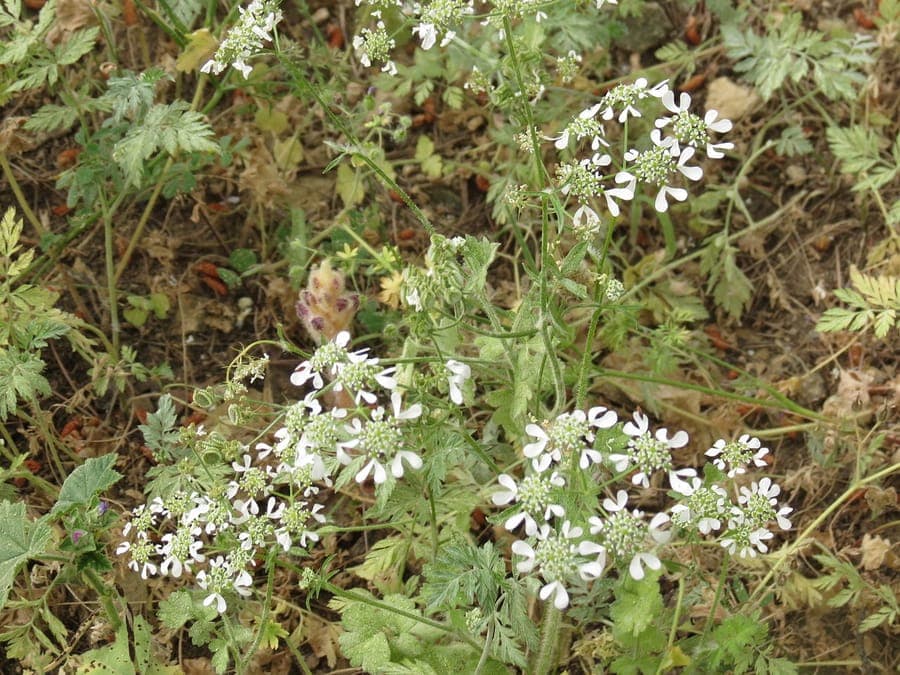
Donald Hobern from Copenhagen, Denmark / CC BY 2.0, via Wikimedia Commons
Mediterranean hartwort: complete guide
Tordylium apulum
¿Quieres ver Mediterranean hartwort: complete guide en tu jardín?
1 minuto, sin tarjeta de crédito
Tordylium apulum, better known as Mediterranean hartwort or Roman pimpernel, is a fascinating annual herbaceous plant native to the Mediterranean region and adjacent areas of North Africa. This plant belongs to the Apiaceae family, the same family as carrots, parsley, and fennel - a family renowned for aromatic, nutritious, and medicinally valuable plants. The plant occurs naturally from southern Europe to north Africa, distributed through Italy, Greece, Spain, France and other Mediterranean countries where it grows in the wild.
Tordylium apulum grows as a compact, upright herbaceous plant typically reaching 15 to 40 centimeters in height, sometimes to 50 centimeters under ideal conditions. The stems are green, lightly hairy, and unbranched or only slightly branched in a regular pattern. The leaves are dark green, pinnate, and subdivided into oblong to lanceolate leaflets approximately 1 to 3 centimeters in length with serrated edges. The leaf texture is fairly rough and tactile, and when rubbed between fingers, they emit a subtle herbal aroma. The leaf stems are short and the leaflets spread widely.
Blooming typically occurs in April to June, making this plant ideal for spring and early summer flowering in wild gardens. The flowers are extremely small, approximately 2 to 3 millimeters in diameter, and white in color with sometimes pink or purple tinges. They appear in characteristic compound umbels, a structure typical of the Apiaceae family. These umbels are flat or slightly domed and reach a diameter of 2 to 3 centimeters. Each umbrella contains dozens of small flowers that together form a very decorative and airy flowering structure. Following pollination, the fruits develop as small, oblong berries with characteristic ribs and small prickly protrusions on the surface that aid in seed dispersal.
This herb is relatively easy to cultivate and thrives in warm, sunny weather with minimal care. It tolerates full sun very well and actually requires minimal watering once established. The soil can be poor to moderately fertile - excessive nutrition leads to excessive leaf growth and fewer flowers. The plant prefers neutral to lightly alkaline soils, with pH values between 7.0 and 7.5. In well-drained soils where water does not stagnate, the plant performs best. Seeds can be sown directly in autumn or early spring where they will self-seed successfully.
The plantable material grows rapidly and completes its entire life cycle in approximately 3 to 4 months in warm conditions. This makes it an ideal plant for spring and early summer flowering in wildflower mixes. The plant loves sunlight and flowers more abundantly in full sun, requiring at least 6 hours of direct sunlight daily. In partial shade, the herb still grows but will flower considerably less. Watering should be moderate; once the plant is established, it can survive almost without additional watering, thanks to its deep roots that can access moisture reserves.
In garden design, Tordylium apulum can be used as a filler in borders, in wildflower mixes, or even in container gardens on balconies. The compact form makes it suitable for small spaces and beds. In southern Europe, the plant is native and regularly appears in undisturbed fields and along roadsides where it provides valuable food for diverse insects. In the Netherlands and Belgium, it is a yearly adventive plant that occasionally appears in unmowed grasslands, though it has not become permanently established as native flora.
Due to its simplicity and charm, Tordylium apulum is a recommendable plant for ecological gardeners and nature enthusiasts. The plant attracts beneficial insects, particularly various flies, hoverflies, and parasitoid wasps that combat harmful insects. This makes the herb not only visually interesting but also functional in biological garden ecology. Many seed suppliers across Europe offer seeds of this species, making cultivation relatively straightforward for enthusiasts.
¿Quieres ver Mediterranean hartwort: complete guide en tu jardín? Crea un diseño gratis ahora.
Sube una foto, elige un estilo y obtén un diseño fotorrealista con lista de plantas en menos de un minuto.
Más de 10.000 jardines diseñados
Sin tarjeta de crédito


Plantas similares
Whorled carrot: complete guide
Daucus involucratus
Daucus involucratus is a Mediterranean umbellifer with white flower heads framed by lacy bracts. Growing this gravel garden gem.
Daucus muricatus: complete guide
Daucus muricatus
Daucus muricatus, the spiny wild carrot, grows wild on Mediterranean coasts. Discover sowing, June-July bloom, and wildflower meadow use.
Daucus pumilus: complete guide
Daucus pumilus
Daucus pumilus is a dwarf wild carrot relative with white lacy umbels, thriving on dunes and coastal rock in poor, fast-draining soil.