
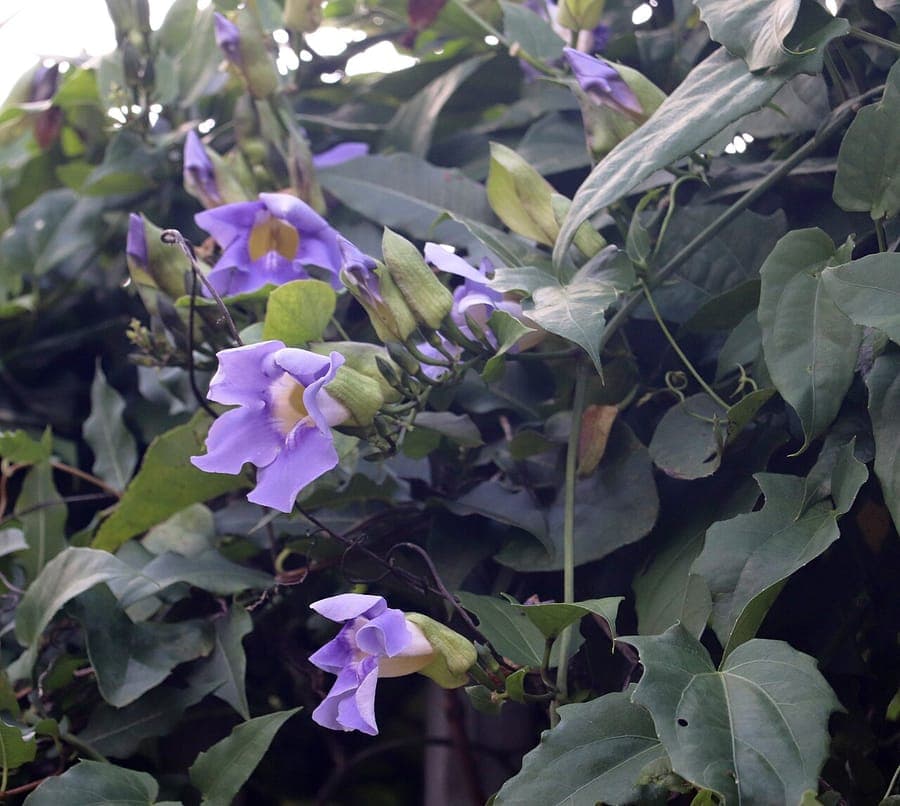
Don McCulley / CC BY-SA 4.0, via Wikimedia Commons
Thunbergia grandiflora: complete guide
Thunbergia grandiflora
¿Quieres ver Thunbergia grandiflora: complete guide en tu jardín?
1 minuto, sin tarjeta de crédito
Overview
Thunbergia grandiflora, known as Bengal Trumpet, Blue Skyflower and Blue Trumpetvine, is a beautiful tropical climbing plant from the Acanthaceae family. Originating from the mountainous regions of central Nepal to southern China and Malaya, this plant is renowned as one of the most spectacular flowering climbers in warm temperate and tropical gardens.
The plant produces months of large, striking violet-blue trumpet-shaped flowers. The combination of lush green foliage and numerous blooms makes Thunbergia grandiflora an absolute showstopper in any garden where it can thrive. In temperate European gardens, it must be grown as a container or greenhouse plant due to frost sensitivity.
Appearance and bloom
Thunbergia grandiflora grows as a vigorous, fast-growing climber with tendrils enabling it to spiral upward. In warm climates it can reach 6 to 8 meters; in temperate Europe it remains much more compact, typically 2 to 3 meters.
Leaves are large, heart-shaped, slightly rough-textured and deep green with subtle veining. They are semi-evergreen, meaning they persist through mild winters but defoliate completely in cold winters.
The flowers are the true stars. They are large, 5 to 7 cm in diameter, trumpet-shaped with five lobes, and intensely violet-blue. Flowers appear in showy, drooping clusters especially in summer and autumn (June to October in European gardens). The flower's interior displays yellow markings around the stamen, creating a pleasant contrast.
Ideal location
Thunbergia grandiflora thrives in full sun to light shade, with at least 4 to 5 hours of direct sunlight daily being ideal. In very warm regions, partial afternoon shade proves beneficial.
In temperate European gardens, position the plant against a warm, southeast-facing wall where it receives passive heating through solar absorption. Protect from strong winds which can break tendrils and impede blooming.
The plant requires a strong support system such as a sturdy trellis or heavy lattice to which it can cling.
Soil requirements
Thunbergia grandiflora performs best in nutrient-rich, well-draining soil with high organic content. In European gardens, amend heavy soils with generous amounts of compost, processed leaf matter and sand.
The plant prefers neutral to slightly acidic soil (pH 6 to 7). In very alkaline soils, chlorosis symptoms may develop (leaf yellowing). In such cases, add ferrous sulfate.
Excellent drainage is essential as waterlogging damages roots, especially during cold winters. Plant in raised beds or containers with loose, native soil mix to maintain perfect control.
Watering
Thunbergia grandiflora is a moisture-loving plant. Water regularly during the growing season, especially in dry summer months. Water when the top layer of soil feels dry, approximately 2-3 centimeters down.
In hot summers, daily watering may be necessary, especially for container plants. Maintain consistent soil moisture without waterlogging. Thrifty gardeners collect rainwater in collection tanks.
Reduce watering in autumn and winter as growth slows and temperatures decline. If overwintering your plant in a cool greenhouse, dry it out somewhat during winter.
Diseño gratis
¿Quieres ver Thunbergia grandiflora: complete guide en tu jardín? Crea un diseño gratis ahora.
Pruning
Pruning helps control Thunbergia grandiflora and stimulates blooming. In early spring (March-April), cut back strong growth to approximately two-thirds of its original length. This stimulates branching and denser growth.
After blooming (October-November), remove dead and weak tendrils. Mature plants tolerate aggressive pruning without damage.
In temperate European gardens where you overwinter the plant in a greenhouse, prune more drastically in February-March before moving outdoors.
Maintenance calendar
Spring (March-May): Move from greenhouse outdoors when frost danger passes. Prune in early spring. New growth begins.
Summer (June-August): Full growth and blooming. Water regularly, at least once daily in warm periods. Apply fertilizer monthly.
Autumn (September-October): Continue blooming with consistent watering. Flowers potentially continue through October if weather remains mild.
Winter (November-February): Move to greenhouse or conservatory for winter protection. Minimal watering. Prune in late winter to prepare growth for next season.
Winter hardiness
Thunbergia grandiflora is only marginally frost-hardy. In Europe, it can grow outdoors only in warm Mediterranean regions where minimum temperatures never drop below 0 degrees Celsius. In all other European regions, it must overwinter in moderate temperatures (10-15 degrees minimum) in a greenhouse or conservatory.
Even light frost (-2 to -5 degrees) will damage much above-ground wood. If the plant dies back, underground roots may re-sprout in following spring if protected.
In container cultivation, carefully move it indoors in October to a cool greenhouse or interior space.
Companion plants
Thunbergia grandiflora combines beautifully with other exotic container plants. Good companions include:
- Bougainvillea - another spectacular tropical bloomer
- Passiflora - another dramatically flowering climber
- Dipladenia - compact, red-flowering form
- Mandevilla - elegant pink flowers
- Ficus - green, low-maintenance backdrop
In European gardens pair it with heat-loving plants such as grapevines, citrus trees and Mediterranean herbs.
Conclusion
Thunbergia grandiflora is not for all gardeners, but for those with patience and warmth, it delivers exceptional rewards. The spectacular blue blooms and lush growth make every effort worthwhile. In temperate European gardens, it requires container cultivation and winter protection, but it is certainly achievable.
Begin with young plants from specialized nurseries. Seed propagation is possible but slow. Place in large container volumes (20+ liters) with well-draining, nutrient-rich soil. Visit gardenworld.app for more ideas to add tropical highlights to your garden.
¿Quieres ver Thunbergia grandiflora: complete guide en tu jardín? Crea un diseño gratis ahora.
Sube una foto, elige un estilo y obtén un diseño fotorrealista con lista de plantas en menos de un minuto.
Más de 10.000 jardines diseñados
Sin tarjeta de crédito


Plantas similares
Limestone wild petunia: complete guide
Ruellia strepens
Ruellia strepens is a long-blooming perennial native to central and eastern North America, with lavender trumpet flowers from June to September.
Shrimp plant: complete guide
Justicia brandegeeana
Everything about the shrimp plant (Justicia brandegeeana): cultivation, ideal location, watering, pruning and overwintering of this popular tender ornamental.
Caricature-plant: complete guide
Graptophyllum pictum
Grow the vibrant Caricature-plant with its striking patterned foliage. Care tips, cultivation, and pairing ideas for indoors and outdoors.