
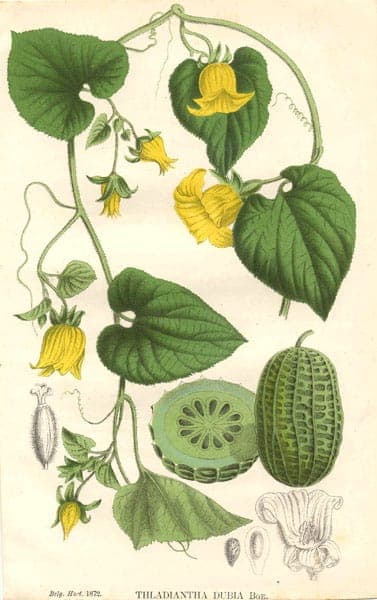
unidentified 19th century artist / Public domain, via Wikimedia Commons
Thladiantha dubia: complete guide
Thladiantha dubia
¿Quieres ver Thladiantha dubia: complete guide en tu jardín?
1 minuto, sin tarjeta de crédito
Overview
Thladiantha dubia is a fascinating and unconventional climbing plant from the Cucurbitaceae family (gourd family), originating from the Russian Far East to China and Korea. This species is known by various names: Red-hailstone, Manchu tubergourd, and Golden Creeper. It represents an exceptional addition to temperate gardens willing to embrace distinction and cherish botanical uniqueness.
Unique to this plant are underground tubers that form food storage organs, much like potatoes. This mechanism allows the plant to survive harsh winters by storing energy beneath the soil. Thladiantha dubia delivers years of flowers and decorative fruits before dying back after frost.
Appearance and bloom
Thladiantha dubia grows as a spiraling climber with tendrils that coil around support structures. Stems can reach 4 to 5 meters in length under good conditions, though often remain more compact in temperate gardens. Leaves are heart-shaped, large, lightly hairy and softly textured green.
Flowers are small, approximately 1-2 cm in diameter, bright yellow in color and appear throughout summer from June to August. Both male and female flowers grow on the same plant (monoecious), making natural fruit setting possible. Following bloom, the plant produces small, round fruits initially green but gradually turning orange-red as they mature.
Fruits remain on the plant creating beautiful decorative effects from September through the first frost. They are not edible when unripe, though mature fruits contain sour pulp suitable only for processing.
Ideal location
Thladiantha dubia grows best in full sun to partial shade, ideally receiving at least four to six hours of direct light daily. The plant performs well on southwest-facing walls or pergolas where it gains protection from intense midday sun in very hot regions.
In Northern European gardens, full sun significantly promotes growth and fruit production. In Central European gardens, partial shade may even prove beneficial to prevent excessive blooming and premature senescence.
The plant requires a strong support structure such as a pergola, lattice or trellis where tendrils can grow freely. Ensure the structure measures at least 2-3 meters high for optimal display.
Soil requirements
Thladiantha dubia is particular about soil conditions but performs well in normal, moderately fertile garden earth. Heavy clay must be amended with organic matter and sand to improve drainage, as the plant dislikes constantly wet feet.
Ideally, provide nutrient-rich, well-draining soil with high organic matter content. Add compost or decomposed peat to the planting hole. Soil pH can range from neutral to slightly acidic (pH 6-7). This is not a xerophyte, so avoid extremely dry soil.
Watering
Thladiantha dubia requires regular watering, especially during the growing season from March through October. The plant prefers moderate moisture and performs poorly in severe drought. Water when the soil surface feels dry but avoid waterlogging.
In hot summers, young plants may require daily watering. Established plants tolerate brief dry periods better but bloom more prolifically with consistent moisture. Drainage problems are less problematic than with other gourds, but death from excessive watering can occur.
Reduce watering in autumn as growth slows before the plant dies back after frost. Underground tubers require minimal water when dormant.
Diseño gratis
¿Quieres ver Thladiantha dubia: complete guide en tu jardín? Crea un diseño gratis ahora.
Pruning
Thladiantha dubia requires minimal pruning once established. In spring (March-April), remove dead wood and long stems can be shortened to support formation. If you wish to control the plant, prune in mid-May before intensive growth begins.
Once the plant dies back after frost (usually October through November), you can remove all dead portions. Underground tubers will re-shoot each spring, so no risk of permanent plant damage exists.
Maintenance calendar
Spring (March-May): Tubers sprout from soil, water regularly. Prune dead wood. First tendrils form on support.
Summer (June-August): Full growth, flowers appear. Water regularly, at least once weekly. Apply organic fertilizer once monthly.
Autumn (September-October): Flowers fade, fruits ripen to orange-red. Reduce watering as temperatures decline.
Winter (November-February): Tubers dormant underground. No water required. Plant dies back above ground.
Winter hardiness
Thladiantha dubia is less winter-hardy than many other climbers in European gardens. The above-ground plant dies back as soon as frost occurs, usually in October or November. However, underground tubers survive winters to approximately -20 degrees Celsius when covered with a protective mulch layer of 5-10 cm dried leaves or twigs.
In very cold regions (mountain areas, northeastern territories), heavily mulch tubers and monitor drainage in spring. In less cold regions (Mediterranean, southwest), tubers survive unprotected.
Companion plants
Thladiantha dubia combines well with other climbers on pergolas and trellises. Beautiful companion choices include:
- Clematis (Clematis species) - other elegant climbers for height
- Hops (Humulus lupulus) - another European climbing plant
- Jasmine (Jasminum nudiflorum) - late-blooming flowers contrast nicely
- Ivy (Hedera) - evergreen base for year-round interest
- Honeysuckle (Lonicera) - fragrant companion climber
Keep space around tubers with low-growing groundcover to prevent drainage issues.
Conclusion
Thladiantha dubia is a fascinating plant for experimental gardeners seeking something beyond the ordinary. With rapid growth, intriguing flowers, decorative red fruits and unique tubers, it adds a botanical dimension to gardens.
The plant requires more attention than simple climbers but rewards are worth the effort. In temperate European gardens it thrives excellently, especially when tuber protection is provided in frost-prone regions.
Source young plants from specialized nurseries or garden seed catalogs. Many standard garden centers don't stock it, but gardenworld.app offers inspiration for unconventional climbers and exotic additions to your garden. This is a plant that will certainly generate conversation!
¿Quieres ver Thladiantha dubia: complete guide en tu jardín? Crea un diseño gratis ahora.
Sube una foto, elige un estilo y obtén un diseño fotorrealista con lista de plantas en menos de un minuto.
Más de 10.000 jardines diseñados
Sin tarjeta de crédito


Plantas similares
Kiwano: complete guide
Cucumis metuliferus
Everything about growing kiwano: location, soil, watering, and harvesting this striking African horned cucumber with spiny orange fruits.
Sponge gourd: complete guide
Luffa aegyptiaca
Full guide to growing sponge gourd (Luffa aegyptiaca): sowing, care, harvesting edible fruits and drying natural loofah sponges in your garden.
Cucumis prophetarum: complete guide
Cucumis prophetarum
Wild cucumber is a fascinating climbing plant with remarkable spiky fruits. Learn how to grow this exotic annual from seed to harvest for decorative interest.