
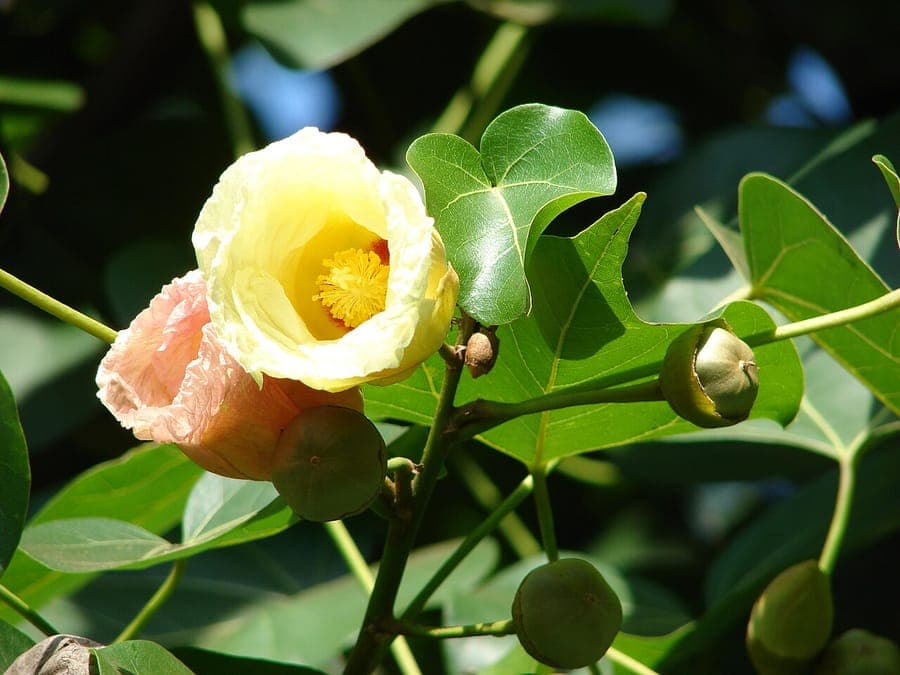
Forest & Kim Starr / CC BY 3.0, via Wikimedia Commons
Portia tree: complete guide
Thespesia populnea
¿Quieres ver Portia tree: complete guide en tu jardín?
1 minuto, sin tarjeta de crédito
Overview
The Portia tree (Thespesia populnea), also called Indian tulip tree or Beach hibiscus, is an attractive tropical shrub with golden-yellow flowers. This tree is especially valued in coastal areas due to its exceptional tolerance for salt and wind. With glossy foliage and continuously blooming golden-yellow flowers, it forms a beautiful ornamental element. It's a relatively fast-growing tree that can develop into a compact specimen.
Appearance and bloom
The Portia tree grows as a compact shrub to small tree, usually 5-8 meters tall. The plant has glossy, heart-shaped leaves that are green and impart an elegant texture. The most striking feature is the beautiful golden-yellow flowers with a red heart or magenta center. These flowers appear continuously throughout the growing season and attract many insects. Following flowering, brown, angular fruits form.
Ideal location
The Portia tree feels most at home in a completely sunny location. This is a plant that loves full sunlight and performs best with at least 6-8 hours of direct sun daily. This makes it ideal for coastal areas, beaches, and tropical gardens. Wind is no obstacle; even strong, salty sea winds are well tolerated. In protected, shady conditions, it grows more slowly.
Soil
The Portia tree is highly adaptable to different soils. It grows well in sand, salt sand, and even rocky soils. Drainage is essential however; avoid wet, clay soils. The plant is salt-tolerant, making it ideal for coastal plantings. pH can range from acidic to alkaline (pH 5.5-8.0). The plant dislikes exhausted soils; some nutrition helps.
Diseño gratis
¿Quieres ver Portia tree: complete guide en tu jardín? Crea un diseño gratis ahora.
Watering
Once established, the Portia tree is fairly drought-tolerant. Provide regular water during the growing season, especially in the first years. Young trees need regular water to build good root systems. Once established, this tree tolerates long dry periods. In very wet climates, be cautious with watering.
Pruning
Pruning is useful for maintaining a compact form and encouraging more flowers. Soft pruning in early spring promotes dense branching. Remove dead branches and any damaged growth. Light pruning of very long branches ensures fuller appearance. Avoid very heavy pruning which can cause damage.
Maintenance calendar
Spring: Active growth, regular watering and feeding\nSummer: Full growth, continuous flowering\nAutumn: Reduce feeding\nWinter: Minimal care in warm climates
Winter hardiness
The Portia tree is not winter-hardy in temperate climates. The plant dies with prolonged exposure to temperatures below 5 degrees Celsius. In cooler regions, it must be brought indoors in large containers before winter. In true tropical and subtropical zones, it can remain outside permanently.
Companion plants
The Portia tree combines well with other salt and wind-tolerant beach plants. Species such as Ipomoea and other beach plants work well together. In larger gardens, it pairs well with Coconut or Casuarina. Low beach grasses can grow beneath the tree.
Conclusion
The Portia tree is an excellent choice for anyone wanting tropical plants specifically for beach or coastal gardens. With its golden-yellow flowers, salt and wind tolerance, this tree deserves a place in warm, sunny coastal regions. Seek young plants at specialized tree nurseries or tropical plant centers.
¿Quieres ver Portia tree: complete guide en tu jardín? Crea un diseño gratis ahora.
Sube una foto, elige un estilo y obtén un diseño fotorrealista con lista de plantas en menos de un minuto.
Más de 10.000 jardines diseñados
Sin tarjeta de crédito


Plantas similares
Crimean linden: complete guide
Tilia × euchlora
Crimean linden is an elegant, fast-growing shade tree ideal for large gardens. Discover cultivars, spacing, maintenance tips and winter hardiness.
California flannelbush: complete guide
Fremontodendron californicum
Everything about California flannelbush (Fremontodendron californicum): sunny placement, drainage, pruning and care for this spectacular yellow-flowering shrub.
Hairy rose mallow: complete guide
Hibiscus moscheutos subsp. lasiocarpos
Full growing guide for hairy rose mallow (Hibiscus moscheutos subsp. lasiocarpos): location, soil, watering, winter hardiness and garden design tips.