
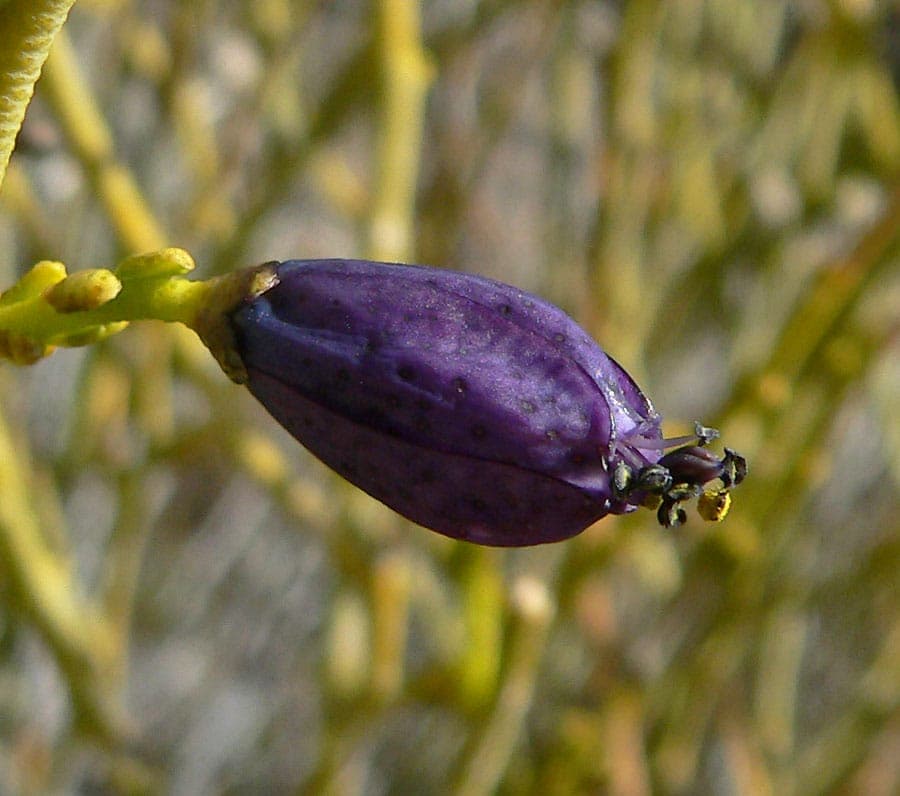
Stan Shebs / CC BY-SA 3.0, via Wikimedia Commons
Thamnosma montana: complete guide
Thamnosma montana
¿Quieres ver Thamnosma montana: complete guide en tu jardín?
1 minuto, sin tarjeta de crédito
Overview
Thamnosma montana, commonly known as turpentine broom, Mojave desertrue, or turpentinebroom, is a distinctive aromatic subshrub in the rue family (Rutaceae), which also includes citrus fruits and garden rue. It is native to the southwestern United States and adjacent northwestern Mexico: Arizona, California, Nevada, Utah, Baja California Norte, and Sonora. The species was formally described by Torrey and Fremont in 1845 from specimens collected during early western exploration, and it remains the only representative of the genus Thamnosma in North America. The common name "turpentine broom" perfectly captures the two most striking features of this plant: its broom-like growth habit of upright, nearly leafless stems, and the powerful, resinous turpentine fragrance released when any part of the plant is crushed or brushed. This characteristic scent results from essential oils concentrated in glands covering the entire plant, a trait shared with other members of the Rutaceae family. Thamnosma montana grows on rocky desert slopes, canyon walls, gravelly washes, and volcanic soils in the Mojave and Sonoran deserts, typically in association with other iconic desert species at elevations from sea level to about 1,500 metres. On gardenworld.app, specialised dry garden and conservatory designs incorporate rare desert botanical specimens like Thamnosma montana alongside other Mojave-adapted plants for a genuinely original look.
Appearance and bloom
Thamnosma montana grows as a slow-growing, multi-stemmed subshrub with a distinctive upright, broom-like form that is immediately recognisable once you know what to look for. The stems are green, nearly leafless in appearance, and serve as the primary photosynthetic organs during dry periods when the plant sheds its foliage to conserve water. This strategy - shifting photosynthesis to green stems while shedding water-expensive leaves - is a remarkable adaptation shared with a handful of other extreme desert species and explains how the plant can survive months of complete drought. When present, the leaves are narrow, small, and yellowish-green in colour. The flowers are purple and appear in early spring on the nearly bare stems, creating a striking visual contrast of vivid purple against green and grey. They are small but conspicuous due to the bright colour, and they attract specialist desert pollinators. After pollination, the plant develops pairs of black, globular fruit capsules that persist on the stems and add ornamental interest through summer and autumn. The entire plant is permeated by a strong turpentine fragrance that is unmistakable once encountered.
Ideal location
Full sun is essential without compromise. Thamnosma montana is a true desert plant adapted to intense solar radiation, extreme summer heat, alkaline rocky substrates, and very low, erratic rainfall. In northern European gardens, this species is suitable only as a conservatory or glasshouse specimen, or as a temporary outdoor plant in a warm, sheltered, south-facing position during the summer months of June through August. The plant requires alkaline conditions with a pH between 7.5 and 8, corresponding to the calcium-rich desert soils of its native Mojave habitat. Acid soils are completely unsuitable and cause rapid decline. A cool but frost-free conservatory or glasshouse with a minimum winter temperature of 5 to 10 degrees Celsius is the best year-round environment for this species in temperate climates. Positioning the plant against a south-facing wall in the glasshouse maximises both light and reflected heat, mimicking the rocky canyon walls where it often grows naturally. On gardenworld.app you can find design inspiration for specialist conservatory collections and dry garden schemes that give extraordinary plants like this one the setting they deserve.
Soil
Thamnosma montana requires excellent drainage and lean, mineral, alkaline soil. In the wild it grows on rocky, calcium-rich substrates with a pH of 7.5 to 8, with minimal or no organic matter present. The soil is extremely poor in nutrients - conditions that would stress most cultivated plants but that Thamnosma montana has evolved to require. In cultivation, a mix of coarse horticultural sand, fine gravel, and a small proportion of lean garden soil works well; a ratio of two parts sand, two parts gravel, and one part soil is a reliable starting point. Do not add compost, bark, or organic fertilisers under any circumstances. A surface layer of horticultural grit or gravel improves drainage further and reflects heat back to the plant, benefiting both photosynthesis and the essential oil production that gives the plant its characteristic scent. Raised beds or containers with generous drainage holes are strongly preferred in the European climate, where natural soils tend to retain far more moisture than this desert species can tolerate.
Watering
Thamnosma montana is among the most drought-tolerant plants available to collectors of rare species. In its native Mojave Desert habitat, it survives months of complete drought, shedding its leaves and reducing metabolic activity to a minimum sustained by stem-based photosynthesis. In cultivation, the greatest risk is consistently overwatering. During the growing season from spring through summer, water sparingly and allow the soil to dry out completely between waterings; the soil should feel bone dry at a depth of 5 centimetres before you water again. As autumn arrives, reduce the frequency dramatically. In winter, give the plant absolutely no water. The plant is in dormancy and has zero requirement for moisture; winter watering almost invariably causes fatal root rot that develops silently and becomes visible only when recovery is no longer possible. This single rule - total winter dryness - is the most important aspect of cultivating this species successfully in temperate climates. Use rainwater or low-mineral water where possible to prevent calcium salt accumulation in containers over time.
Diseño gratis
¿Quieres ver Thamnosma montana: complete guide en tu jardín? Crea un diseño gratis ahora.
Pruning
Minimal pruning is needed. The broom-like stems grow naturally into an attractive, upright form that requires no corrective shaping. In early spring, as growth resumes, remove any dead stems by cutting cleanly back to living tissue, which is identifiable by the green colour visible when the stem is cut. For pot-grown specimens in a conservatory, light shaping in spring can help maintain a compact, dense broom habit and prevent the plant from becoming too straggly. Always wear gloves when pruning, as the resinous oils produced by the plant can cause skin irritation in sensitive individuals after prolonged contact. Hard pruning back to the woody base is not recommended and will be recovered from only very slowly given the inherently slow growth rate of this species. The goal of pruning should be refinement and tidying rather than size reduction.
Maintenance calendar
January to February: plant is in dry dormancy in the conservatory or glasshouse. No water, no fertiliser, no pruning. Check monthly for signs of rot at the stem base, which appears as soft, darkened tissue. March: begin very careful, minimal watering as the first signs of growth appear - small green buds or slight swelling of the stems. March to April: flowering period, purple flowers appear on the bare stems; do not remove flowering stems. May to June: growing season, water sparingly, move the plant outside to a warm, sunny, sheltered position if desired. July to August: peak summer heat, plant is outdoors in full sun with minimal watering. September: reduce watering as temperatures drop, prepare for overwintering. October: before the first night frost, bring the plant inside to a frost-free, bright space. November to December: complete dry winter dormancy, absolutely no watering under any circumstances.
Winter hardiness
Thamnosma montana is not frost hardy in the European climate and cannot tolerate the combination of cold and moisture that characterises European winters. In its native Mojave range, winter nights can drop to -5 degrees Celsius, but winters there are dry and daytime temperatures remain relatively mild. In Europe, it is the combination of low temperatures with high atmospheric humidity and wet soil conditions that is fatal to this plant. Always overwinter Thamnosma montana dry and frost-free at a temperature of 5 to 10 degrees Celsius in a bright, well-ventilated space. Higher is better than lower when in doubt. A cool conservatory, a heated glasshouse, or a bright cool room indoors are all suitable overwintering environments. Never leave the plant outside after mid-September in northern Europe. Young plants in their first year require even more careful attention to overwintering conditions. Visit gardenworld.app for design concepts featuring Mojave and Sonoran desert plants in specialised conservatory and dry garden settings.
Companion plants
In a specialist desert collection in a conservatory or sheltered dry garden, Thamnosma montana combines effectively with other Mojave and Sonoran desert plants that share similar growing requirements. Larrea tridentata, the creosote bush, is a natural companion from the same ecosystem and reinforces the authentic desert character of the planting with its own resinous fragrance. Encelia farinosa, with its grey foliage and yellow ray flowers, provides colour and textural contrast. Yucca brevifolia, the Joshua tree, contributes a dramatic vertical element that anchors any desert collection. Opuntia species and other cacti fill lower levels with interesting geometric forms. Compact Agave species provide structural anchoring at ground level. In a large conservatory, a combination of Thamnosma montana with Fouquieria splendens (ocotillo) creates a spectacular display that genuinely evokes the Mojave landscape. Avoid pairing with moisture-loving or humidity-dependent plants, as their requirements are fundamentally incompatible with those of Thamnosma montana.
Closing thoughts
Thamnosma montana is a botanical rarity reserved for the most dedicated enthusiasts of desert plants. Its broom-like habit, early purple flowers on bare stems, decorative black fruit, and unique turpentine fragrance make it a captivating specimen plant unlike anything available in mainstream garden centres. Those who find and cultivate this plant possess something genuinely special: a direct botanical connection to one of the most extreme and fascinating landscapes on earth. Grown alongside other Mojave desert plants in a dry conservatory, it creates an authentic desert atmosphere that is impossible to replicate with more conventional garden plants. The strongly aromatic foliage, the near-leafless photosynthesising stems, and the early purple bloom together tell the remarkable story of adaptation to extreme conditions. For more inspiration on specialist dry gardens and exotic conservatory collections featuring rare desert plants from around the world, explore the design possibilities at gardenworld.app.
¿Quieres ver Thamnosma montana: complete guide en tu jardín? Crea un diseño gratis ahora.
Sube una foto, elige un estilo y obtén un diseño fotorrealista con lista de plantas en menos de un minuto.
Más de 10.000 jardines diseñados
Sin tarjeta de crédito


Plantas similares
Narrow-leaved fringed rue: complete guide
Ruta angustifolia
Everything about Ruta angustifolia: location, soil, watering, pruning and winter care for this Mediterranean subshrub.
Mountain rue: complete guide
Ruta montana
A complete guide to Ruta montana: best location, soil, watering, pruning and overwintering of this aromatic Mediterranean subshrub.
Amyris balsamifera: complete guide
Amyris balsamifera L.
Balsam amyris is an aromatic tree from tropical America with fragrant wood. Learn care requirements, growing conditions, and how to successfully cultivate this valuable plant in warm climates.