
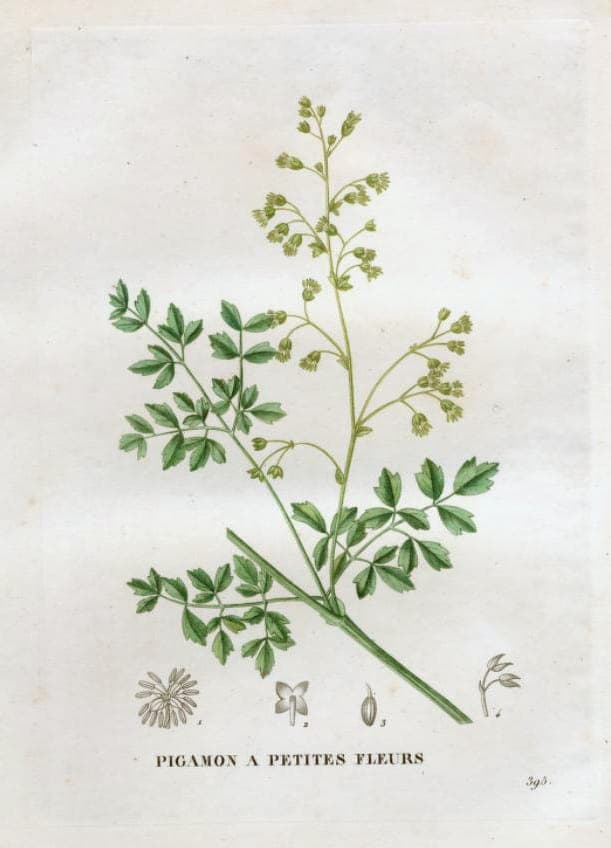
M. Jaume Saint-Hilaire (1772-1845) / Public domain, via Wikimedia Commons
Lesser meadow-rue: complete guide
Thalictrum minus
¿Quieres ver Lesser meadow-rue: complete guide en tu jardín?
1 minuto, sin tarjeta de crédito
Lesser meadow-rue: complete guide
Overview
Lesser meadow-rue (Thalictrum minus), also called small meadow-rue and small pigamon, is an elegant alpine plant from the Ranunculaceae family. This refined plant naturally grows on steep mountain slopes and dry sandy shores from Europe to North Africa and the Middle East. Lesser meadow-rue brings alpine meadow elegance and grace to rock gardens and dry sites.
Historically prized in Victorian alpine collections, lesser meadow-rue remains favorite among alpine gardeners and collectors of compact ornamental plants. Despite its small stature, lesser meadow-rue possesses unforgettable grace with its fine, blue-green foliage.
Appearance and bloom time
Lesser meadow-rue forms compact, tufted clumps of very fine, tripinnately divided leaves that are gray-green to blue-green in hue. Each leaflet measures only millimeters. The plant forms neat, dense rosettes or mats.
Flowers appear from June to August in thin, distinctly upright racemes. Blooms are small, yellowish-green, composed mainly of delicate yellow stamens creating airy, feathery appearance. Seed clusters follow, adding textural interest.
The plant reaches merely 20 to 60 centimeters tall, highly variable depending on growing conditions. In fertile soils it grows taller; on poor mountain soils it remains smaller and more compact.
Ideal location
Lesser meadow-rue thrives in full sun on cool, dry slopes. It tolerates far less shade than many other Thalictrum species. In warm lowland gardens, light afternoon shade prevents excessive drying.
Ideal on steep slopes, in alpine rock gardens, in dry borders, and on sunny mountain terrain. The compact growth of lesser meadow-rue makes it perfect for alpine troughs and screes. Excellent in high alpine settings.
Soil
Lesser meadow-rue prefers acidic, lean mountain soils with pH 5.5 to 6.5. In its natural habitat, it grows on very poor, stony sandy soils. Add little organic matter; it prefers impoverished conditions.
Excellent drainage is essential. On heavy soils, add grit, sand, and slate-like materials. Avoid rich, compost-laden soils, which cause poor growth. In alpine settings, it thrives on very lean soils.
Diseño gratis
¿Quieres ver Lesser meadow-rue: complete guide en tu jardín? Crea un diseño gratis ahora.
Watering
Lesser meadow-rue is highly drought-tolerant once established. Water regularly in the first season, then very sparingly. The plant prefers arid conditions and cannot tolerate waterlogging.
In alpine regions, natural precipitation usually suffices. In lowlands, water sparingly in very dry spells, but avoid waterlogging. This is a very drought-loving plant.
Pruning
Pruning is unnecessary. Lesser meadow-rue maintains neat, compact form naturally. Remove dead flower or leaf stems after senescence. The plant spreads slowly via underground stems or self-seeding.
Maintenance calendar
March-April: Growth begins May-June: Growth accelerates, very sparse watering June-August: Blooms appear, enjoy delicate flowers September-October: Growth slows, restrict water November-February: Dormancy, plant may die back
Winter hardiness
Lesser meadow-rue is fully hardy in mountain zones to USDA zone 4 (-30°C) and higher in alpine regions. In lowlands, it is hardy but may be lost in extremely wet winters. Snow cover protects against extremes.
Companion plants
Lesser meadow-rue combines well with other dry-site alpines: saxifrages, sempervivums, alpine sedums, small alpine thistles. In alpine meadow scenes, pair with alpine daisies, dwarf lupines, and small alpine flora. In rock gardens, plant with alpine stonecrop and small alpine moss.
Avoid vigorous or moisture-loving neighbors that would smother this dry-site plant.
Closing thoughts
Lesser meadow-rue is a true jewel for alpine gardeners and enthusiasts of remarkable mountain plants. Though small and drought-loving, it rewards patient gardeners with years of delicate blooms and compact elegance. In correct conditions (dry, well-drained, acidic soil), lesser meadow-rue will flourish and slowly self-propagate.
Seek stock from specialized alpine nurseries in German or Swiss mountain regions.
¿Quieres ver Lesser meadow-rue: complete guide en tu jardín? Crea un diseño gratis ahora.
Sube una foto, elige un estilo y obtén un diseño fotorrealista con lista de plantas en menos de un minuto.
Más de 10.000 jardines diseñados
Sin tarjeta de crédito


Plantas similares
Drummond's anemone: complete guide
Anemone drummondii
Discover Drummond's anemone (Anemone drummondii): a silvery-grey mountain plant for cool rock gardens and alpine troughs.
Korean clematis: complete guide
Clematis serratifolia
Clematis serratifolia is a hardy climber with fragrant yellow bell flowers in August-September. Pruning group 3, location and care tips.
Aquilegia brevistyla: complete guide
Aquilegia brevistyla
Discover Aquilegia brevistyla, the elegant North American columbine. Growing tips, shade tolerance, and design ideas for woodland and shadowed gardens.