
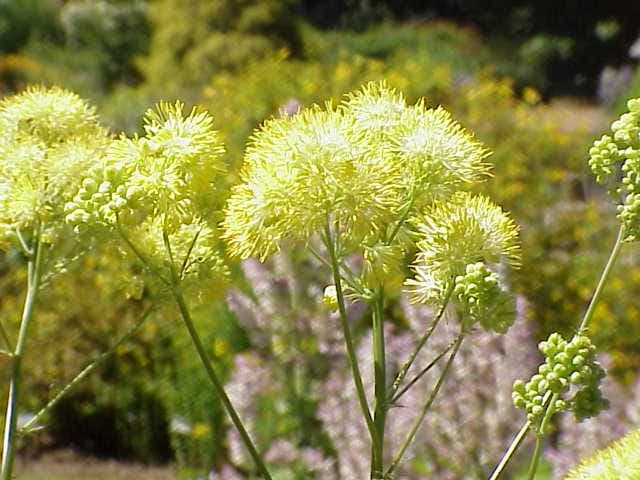
Kurt Stüber [1] / CC BY-SA 3.0, via Wikimedia Commons
Common meadow-rue: complete guide
Thalictrum flavum
¿Quieres ver Common meadow-rue: complete guide en tu jardín?
1 minuto, sin tarjeta de crédito
Common meadow-rue: complete guide
Overview
Common meadow-rue (Thalictrum flavum), also called yellow meadow-rue and water-dropwort, is an impressive perennial from the Ranunculaceae family. This elegant plant naturally grows in marsh and streamside habitats across Europe to Siberia. Common meadow-rue brings refinement and height to wet gardens but thrives equally in normal soils.
Historically cultivated in English cottage gardens, where its yellow flowers and imposing stature commanded attention, common meadow-rue remains beloved by modern gardeners for its versatility, grace, and pollinator appeal.
Appearance and bloom time
Common meadow-rue forms fountains of fine, tripinnately divided leaves that are bright green. The foliage imparts an airy, elegant appearance. Leaves grow up to 40 centimeters long, providing substantial structure.
Flowers appear from May to September in dense, upright clusters. Individual flowers are tiny, but numerous yellow stamens create prominent, pale yellow flower heads. This characteristic yellow color distinguishes common meadow-rue from many other Thalictrum species.
The plant reaches 80 to 150 centimeters tall depending on moisture levels. In marshy soils it grows taller. Sturdy, erect stems rarely need staking, even in windy gardens.
Ideal location
Common meadow-rue thrives in full sun to light dappled shade. It prefers sun to shade. In warm climates, afternoon shade prevents excessive drying.
Ideal at waterside, in bog gardens, in wet borders and along ditches. The imposing height of common meadow-rue makes it suitable as background planting in large borders. Excellent in wild gardens and natural plantings.
Soil
Common meadow-rue grows best on rich, moist to wet soils. Unlike many garden plants, this one thrives in nutrient-rich, compost-laden grounds. In marshes, it performs particularly well.
On normal dry soils it also grows, but smaller and less vigorous. Incorporate plenty of organic matter for water retention. A pH of 6.5 to 7.5 is ideal, though it tolerates soils from pH 5.5 to 8.0.
Diseño gratis
¿Quieres ver Common meadow-rue: complete guide en tu jardín? Crea un diseño gratis ahora.
Watering
Common meadow-rue prefers consistent moisture year-round. During growing season (April to October) water regularly, keeping soil moderately moist. The plant tolerates far greater moisture than typical garden plants.
As close to the waterside as possible is ideal. The plant even thrives in shallow water basins if well-aerated. In very dry spells, additional water helps, but avoid stagnation.
Pruning
Pruning is unnecessary. The plant naturally maintains neat form. After flowering, if you wish to prevent self-seeding, cut off spent flower heads. In spring, remove dead stems from the previous year.
Common meadow-rue can be pruned for neater shape, though this is rarely necessary. It grows naturally upright and compact.
Maintenance calendar
March-April: Growth begins, water regularly May-June: Growth accelerates, apply fertilizer June-September: Full bloom, enjoy flowers and pollinators October-November: Growth slows, gradually reduce water December-February: Dormancy, plant dies back to root
Winter hardiness
Common meadow-rue is fully hardy throughout Western Europe to USDA zone 3 (-40°C). The plant dies completely back to the root system in winter, but the rhizome is entirely reliable. New shoots emerge in March.
Companion plants
Common meadow-rue combines beautifully with other moisture-loving plants: iris, hostas, ferns, astilbes, and ligularia. In wild borders, it pairs well with yarrow, betony, and other perennials. In wet gardens, plant with Primula species and trollius.
For pollinators, combine common meadow-rue with other insect-attracting plants.
Closing thoughts
Common meadow-rue is a versatile, reliable plant for wet and normal gardens. Its imposing height, yellow flowers, and fine foliage make it a summer highlight. Easy to grow, it attracts pollinators and thrives in diverse conditions.
Plant stock is widely available. Position in groups for maximum impact along wateredges.
¿Quieres ver Common meadow-rue: complete guide en tu jardín? Crea un diseño gratis ahora.
Sube una foto, elige un estilo y obtén un diseño fotorrealista con lista de plantas en menos de un minuto.
Más de 10.000 jardines diseñados
Sin tarjeta de crédito


Plantas similares
Drummond's anemone: complete guide
Anemone drummondii
Discover Drummond's anemone (Anemone drummondii): a silvery-grey mountain plant for cool rock gardens and alpine troughs.
Korean clematis: complete guide
Clematis serratifolia
Clematis serratifolia is a hardy climber with fragrant yellow bell flowers in August-September. Pruning group 3, location and care tips.
Aquilegia brevistyla: complete guide
Aquilegia brevistyla
Discover Aquilegia brevistyla, the elegant North American columbine. Growing tips, shade tolerance, and design ideas for woodland and shadowed gardens.