
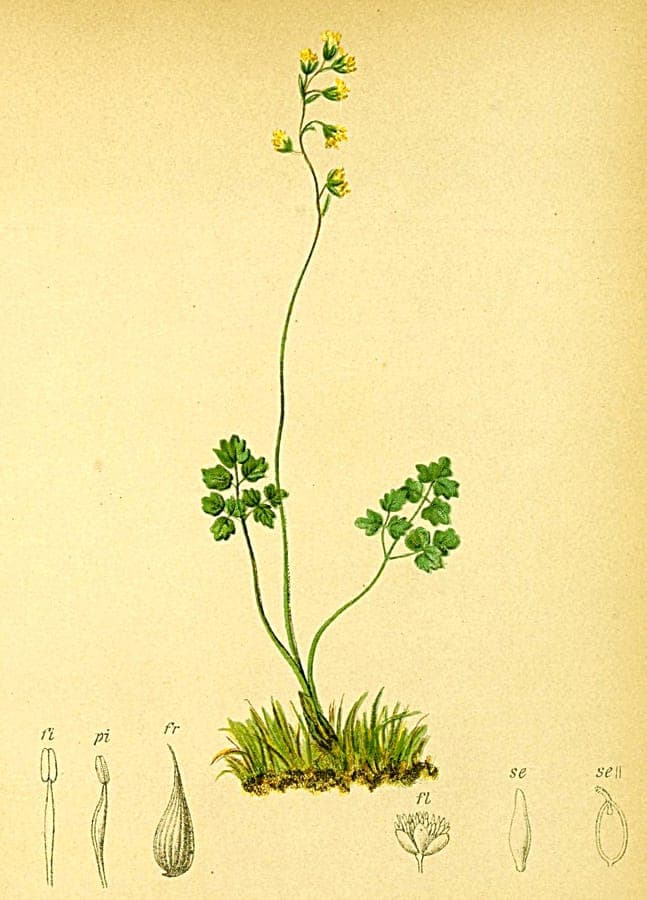
Anton Hartinger / Public domain, via Wikimedia Commons
Arctic meadow-rue: complete guide
Thalictrum alpinum
¿Quieres ver Arctic meadow-rue: complete guide en tu jardín?
1 minuto, sin tarjeta de crédito
Arctic meadow-rue: complete guide
Overview
Arctic meadow-rue (Thalictrum alpinum), also called dwarf meadow-rue, is an exquisite alpine plant from the Ranunculaceae family. This delicate mountain flora naturally inhabits arctic and subalpine zones across the Northern Hemisphere, from Iceland to the Himalaya. Arctic meadow-rue brings alpine meadow magic even to lowland gardens, though its cultivation demands cool sites and good drainage.
This plant was treasured in historic botanical collections and remains a favorite among alpine gardeners. Despite its diminutive size, arctic meadow-rue possesses unforgettable elegance with its lacy, bluish-green foliage and delicate rose-purple flowers.
Appearance and bloom time
Arctic meadow-rue forms dense, low mats of extremely fine, tri-pinnately divided leaves that are bluish-green in hue. Each leaflet measures only millimeters, giving the plant exceptional delicacy. New foliage emerges in April and May.
Flowers appear from June to August in airy, loose racemes. Blooms are small and rose to violet, composed chiefly of numerous delicate, elongated stamens that dominate the flower's silhouette, creating a characteristically feathery appearance.
The plant reaches merely 10 to 30 centimeters tall, making it perfect for alpine troughs and rock gardens. Growth is slow, especially in the first years.
Ideal location
Arctic meadow-rue thrives in full sun to light dappled shade on cool, well-drained alpine slopes. In warmer gardens, afternoon shade helps. The plant prefers cool conditions with excellent air circulation.
Good air movement is essential. In lowlands, extra ventilation or raised planting positions support vigor. Plant on slopes or raised beds where water drains rapidly. Woodland edges with humus-rich, well-drained soils are ideal.
Soil
Arctic meadow-rue prefers acidic to neutral soils with pH 6.0 to 7.0. In its natural habitat, it grows on lean, lime-free mountain soils. Incorporate organic matter (moss-free alpine potting mix) for nutrition and water retention.
Good drainage is non-negotiable. On heavy soils, add grit, sand, and slate to improve structure. Avoid over-rich, compost-laden soils, which cause disease and decline.
Diseño gratis
¿Quieres ver Arctic meadow-rue: complete guide en tu jardín? Crea un diseño gratis ahora.
Watering
Arctic meadow-rue prefers moderate moisture during the growing season (March to August). Water regularly, but avoid waterlogging. In dormancy (October to February), reduce watering but do not allow complete desiccation.
In mountains, natural precipitation usually suffices. In lowlands, supplement in dry spells, especially in early years. This is a moisture-loving alpine that is not drought-tolerant like some others.
Pruning
Pruning is unnecessary. Arctic meadow-rue maintains neat form naturally. Remove dead flower or leaf stems after senescence. The plant spreads gradually via underground stems.
Maintenance calendar
March: First foliage emerges April-May: Growth accelerates, regular watering June-August: Enjoy blooms, maintain moisture September-October: Growth slows, gradually reduce water November-February: Dormancy, minimal water
Winter hardiness
Arctic meadow-rue is fully hardy to USDA zone 3 (-40°C) and is thus superior in alpine gardens and higher elevations. Winter dormancy is essential; no protection is needed. Snow cover protects against extremes.
Companion plants
Arctic meadow-rue combines beautifully with other alpines: saxifrages, alpine primulas, sedums, and edelweiss. In alpine meadow scenes, pair with alpine daisies, lupines, and alpine forget-me-nots. In alpine troughs, plant with alpine bistorta and small alpine sedges.
Avoid vigorous neighbors like aggressive grasses that would overtake this delicate alpine.
Closing thoughts
Arctic meadow-rue is a true jewel for alpine gardeners and rare plant enthusiasts. Though small and slow-growing, it rewards patient cultivators with years of delicate blooms. In correct conditions (cool, well-drained, acidic soil), arctic meadow-rue will flourish and slowly self-propagate, eventually forming substantial alpine mats.
Seek stock from specialized alpine nurseries throughout Western Europe, particularly in mountain regions.
¿Quieres ver Arctic meadow-rue: complete guide en tu jardín? Crea un diseño gratis ahora.
Sube una foto, elige un estilo y obtén un diseño fotorrealista con lista de plantas en menos de un minuto.
Más de 10.000 jardines diseñados
Sin tarjeta de crédito


Plantas similares
Drummond's anemone: complete guide
Anemone drummondii
Discover Drummond's anemone (Anemone drummondii): a silvery-grey mountain plant for cool rock gardens and alpine troughs.
Korean clematis: complete guide
Clematis serratifolia
Clematis serratifolia is a hardy climber with fragrant yellow bell flowers in August-September. Pruning group 3, location and care tips.
Aquilegia brevistyla: complete guide
Aquilegia brevistyla
Discover Aquilegia brevistyla, the elegant North American columbine. Growing tips, shade tolerance, and design ideas for woodland and shadowed gardens.