
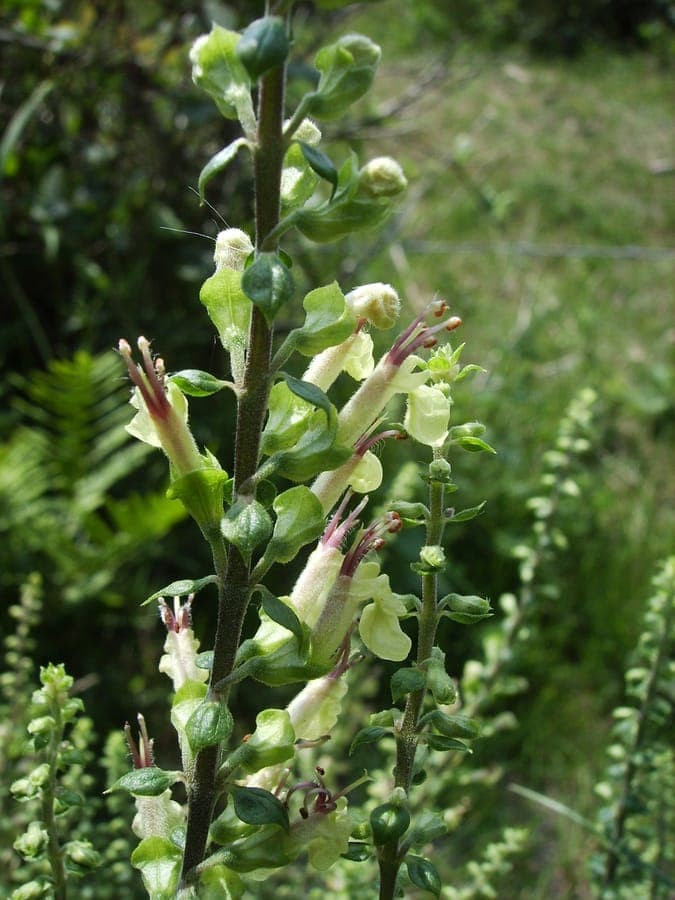
Teun Spaans / CC BY 2.5, via Wikimedia Commons
Wood germander: complete guide
Teucrium scorodonia
¿Quieres ver Wood germander: complete guide en tu jardín?
1 minuto, sin tarjeta de crédito
Wood germander: complete guide
Overview
Wood germander (Teucrium scorodonia), also called woodland sage and hedge germander, is a remarkable wildflower native to woodlands and heaths across Europe. This semi-herbaceous plant belongs to the mint family (Lamiaceae) and brings wild character to any garden space. Once established, it thrives with minimal intervention, making it perfect for low-maintenance landscaping.
Historically, wood germander was widely used in traditional herbal medicine. The leaves release a distinctive garlic-like fragrance when bruised, reflected in the scientific name 'scorodonia' (Greek for garlic). Modern gardeners appreciate this plant for its reliability, its appeal to pollinators, and its textural evergreen foliage.
Appearance and bloom time
Wood germander forms loose clusters of rough, heart-shaped leaves that are distinctly wrinkled and somewhat hairy. The foliage is dark green with gray-green undersides. Leaves are sharply toothed and release a crushed aroma when handled.
Flowers appear from June through September in branched spikes of small white to pale pink blooms. These delicate flowers attract honeybees, bumblebees, and beneficial insects throughout the summer. The plant reaches 30 to 60 centimeters in height with a spreading habit. Brown seeds follow flowering, allowing natural self-seeding.
New foliage emerges in April and May. In autumn, leaves gradually senesce before the plant retreats to its rhizome for winter dormancy.
Ideal location
Wood germander performs best in dappled shade to partial sun. While it tolerates bright locations, it actually prefers afternoon shade in hot climates. Throughout Western Europe, the plant thrives equally under light woodland shade or in full sun positions.
Site your plant where drainage is good. Although drought-tolerant once established, wood germander performs best with moderate moisture. This makes it excellent for the transition zone between dry areas and wetter spaces, and for permaculture plantings under shrub canopies.
Diseño gratis
¿Quieres ver Wood germander: complete guide en tu jardín? Crea un diseño gratis ahora.
Soil
Wood germander adapts to virtually any soil type. From acidic heathland soils to lime-rich substrates, this plant accommodates diverse conditions. It prefers moderately fertile ground over very rich, compost-laden soils.
Ensure good drainage. Light, sandy soils are ideal. On heavy clay, work in sand or grit before planting. A soil pH between 5.0 and 5.5 suits it well, though it tolerates soils up to pH 7.0.
Watering
Once established (after the first growing season), wood germander is highly drought-tolerant. Water regularly during the first year, especially in dry spells. Thereafter, rainfall usually suffices. The plant dislikes waterlogging, which causes root rot. In extreme droughts, deep watering helps, but the plant survives dry periods well.
Pruning
Pruning is largely optional. After flowering, you may remove spent flower spikes for tidiness and to encourage branching. In spring, remove dead wood and lightly shape if desired. Wood germander tolerates firm pruning without ill effect.
Maintenance calendar
March-April: Remove dead material, light pruning May-June: Water during dry spells, enjoy early flowers July-September: Enjoy peak bloom, deadhead spent flowers October-November: Foliage dies back, prepare for dormancy December-February: Rest period, minimal care needed
Winter hardiness
Wood germander is fully cold-hardy to USDA zone 5 (-28°C) throughout Western Europe. The above-ground stems die back in winter, but the rhizome is utterly reliable. New shoots emerge in March. This plant asks no winter protection.
Companion plants
Wood germander combines beautifully with other shade-tolerant herbs and wildflowers: plant it alongside Heuchera, ivy, Solomon's seal, or barberry. In sunnier spots, pair with marjoram, thyme, and sage for a Mediterranean herb guild. These combinations create natural garden harmonies.
For pollinator gardens, combine wood germander with other nectar plants such as fleabane, betony, and self-heal.
Closing thoughts
Wood germander deserves far greater recognition in gardens. This tough, aromatic plant asks little in return for seasons of delicate flowers and insect activity. Whether brightening a shaded corner, edging a path, or establishing a wildflower garden, wood germander is an excellent choice. Stock is available at most European garden centers; ask for Teucrium scorodonia or its common names.
¿Quieres ver Wood germander: complete guide en tu jardín? Crea un diseño gratis ahora.
Sube una foto, elige un estilo y obtén un diseño fotorrealista con lista de plantas en menos de un minuto.
Sin tarjeta de crédito


Plantas similares
Apple mint (Mentha x villosa): complete guide
Mentha x villosa
Meet apple mint (Mentha x villosa): a fruity-scented kitchen herb with woolly leaves, perfect for tea and mojitos.
Salvia peyronii: complete guide
Salvia peyronii
Discover Salvia peyronii, a rare Lebanese mountain sage. Growing tips, hardiness, and companion planting for a Mediterranean gravel garden.
Bigleaf mint (Mentha x rotundifolia): complete guide
Mentha x rotundifolia
Discover bigleaf mint: cultivation, care tips, and garden uses. Learn how to grow this aromatic herb with soft, hairy leaves.