
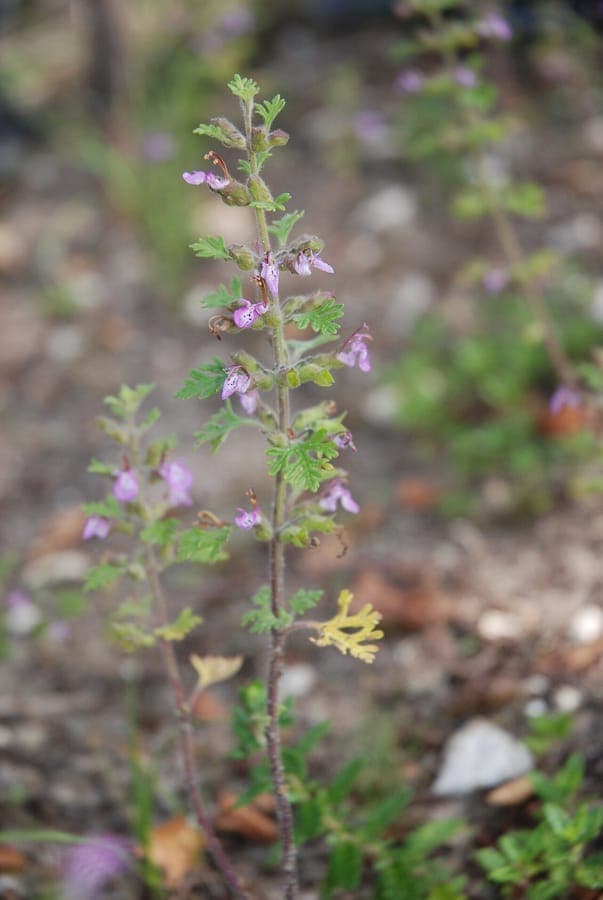
Olivier Pichard / CC BY-SA 3.0, via Wikimedia Commons
Cut-leaf germander: complete guide
Teucrium botrys
¿Quieres ver Cut-leaf germander: complete guide en tu jardín?
1 minuto, sin tarjeta de crédito
Overview
Cut-leaf germander (Teucrium botrys) is an elegant plant from the Lamiaceae family (mint family) that occurs mainly in Mediterranean regions. This annual to biennial plant is known for its refined appearance and attractive purple flowers.
Appearance and bloom
Cut-leaf germander grows as a finely branched herb with delicately divided leaves that are strongly cut. The plant reaches a height of 20-50 cm and forms characteristic purple flowers in elongated, clustered flower spikes. The flowering period extends from June to October, providing a long summer bloomer. Each flower is small but numerous, giving rise to the name "botrys" (cluster).
Ideal location
Cut-leaf germander grows optimally in warm, sunny spots. The plant prefers full sun and thrives poorly in partial shade. Providing a well-ventilated position helps insect visitation and flower production. In Mediterranean gardens and drought-resistant garden design an excellent choice.
Soil type
The plant grows well in nutrient-poor, drought-resistant soils. Cut-leaf germander prefers loamy to sandy soil with good drainage. A pH range of 6.5 to 8.0 is optimal. The plant is not a preference for very fertile soils, making it ideal for poor soils.
Diseño gratis
¿Quieres ver Cut-leaf germander: complete guide en tu jardín? Crea un diseño gratis ahora.
Watering
Once established, Cut-leaf germander is very drought-resistant. Water regularly during the first growing season, but avoid waterlogging. In later years, water can be drastically reduced. The plant prefers dry periods and tolerates drought well.
Pruning
Pruning is not essential. Remove dead flowers to encourage new flowering. In spring, elongated branches can be shortened to promote compact growth. After frost damage, damaged parts can be removed.
Maintenance calendar
Cut-leaf germander requires minimal maintenance. Water regularly during the growing season until roots are established. Removing dead flowers extends the flowering period. In autumn the plant can be cut back or treated as an annual.
Winter hardiness
Cut-leaf germander is not fully hardy in northern climates. In milder zones to southern Europe it can overwinter. In colder areas it is usually grown as an annual or moved to a greenhouse.
Companion plants
Cut-leaf germander grows beautifully together with other Mediterranean herbs such as lavender, sage and thyme. Sun-lovers such as chicory and bird's foot also fit well. In border design, combine with other purple bloomers.
Conclusion
Cut-leaf germander is a charming plant that adds length and summer bloomers to gardens. The purple flowers attract butterflies and bees. Perfect for dry spots and Mediterranean designs. Discover more: gardenworld.app/en
¿Quieres ver Cut-leaf germander: complete guide en tu jardín? Crea un diseño gratis ahora.
Sube una foto, elige un estilo y obtén un diseño fotorrealista con lista de plantas en menos de un minuto.
Sin tarjeta de crédito


Plantas similares
Apple mint (Mentha x villosa): complete guide
Mentha x villosa
Meet apple mint (Mentha x villosa): a fruity-scented kitchen herb with woolly leaves, perfect for tea and mojitos.
Salvia peyronii: complete guide
Salvia peyronii
Discover Salvia peyronii, a rare Lebanese mountain sage. Growing tips, hardiness, and companion planting for a Mediterranean gravel garden.
Bigleaf mint (Mentha x rotundifolia): complete guide
Mentha x rotundifolia
Discover bigleaf mint: cultivation, care tips, and garden uses. Learn how to grow this aromatic herb with soft, hairy leaves.