
Hans Hillewaert / CC BY-SA 3.0, via Wikimedia Commons
Indian-almond: complete guide
Terminalia catappa
¿Quieres ver Indian-almond: complete guide en tu jardín?
1 minuto, sin tarjeta de crédito
Overview
The Indian-almond (Terminalia catappa), also known as Bengal almond or Malabar almond, is an impressive large tropical tree. This tree is renowned for its enormous, architecturally interesting leaves and valuable fruits. With a broad, umbrella-shaped crown providing substantial shade, this tree creates a striking landscape feature. The foliage color that changes from green to red and yellow adds extra visual interest.
Appearance and bloom
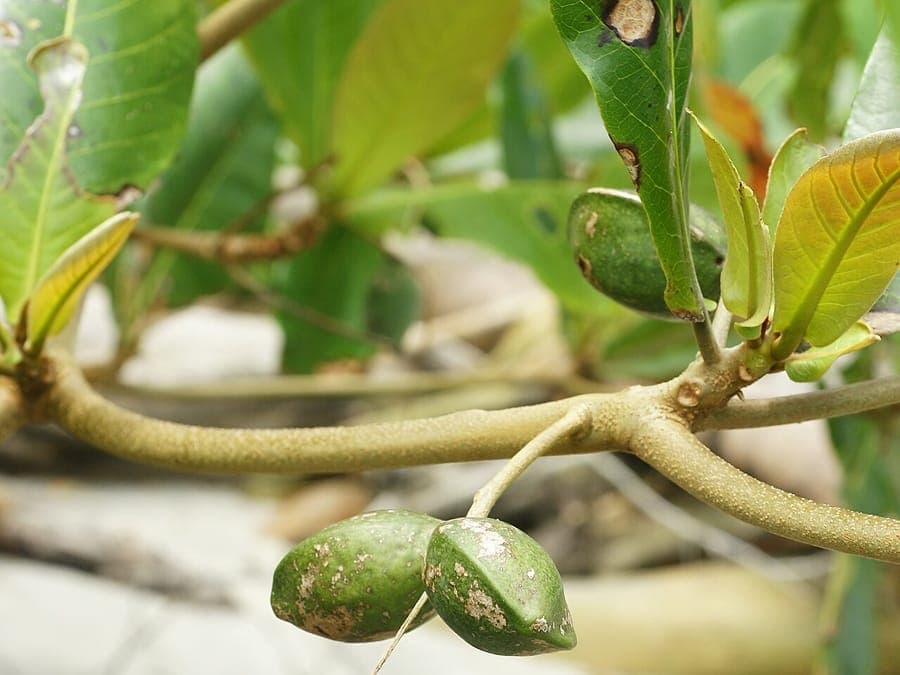
The Indian-almond grows into a large tree reaching 10-20 meters with a characteristic broad crown casting abundant shade. The leaves are large, glossy green with a remarkable parallel vein structure. Before winter, leaves change spectacularly from green to yellow, orange, and red, almost like a European autumn in tropical zones. Small yellowish-green flowers appear in inconspicuous clusters. Following flowering, flat brown fruits develop with a pit inside, resembling a large olive.
Ideal location
Indian-almond thrives best in full sun to partial shade. This tree produces substantial shade and forms a natural parasol over spaces below. Plant where it can grow freely without obstructions. Near beaches and coastal areas, this plant feels at home thanks to salt and wind tolerance. In temperate climates, it can be kept outside in large containers during summer.
Soil
Indian-almond is highly adaptable and grows in many different soils. It prefers however well-draining soil with moderate fertility. Sandy and loamy soils are well tolerated. The tree is salt-tolerant, making it ideal for coastal areas. pH can range from slightly acidic to neutral (pH 6.0-7.5). Avoid heavy clay and waterlogging.
Diseño gratis
¿Quieres ver Indian-almond: complete guide en tu jardín? Crea un diseño gratis ahora.
Watering
Although Indian-almond is highly drought-tolerant once established, young trees need regular watering. Provide consistent water during the growing season but allow soil to dry between waterings. Once established, this tree tolerates long dry periods. Even in wet climates, be careful with excessive water as it causes root rot.
Pruning
Pruning is usually unnecessary for natural shaping of this tree, as it naturally assumes an attractive form. However, remove any dead, damaged, or crossing branches. Light pruning of lower branches can allow more light under the crown. Heavy pruning should be avoided as it causes damage and slow healing.
Maintenance calendar
Spring: Active growth, regular watering\nSummer: Full growth, spectacular shade formation\nAutumn: Spectacular foliage color change, reduce feeding\nWinter: Minimal care, possible leaf drop in subtropical areas
Winter hardiness
Indian-almond is not winter-hardy in temperate climates. Trees die with prolonged exposure to temperatures below 5 degrees Celsius. Although they may experience leaf drop in cold periods, they can regrow if not exposed to complete frost. In cooler regions, use as a container plant that must be brought indoors before winter.
Companion plants
The broad crown of this tree provides shelter for numerous understory plant communities. Plants tolerating shade and able to grow under the tree's canopy drip line are ideal. These can include Plumbago, tropical ferns, or low shrubs.
Conclusion
Indian-almond is an excellent choice for anyone wanting a large, impressive shade tree offering interesting visual properties and fruits. With its tolerance for difficult conditions and spectacular autumn coloring, this tree deserves a place in warm, sunny gardens. Seek young specimens from specialized tree nurseries.
¿Quieres ver Indian-almond: complete guide en tu jardín? Crea un diseño gratis ahora.
Sube una foto, elige un estilo y obtén un diseño fotorrealista con lista de plantas en menos de un minuto.
Más de 10.000 jardines diseñados
Sin tarjeta de crédito


Plantas similares
White-flowered mangrove: complete guide
Lumnitzera racemosa
Discover the white-flowered mangrove. This article covers cultivation, care and placement for coastal gardens.
Terminalia superba (Limba): complete guide
Terminalia superba
Terminalia superba, known as Limba or Afara, is a majestic West African tree. With its light timber quality and elegant appearance, this species adds structure to large gardens.
Kinkeliba: complete guide
Combretum micranthum
Discover Kinkeliba (Combretum micranthum), an African shrub with medicinal value. Warm-climate lover, fine foliage, traditionally used in herbal medicine.