
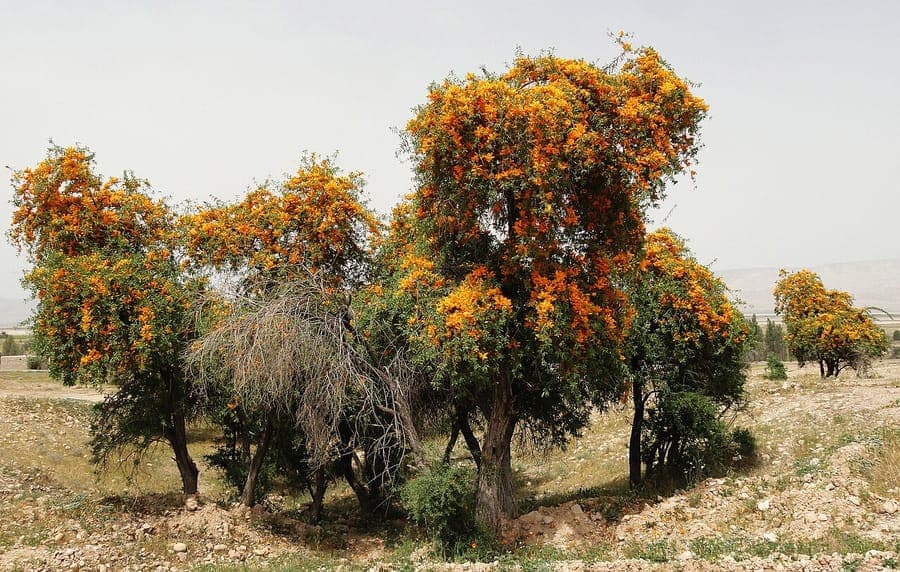
Hadi Karimi / CC BY 3.0, via Wikimedia Commons
Rohida Tree: Complete Guide to This Desert Specimen
Tecomella undulata
¿Quieres ver Rohida Tree: Complete Guide to This Desert Specimen en tu jardín?
1 minuto, sin tarjeta de crédito
Overview
The Rohida tree (Tecomella undulata), also called Honeytree or Desert Teak, is a striking tree native to the arid regions of Oman, Iran, Afghanistan, and India. This robust plant has adapted over millennia to extreme drought and heat, making it an outstanding choice for Mediterranean and desert-style gardens across Europe.
With its distinctive orange flowers and elegant growth pattern, the Rohida offers not just functional shade but also aesthetic beauty. Once established, the tree is extremely drought-tolerant, perfect for xeriscaping projects in Southern Europe.
Appearance and Bloom
The Rohida typically grows into a medium-sized tree, reaching about 5 to 7 meters tall in cultivation, though it may grow larger in its natural habitat. The tree displays an open, airy crown with grayish-brown bark that provides textural interest.
The flowers are the highlight: bright orange to yellow-orange trumpet-shaped blooms appear in clusters at the end of the dry season (March to May). These flowers attract pollinators and create a spectacular color display in the garden. The foliage is small, feathery, and grayish, giving the tree an ethereal appearance.
After pollination, elongated seed pods form within the blooms. The fruiting extends the visual interest over several months.
Ideal Location
The Rohida thrives in locations with full sun exposure - at least 8 hours of direct sunlight daily is ideal. This promotes abundant flowering and vigorous growth. Provide ample space: plant it away from walls or other trees so it can develop its characteristic open form.
In cooler northern European climates, protected placement (against a south-facing wall, sheltered from wind) is essential. In Mediterranean zones, it can grow openly and freely.
Avoid low spots where cold water pools in winter. Elevated or sloping positions are preferable for promoting drainage.
Soil
The Rohida is not particular about soil composition, but prefers well-draining, slightly acidic to neutral ground. Heavy clay soils should be amended by adding sand, gravel, and organic matter.
For container growing: use a mixture of potting soil, coco fiber, and perlite (3:1:1 ratio) for optimal drainage. A pH between 5.5 and 7.0 is ideal.
Ensure at least 30 cm of soil depth for young trees. Mature specimens develop deep roots, so deeper planting holes are preferable.
Diseño gratis
¿Quieres ver Rohida Tree: Complete Guide to This Desert Specimen en tu jardín? Crea un diseño gratis ahora.
Watering
Once established (after 2-3 years), the Rohida is highly drought-tolerant. During the first establishment year, weekly deep watering helps the tree develop a strong root system.
In the established phase, water only during dry periods - natural rainfall usually suffices. In Mediterranean summers, extra watering may be needed if no rain falls for 3+ weeks.
Overwatering is more dangerous than underwatering. Avoid waterlogging completely; ensure drainage always functions properly.
Pruning
Minimal pruning is necessary. The Rohida grows naturally into an attractive shape. Remove only dead, damaged, or diseased branches.
Light formative pruning in spring (March-April) is acceptable if you want a more compact crown. Avoid heavy pruning, which can reduce flowering.
Remove crossing branches and thin growth in the center to improve air circulation.
Maintenance Calendar
Spring (March-May): Possible light pruning, begin fertilizing with slow-release fertilizer, enjoy the blooming period.
Summer (June-August): Keep up watering during dry periods, deadhead faded flowers to encourage extended blooming.
Autumn (September-October): Gradually reduce watering frequency, apply final fertilization (early autumn).
Winter (November-February): Complete rest, no watering except natural rainfall, no feeding.
Winter Hardiness
The Rohida is not fully winter-hardy in northern Europe. In zones down to -5 degrees Celsius, some damage may occur. In areas with temperatures below -5 degrees, container cultivation or relocation to a protected location is recommended.
In Mediterranean zones (USDA 8-9, approximately 10 to -10 degrees Celsius), it is winter-hardy outdoors with some protection.
For extra winter protection: mulch around the base, wrap the crown in burlap during harsh winters.
Companion Plants
The Rohida works beautifully alongside other desert plants:
- Lavender (Lavandula) - similar water needs
- Rosemary (Rosmarinus officinalis) - medicinal utility
- Box (Buxus) - evergreen structure
- Olive (Olea europaea) - Mediterranean atmosphere
- Silver-foliaged plants like Artemisia - textural contrast
Conclusion
The Rohida tree is a fantastic choice for gardeners seeking drought-tolerant, spectacular flowering trees. With its orange trumpet flowers, elegant foliage, and minimal maintenance requirements, this tree brings a touch of Indian desert to your garden.
Specialist nurseries and online retailers stock this exotic specimen. Gardenworld.app helps you visualize how this tree fits into your garden design. For inspiration: plant it as a solo specimen in a dry garden, or group it with other Mediterranean shrubs for a cohesive desert theme.
Bring the sunny warmth of Oman into your garden with the Rohida tree.
¿Quieres ver Rohida Tree: Complete Guide to This Desert Specimen en tu jardín? Crea un diseño gratis ahora.
Sube una foto, elige un estilo y obtén un diseño fotorrealista con lista de plantas en menos de un minuto.
Más de 10.000 jardines diseñados
Sin tarjeta de crédito


Plantas similares
Tabebuia pallida: complete guide
Tabebuia pallida
Full growing guide for Tabebuia pallida: location, soil, watering, pruning, hardiness and companion plants for this tropical trumpet tree.
Northern catalpa: complete guide
Catalpa speciosa
Everything about northern catalpa (Catalpa speciosa): bold white flowers, fast growth, and how to grow this striking tree in your garden.
Desert willow: complete guide to Chilopsis linearis
Chilopsis linearis
Complete growing guide for desert willow (Chilopsis linearis): sun, soil, flowering, pruning, and winter care for this spectacular flowering small tree.