
Javier martin / Public domain, via Wikimedia Commons
Tamarix parviflora: complete guide
Tamarix parviflora
¿Quieres ver Tamarix parviflora: complete guide en tu jardín?
1 minuto, sin tarjeta de crédito
Overview
Tamarix parviflora, commonly known as small-flowered tamarisk, is a graceful shrub native to the Mediterranean region, from southeastern Europe through Iran. This ornamental plant is celebrated for its fine, feathery foliage and delicate pink-white flowers that bloom in spring. The tamarisk is particularly valuable for coastal gardens or areas with poor drainage and salty soil, as it thrives in these challenging conditions.
With its distinctive growth pattern and gentle appearance, tamarisk brings elegance to any front yard. The plant is frequently used in Mediterranean and contemporary garden designs, providing privacy through its dense, fine foliage. In the Netherlands and Belgium, you can find this shrub at specialized garden centers like Intratuin and Gamma. German gardening enthusiasts will discover it at OBI and Hornbach.
Appearance and bloom
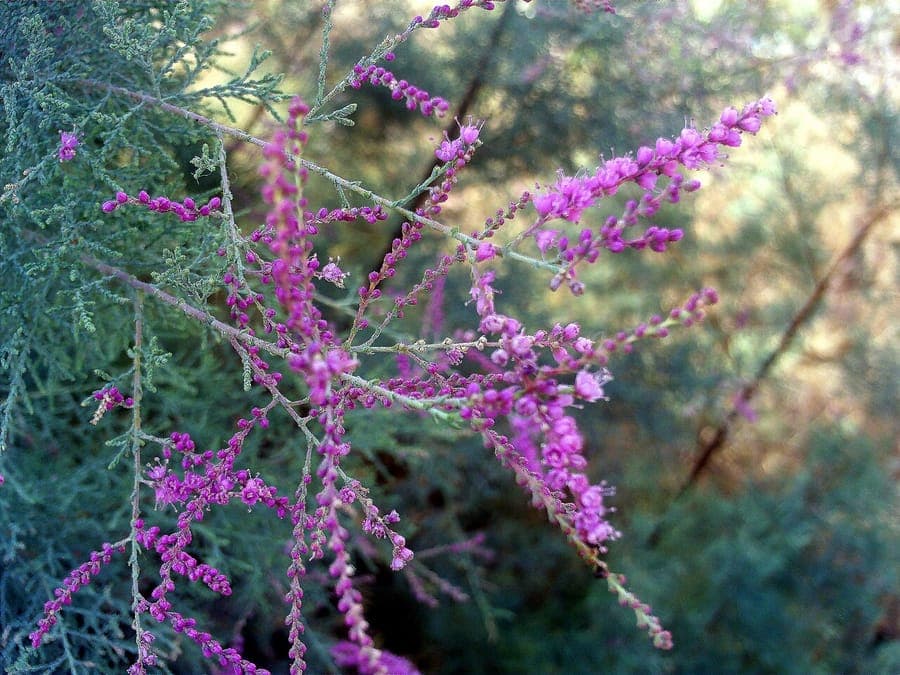
Small-flowered tamarisk grows as a dense, upright shrub with a naturally elegant form. The leaves are exceptionally small and scale-like, nearly needle-like, giving the plant its characteristic delicate appearance. They are green to bluish-green, creating a beautiful contrast with the flowers.
Flowers appear in spring, from March through May, depending on your climate zone. They grow in long, slender plumes at the branch tips. Each individual flower is tiny, but their abundance creates an airy, almost hazy effect of pink-white colors. After blooming, small seeds develop and are dispersed by wind.
Ideal location
Tamarix parviflora thrives in full sunlight. At least six hours of direct sun daily is ideal; the more sun, the richer the flowering. The plant can also grow in light partial shade, but will bloom less abundantly.
Protection from strong winds is beneficial, though the plant is reasonably wind-resistant. Do not plant directly against south-facing walls that reflect excessive heat, as while the plant tolerates drought, it may need supplemental water in extreme heat. The plant is ideal for coastal gardens due to its salt resistance.
Soil
Unlike many ornamentals, small-flowered tamarisk actually thrives in poor, lean soils. Sandy and gravelly substrates are even ideal. The plant is highly tolerant of salty soils, making it perfect for coastal gardens.
Ensure good drainage; waterlogged soil is the main problem for this species. In heavy clay soils, it is advisable to break out the planting hole and amend it with sand or gravel. The pH can be neutral to slightly acidic (pH 7 to 7.5 is ideal, though tolerance is broad).
Watering
Once established, Tamarix parviflora is highly drought-tolerant. During the growing season in the first and second year after planting, water regularly until the plant is well-established. Water until the soil is consistently moist, but not waterlogged.
In dry summers, supplemental water can be beneficial, especially during the growing season. However, overestimating the plant's water needs is risky; this species prefers lean conditions to vigorous growth. Once mature, keep watering to a minimum. In autumn and winter, reduce watering significantly.
Diseño gratis
¿Quieres ver Tamarix parviflora: complete guide en tu jardín? Crea un diseño gratis ahora.
Pruning
Small-flowered tamarisk requires minimal pruning; it grows naturally graceful. Light pruning in late summer, after flowering, helps maintain shape and stimulates richer blooms next season. Remove overgrown branches and gently shape as desired.
Heavy pruning, tolerated by some shrubs, is not recommended here. Trim branches back to about one-third of their length. Avoid pruning in early spring just before flowering, as this reduces bloom.
Maintenance calendar
January - February: Planting season. Check ties on young plants. Begin removing damaged branches.
March - April: Apply supplemental feeding for the growing season; organic fertilizer suffices. Monitor watering as it becomes drier. Full bloom period.
May - July: Continue watering during dry spells. Light pruning after flowering (late May/June). Check for damage.
August - October: Reduce watering. No new fertilizer. Prepare for winter.
November - December: Minimal care. No watering unless extreme drought. Check winter hardiness in northern regions.
Winter hardiness
Tamarix parviflora is reasonably hardy in the Netherlands, Belgium, and Germany, tolerating temperatures down to approximately -10 to -15 degrees Celsius. In warmer parts of these countries (southern Netherlands, Flanders) the plant survives winters in open ground. In colder regions (Germany, northern Netherlands), winter damage may occur.
In very cold areas, protection is advisable; cover the plant with straw or cloth at temperatures below -15 degrees. Container-grown specimens should be kept frost-free over winter.
Companion plants
Small-flowered tamarisk pairs beautifully with other Mediterranean plants. Combine with Cistus (rock rose), Santolina, lavender, and Euphorbia. Tamarix also works well with artemisia, winter jasmine, and bell heather.
In coastal gardens, pair it with other salt-tolerant plants like Halimium and Helichrysum. The fine foliage contrasts nicely with structural plants such as bamboos in protected locations.
Closing
Tamarix parviflora is ideal for those seeking elegance in the front yard without intensive maintenance. Its drought and salt tolerance, combined with beautiful spring flowers, make it a valuable choice for modern Mediterranean gardens. Plant it in sunny, well-drained locations and enjoy its graceful appearance for years. Find specimens at Intratuin and Gamma in the Netherlands and Belgium, or OBI and Hornbach in Germany. On gardenworld.app you will also find inspiration and advice for integrating tamarisk into your garden design.
¿Quieres ver Tamarix parviflora: complete guide en tu jardín? Crea un diseño gratis ahora.
Sube una foto, elige un estilo y obtén un diseño fotorrealista con lista de plantas en menos de un minuto.
Más de 10.000 jardines diseñados
Sin tarjeta de crédito


Plantas similares
Athel tamarisk: complete guide
Tamarix aphylla
Discover the Athel tamarisk, a remarkable desert tree with delicate feathery foliage and pink flowers. Highly drought and salt-tolerant, ideal for challenging landscapes and coastal gardens.
Four-Stamen Tamarisk: complete guide
Tamarix tetrandra
Tamarix tetrandra is an elegant shrub with fine, feathery white and purple flowers. Ideal for dry and salt-tolerant soils, this tamarisk offers year-round interest in gardens.
Tamarix chinensis: complete guide
Tamarix chinensis
Master the care of Tamarix chinensis (Chinese tamarisk) - an elegant shrub perfect for dry gardens with stunning pink flowers and minimal maintenance.