
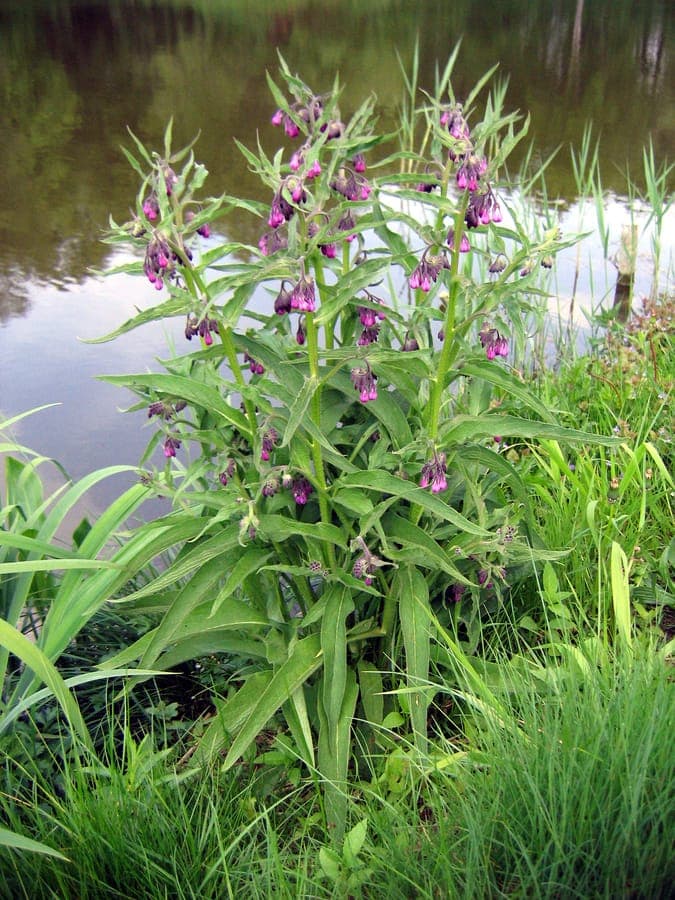
Agnieszka Kwiecień (Nova) / CC BY 2.5, via Wikimedia Commons
Comfrey (Symphytum officinale): complete guide
Symphytum officinale
¿Quieres ver Comfrey (Symphytum officinale): complete guide en tu jardín?
1 minuto, sin tarjeta de crédito
Comfrey (Symphytum officinale): Complete Guide
Overview
Comfrey (Symphytum officinale) is a robust perennial herb from the Boraginaceae family, celebrated for its remarkable healing properties and deep, persistent root system. This historic plant has been employed in traditional medicine for centuries and remains invaluable in permaculture systems. With its distinctive dark green, textured leaves and characteristic drooping flowers in white, pink, and purple, comfrey presents a visually intriguing presence in any garden.
The plant naturally reaches 60 to 120 centimeters in height, forming dense clusters with remarkably deep roots. It is exceptionally suited for sustainable gardens and is frequently selected as a companion plant in regenerative agriculture designs.
Appearance and Bloom
Comfrey displays thick, rough, lance-shaped leaves with prominent veining patterns. The leaf undersides are lighter and feel somewhat spongy to the touch. The small tubular flowers hang in loose racemes and range from pure white to deep purple.
The plant flowers from May through July, attracting bees and beneficial pollinators. Flowers develop into nutlets that disperse naturally. The roots are cream-colored and penetrate deeply into soil, making the plant exceptionally drought-resistant once established.
Ideal Location
Comfrey thrives in full sun to partial shade conditions. At minimum, provide four hours of direct sunlight daily for optimal performance. The plant is remarkably tolerant and can flourish in virtually any light condition, though full sun enhances flowering intensity.
This adaptable herb performs equally well in moist environments or drier conditions. Avoiding water stagnation is critical for long-term health.
Soil
Comfrey is remarkably soil-tolerant and grows vigorously in both poor and fertile soils. Optimal pH ranges from 7.0 to 7.5. Well-draining, moisture-retentive soil promotes the most vigorous growth pattern.
Incorporate organic material such as compost or leaf mold to enhance long-term soil fertility. This addition also improves drainage and moisture retention characteristics.
Diseño gratis
¿Quieres ver Comfrey (Symphytum officinale): complete guide en tu jardín? Crea un diseño gratis ahora.
Watering
Once established, comfrey is extraordinarily drought-tolerant due to its extensive deep root system. Young plants require consistent moisture until they become fully established. Water regularly until the surrounding soil maintains consistent moisture without waterlogging.
During dry summers, provide deep watering once weekly. The plant recovers quickly from drought but cannot tolerate permanent water stagnation.
Pruning
Comfrey requires minimal maintenance. Remove discolored or damaged leaves regularly. After flowering concludes, trim flower stems to prevent excessive seed dispersal if desired.
The plant can be cut back substantially in early spring to encourage more compact growth patterns. This approach also promotes fuller development the following season.
Maintenance Calendar
Spring: Remove dead aerial parts. Incorporate organic compost. Adjust watering as growth resumes. Summer: Water consistently during dry periods. Remove flower stems after blooming completes. Autumn: Allow leaf material to remain for winter protection. Permit seeds to mature and disperse naturally. Winter: No maintenance required. Plant rests completely underground.
Winter Hardiness
Comfrey exhibits exceptional cold hardiness, tolerating temperatures to -20°C without injury. The aerial portions die back completely at first frost, but the underground rhizome system survives robustly.
In temperate zones, no supplementary protection is necessary. The plant regenerates each spring from its underground crown.
Companion Plants
Comfrey establishes excellent combinations with:
- Lemon balm (Melissa officinalis) - both medicinal herbs
- Sage (Salvia officinalis) - complementary aromatic plants
- Lavender (Lavandula angustifolia) - together for dry, sunny areas
- Oregano (Origanum vulgare) - both healing herbs
- Delphinium - for contrasting flower heights
Conclusion
Comfrey stands as a remarkable plant that has served generations of gardeners. With minimal effort and maximum benefits, it represents an excellent choice for sustainable and medicinal gardens. Visit gardenworld.app/en for more inspiration on herb gardens and plant combinations. For additional garden guidance, consult gardenworld.app/en for professional design advice.
¿Quieres ver Comfrey (Symphytum officinale): complete guide en tu jardín? Crea un diseño gratis ahora.
Sube una foto, elige un estilo y obtén un diseño fotorrealista con lista de plantas en menos de un minuto.
Más de 10.000 jardines diseñados
Sin tarjeta de crédito


Plantas similares
Western waterleaf: complete guide
Hydrophyllum occidentale
Full growing guide for western waterleaf (Hydrophyllum occidentale): shade tolerance, soil needs, watering, winter hardiness and naturalistic garden use.
Limestone phacelia (Phacelia affinis): complete guide
Phacelia affinis
Full guide to Phacelia affinis, the limestone phacelia: sowing tips, purple-blue bee flowers, drought tolerance and uses in dry or wildlife gardens.
Pyrenean viper's bugloss: complete guide
Echium asperrimum
Echium asperrimum is a striking biennial from the western Mediterranean with rough bristly stems and vivid blue flowers. A magnet for bees and a bold border plant.