
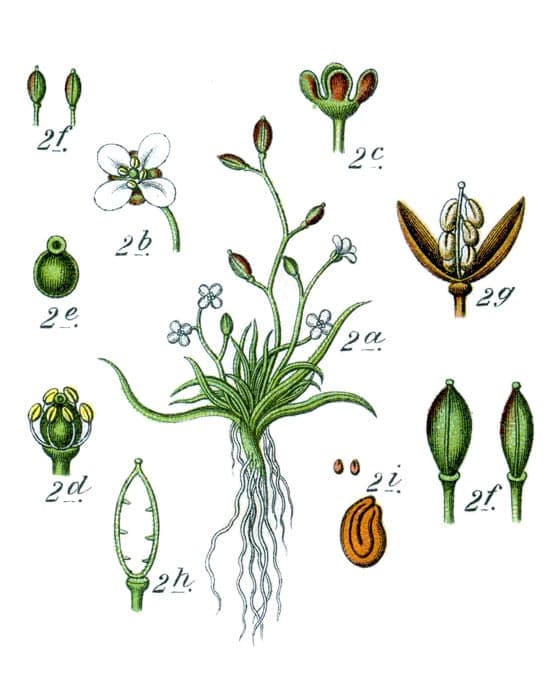
Johann Georg Sturm (Painter: Jacob Sturm) / Public domain, via Wikimedia Commons
Awlwort: complete guide
Subularia aquatica
¿Quieres ver Awlwort: complete guide en tu jardín?
1 minuto, sin tarjeta de crédito
Awlwort (Subularia aquatica), also called water awlwort or waterawlwort, is a fascinating aquatic plant that thrives in cold waters. This annual or compound water plant grows in shallow pools, lakes, and rivers in northern climates. With its slender, awl-shaped leaves and delicate white flowers, awlwort offers a unique choice for gardeners with water features. In this guide, we explore everything you need to know about cultivating this special aquatic plant.
Overview
Awlwort is an aquatic herb from the Brassicaceae family (mustard plant family). The plant is native to subarctic and temperate water habitats in the Northern Hemisphere. It grows in shallow water on rocky or sandy substrates and plays an important role in aquatic ecosystems as food for waterfowl and fish.
Appearance & Bloom
Awlwort forms an underwater rosette of extremely thin, needle-like leaves reaching up to 5 centimeters in length. Above water, flowering shoots emerge with tiny, white flowers. The flowers have four petals and are quite inconspicuous. The plant produces small fruits (siliquae) characteristic of the mustard plant family. Although small and modest, awlwort possesses a certain elegance with its fine foliage.
Ideal Location
Awlwort grows optimally in shallow water with strong water movement. Plant this aquatic specimen in water depths between 5 and 30 centimeters, preferably with sunny light. The plant tolerates full sun to partial shade. In water gardens, awlwort works best as submerged vegetation rather than as a shore plant.
Soil
Awlwort thrives best on rocky or sandy water substrates. The plant requires minimal nutrients; in fact, it grows better in nutrient-poor waters. Do not add extra nutrients to the water. The plant can be planted directly on stone or sand, or in soil mats for water gardening.
Watering
This is not applicable to awlwort since it is a fully aquatic plant! Provide clean, cool water, ideally with regular water changes in aquaria or fountain environments. Stagnant water can promote algae growth that smothers the plant.
Pruning
Awlwort requires no regular pruning. The plant grows naturally compact and will not overgrow. Remove only damaged or wilted leaves, or plants with accumulated algae.
Maintenance Calendar
Most year-round: Planting in water (spring placement). Apr-May: Growth start and blooming. Jun-Jul: Full growth. Aug-Sep: Seed formation. Oct-May: Winter dormancy in cool water.
Winter Hardiness
Awlwort is very hardy and actually grows better in cold waters. The plant thrives in subarctic and temperate zones. In tropical or warm waters, awlwort cannot grow well.
Companion Plants
Awlwort combines well with other aquatic plants in nutrient-poor, cold water habitats. Other submerged plant companions include waterweed and water milfoil (Myriophyllum). These combinations create balanced aquatic ecosystems.
Closing
Awlwort is an elegant aquatic plant that can enhance interesting water features. With its fine foliage, delicate flowers, and preference for cool waters, awlwort is an excellent choice for gardeners with water gardens in temperate climates. Visit gardenworld.app/en for more plant recommendations for water gardens.
¿Quieres ver Awlwort: complete guide en tu jardín? Crea un diseño gratis ahora.
Sube una foto, elige un estilo y obtén un diseño fotorrealista con lista de plantas en menos de un minuto.
Más de 10.000 jardines diseñados
Sin tarjeta de crédito


Plantas similares
Brassica cretica: complete guide
Brassica cretica
Brassica cretica, the Cretan cabbage, grows wild on Aegean cliffs. Discover how to grow this drought-tolerant, yellow-flowered Mediterranean perennial.
Corsican cabbage: complete guide
Brassica insularis
Corsican cabbage is a rare Mediterranean rock cabbage with white flowers and blue-green leaves. Location, soil and winter protection.
Prostrate cabbage: complete guide
Brassica procumbens
Prostrate cabbage is a creeping North African cliff plant with yellow flowers. Discover location, soil type and winter protection.