
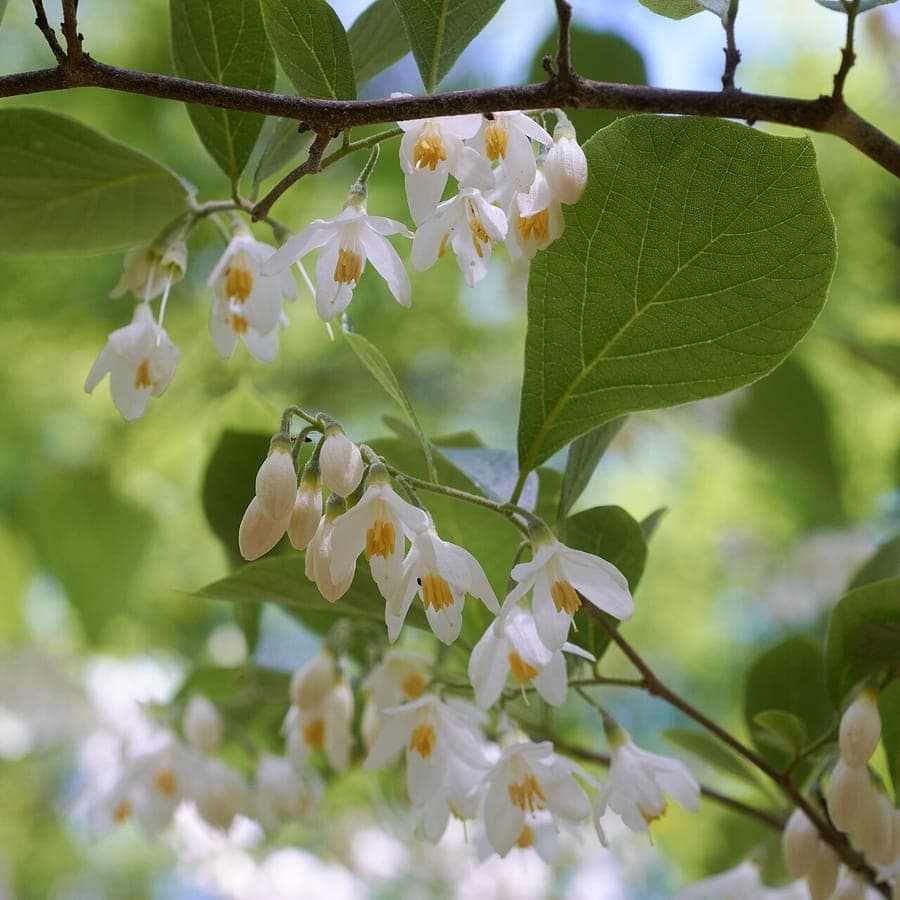
Eric Hunt / CC BY-SA 4.0, via Wikimedia Commons
Styrax grandifolius: complete guide
Styrax grandifolius
¿Quieres ver Styrax grandifolius: complete guide en tu jardín?
1 minuto, sin tarjeta de crédito
Overview
Styrax grandifolius, commonly known as bigleaf snowbell or large-leaf storax, is a slow-growing shrub or small tree in the family Styracaceae, native to the central and southeastern United States. Its natural range extends from Alabama, Arkansas, and Florida through Georgia, the Carolinas, Virginia, Ohio, Indiana, Illinois, Kentucky, Louisiana, Mississippi, Tennessee, and Texas. The species was formally described by William Aiton in 1789, making it one of the earliest American plants to receive an official botanical name. The epithet 'grandifolius' means 'large-leaved' in Latin, referring to the notably broad foliage that readily distinguishes this species from the more familiar Styrax japonicus. In the wild, Styrax grandifolius grows as an understorey shrub or small tree in mixed deciduous forests, on moist slopes, along stream banks, and in shaded ravines, always on acidic, humus-rich, well-drained soil. It shares its habitat with rhododendrons, mountain laurels, and other ericaceous plants. Gardeners looking for distinctive flowering shrubs for shaded garden spaces will find on gardenworld.app that Styrax grandifolius can serve as a truly elegant focal point in a woodland-style border.
Appearance and bloom
Styrax grandifolius is a multi-stemmed shrub or small tree reaching 3 to 6 metres in height under favourable conditions, though its slow growth rate means a decade or more is needed to approach full size. The foliage is immediately striking: broadly oval to elliptical blades measuring 10 to 20 centimetres in length, dark green and smooth on the upper surface, paler and softly hairy with a slightly felty texture on the underside. These large, bold blades give the plant a lush, almost subtropical presence even when not in flower. The flowers, however, are the undisputed highlight of the year: pure white, bell-shaped blooms hanging in pendulous racemes along the young branches in late spring. They appear in May or early June as the new foliage emerges, and they carry a delicate, sweet fragrance that fills the garden on warm spring days. The stamens are yellow, providing a gentle contrast to the pure white petals. After blooming, small brownish fruits develop and ripen through the autumn, attracting small birds. The plant is deciduous; foliage turns yellow before dropping in autumn.
Ideal location
Styrax grandifolius is a shade and partial shade plant that in nature always grows beneath the canopy of taller trees. In the garden, a north- or east-facing position, the sheltered side of a building, or the understorey beneath mature trees provides the ideal conditions. Direct midday summer sun can scorch the large foliage, particularly on young plants or in exposed situations, resulting in unsightly brown patches and premature leaf drop. Dappled or filtered light beneath a deciduous canopy, as found in a classic woodland garden design, is the optimum situation. The plant appreciates a sheltered, humid microclimate similar to its native forest floor. A position near a pond, stream, or in an enclosed courtyard garden maintains the atmospheric moisture that the plant prefers and promotes the best flowering. Shelter from cold, desiccating east or north winds in winter is helpful, especially for plants in their first few years. For those planning a woodland-style garden or shaded border, gardenworld.app offers design tools that help incorporate statement shrubs like Styrax grandifolius into a coherent and beautiful planting scheme.
Soil
This is an acid-loving plant that performs best at a soil pH between 4.5 and 6.5. It thrives in the same acidic, humus-rich, moisture-retentive but well-drained soil that suits rhododendrons, azaleas, Pieris japonica, and Kalmia. Alkaline or chalky soil is entirely unsuitable: at high pH the plant develops iron-deficiency chlorosis, with the foliage turning yellow between the veins while the veins themselves remain green. At planting, incorporate generous quantities of ericaceous compost or acidic leaf mould into the planting hole. Mulch deeply with woodchip or leaf mould to maintain soil acidity, retain moisture through dry spells, and protect the root system. A mulch layer of at least 10 centimetres is recommended, and it should be topped up each autumn or early spring. Never use farmyard manure or mushroom compost, as both can raise soil pH over time. Avoid lime in any form near this plant.
Watering
Styrax grandifolius needs consistent moisture throughout the growing season. In its native forest habitat it benefits from the naturally humid, moist microclimate beneath the canopy, where rain percolates slowly and the soil rarely dries out completely. In the garden, the root zone should never be allowed to dry out for extended periods. Young plants in their first two to three years after planting need regular watering during dry spells to develop a strong, wide-spreading root system. Established plants in well-mulched, humus-rich soil need less intervention but should still be watered during prolonged summer droughts. Avoid waterlogging, especially in cold winter conditions: the combination of wet soil and hard frost can cause root damage. Good drainage that removes excess rainfall promptly is therefore just as important as maintaining adequate moisture during the growing season.
Diseño gratis
¿Quieres ver Styrax grandifolius: complete guide en tu jardín? Crea un diseño gratis ahora.
Pruning
Styrax grandifolius requires minimal pruning and naturally develops an attractive branching habit without intervention. Remove dead, damaged, or crossing branches in late spring, after the risk of frost has passed. Light shaping or thinning can be carried out after the flowering period ends, typically in July, before the following year's flower buds begin to form. Avoid pruning in autumn or winter, when the flower buds for the coming season are already present on the branches: inadvertent removal of these buds results in a blossomless year. An annual post-flowering inspection with targeted, light intervention is entirely sufficient to keep this shrub in excellent condition. Do not attempt to force faster growth through heavy pruning; Styrax grandifolius recovers slowly after drastic cutting and vigorous growth at the expense of flowering is rarely desirable.
Maintenance calendar
In January and February, no action is required; protect young plants during periods of sustained hard frost using horticultural fleece. In March, remove any dead branches identified over winter and apply fresh mulch to the root zone if not done in autumn. April and May are active growing weeks; water if the spring is dry and check that the mulch layer is maintaining adequate depth. In May and June, enjoy the spectacular flowering period, which is the highlight of the year for this plant. In July, carry out any light shaping after the blooms have finished. August and September see the fruits developing; no maintenance is needed. In October and November, top up the mulch before winter and ensure that drainage channels around the plant are clear of fallen foliage. In December, protect young specimens with fleece if extended hard frost is forecast.
Winter hardiness
Styrax grandifolius tolerates frost to approximately -15 degrees Celsius and is suitable for most regions of northern and western Europe when planted in a sheltered position. Established, well-rooted plants require no winter protection in average winters across the UK, the Netherlands, and Belgium. Young plants in their first two years are more vulnerable and benefit from a straw mulch or fleece cover during periods of sustained hard frost. A sheltered position away from cold, drying winds is always advisable: winter wind causes more damage through desiccation than cold alone. In regions with unusually harsh winters, or on exposed sites, some additional protection is wise. Visit gardenworld.app for inspiration on designing sheltered garden spaces that suit demanding but rewarding woodland shrubs like Styrax grandifolius.
Companion plants
Styrax grandifolius combines beautifully with a wide range of other acid-loving woodland plants that share the same soil and light requirements. In the shrub layer, Rhododendron, Pieris japonica, Kalmia latifolia, Enkianthus campanulatus, Leucothoe fontanesiana, and Fothergilla are all outstanding companions that create a layered, multi-season woodland planting. For ground-level interest beneath the shrubs, Tiarella cordifolia, various Epimedium species, Brunnera macrophylla, Polypodium ferns, and Trillium thrive in the dappled shade cast by Styrax and its companions. Avoid pairing Styrax grandifolius with Mediterranean or drought-tolerant plants, or with any species that requires alkaline or lime-rich soil, as their cultural requirements are fundamentally incompatible. A well-composed combination of these acid-soil woodland plants creates a garden scene of considerable elegance and botanical interest.
Closing thoughts
Styrax grandifolius is a distinguished and somewhat underappreciated shrub for the sheltered, acidic woodland garden. Its combination of impressively large bold foliage, exquisitely fragrant pendant white flowers, graceful multi-stemmed form, and subtle autumn colour makes it a plant of considerable horticultural merit that deserves far wider use in European gardens. It rewards those who take the time to provide the right conditions - acidic, humus-rich, moist soil in partial shade - with a reliable, spectacular spring flowering display year after year. For gardeners who want to create a truly refined garden with plants of character that also support pollinators and birds, Styrax grandifolius earns a prominent and permanent place. For more planting ideas and personalised garden designs that make the most of exceptional flowering shrubs like this one, visit gardenworld.app.
¿Quieres ver Styrax grandifolius: complete guide en tu jardín? Crea un diseño gratis ahora.
Sube una foto, elige un estilo y obtén un diseño fotorrealista con lista de plantas en menos de un minuto.
Más de 10.000 jardines diseñados
Sin tarjeta de crédito


Plantas similares
Two-wing silverbell: complete guide
Halesia diptera
Full guide to two-wing silverbell: best growing conditions, soil, watering, pruning, and companion plants for a stunning garden display.
Halesia carolina: complete guide
Halesia carolina
Discover Halesia carolina, a stunning American snowdrop tree. Complete guide to planting, growing, and caring for this beautiful ornamental tree.
Storax: complete guide
Styrax officinalis
The Storax (Styrax officinalis) is a Mediterranean ornamental tree with fragrant white flowers and elegant growth habits.