
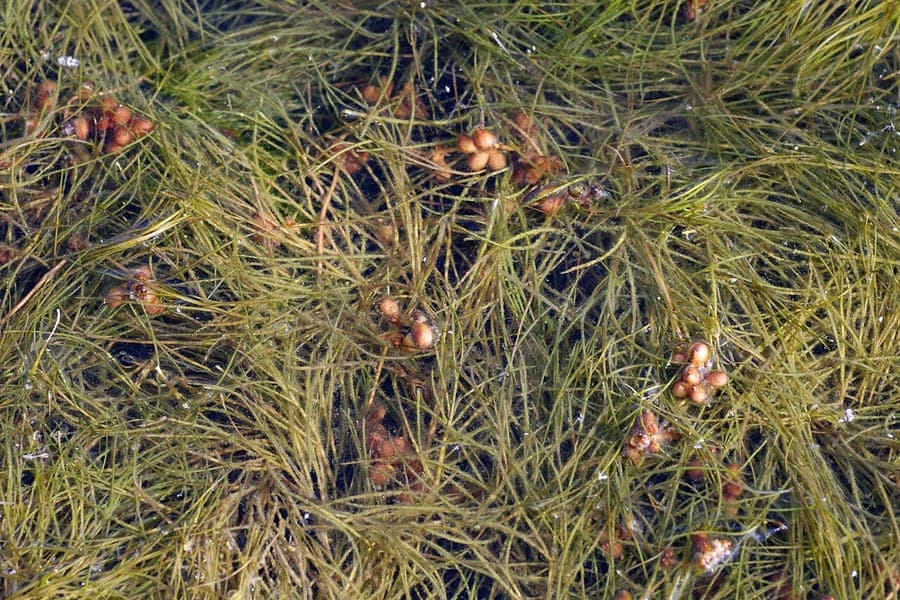
Christian Fischer / CC BY-SA 3.0, via Wikimedia Commons
Sago pondweed: complete guide
Stuckenia pectinata
¿Quieres ver Sago pondweed: complete guide en tu jardín?
1 minuto, sin tarjeta de crédito
Sago Pondweed: Complete Guide
Sago pondweed (Stuckenia pectinata) is an underwater sculpture found in virtually every climate zone worldwide. This member of the pondweed family (Potamogetonaceae) is known for its extremely fine, comb-like leaves and importance for aquatic ecosystems. In this complete guide, we present this nutrient-rich water plant.
Overview
Stuckenia pectinata is a submerged water plant naturally found in fresh waters in many locations. The plant grows from the bottom upward and reaches to the water surface. This makes it an important part of the aquatic food web and oxygen producer.
Appearance and Growth
The plant has very fine, comb-shaped leaves that grow in opposite pairs along the stem. The leaves are linear and reach about 2-4 cm in length. Very small flowers appear above water from May to September. The plant grows rapidly in summer and forms dense, blue-green clumps underwater.
Ideal Location
Sago pondweed grows optimally in full sun. The plant thrives in open water areas and can also survive in flowing water. Avoid areas with very deep shade.
Water Composition
The plant is highly adaptive and grows in many different water types. It tolerates both fresh and brackish water and various pH values (pH 6.5-8.0 is optimal). Nutrient-rich waters are favorable, but the plant can also survive in more nutrient-poor environments.
Diseño gratis
¿Quieres ver Sago pondweed: complete guide en tu jardín? Crea un diseño gratis ahora.
Watering
As a submerged plant, Sago pondweed requires no supplementary watering. Ensure water level remains constant and does not completely dry out.
Pruning
Remove dead pieces regularly. In case of excessive growth, parts of the plant can be removed. The plant grows rapidly and can suppress other plants if not managed.
Maintenance Calendar
In spring, regularly check for growth. During summer, remove dead material. After flowering, remove portions that prevent overgrowth. In autumn, prepare for winter storage.
Winter Hardiness
Sago pondweed is hardy throughout Europe. The plant can enter dormancy (submerged branches disappear) and regrow in spring.
Ecological Importance
Sago pondweed is an extremely important food for waterfowl (especially ducks) and other herbivorous water animals. It also provides shelter for small fish and invertebrates. The plant plays a crucial role in aquatic ecosystems.
Conclusion
Sago pondweed is indispensable in healthy ponds and water areas. With its fine leaves and rapid growth, it contributes to oxygen production and water quality. For more information about pond and water plants, visit gardenworld.app/en.
¿Quieres ver Sago pondweed: complete guide en tu jardín? Crea un diseño gratis ahora.
Sube una foto, elige un estilo y obtén un diseño fotorrealista con lista de plantas en menos de un minuto.
Más de 10.000 jardines diseñados
Sin tarjeta de crédito


Plantas similares
Robbins' pondweed: complete guide
Potamogeton robbinsii
Complete care guide for Potamogeton robbinsii, the submerged aquatic plant perfect for wildlife ponds and natural water gardens.
Flatstem pondweed: complete guide
Potamogeton zosteriformis
Complete care guide for Potamogeton zosteriformis, the flatstem pondweed perfect for clear freshwater ponds and naturalistic water gardens.
Largeleaf pondweed: complete guide
Potamogeton amplifolius
Everything about largeleaf pondweed (Potamogeton amplifolius): pond cultivation, water depth, substrate, care calendar and ecological role in garden ponds.