
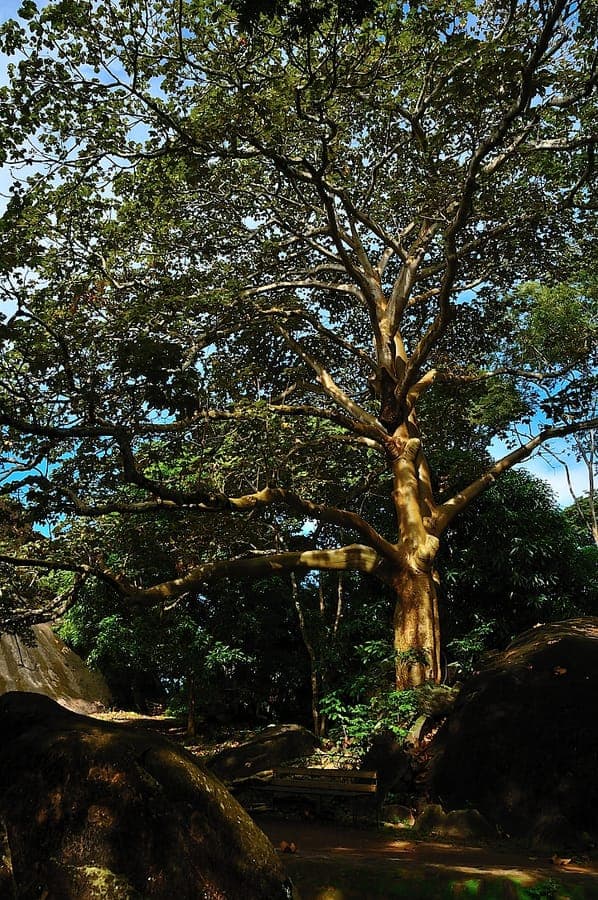
Oscar Silva / CC BY 3.0, via Wikimedia Commons
Panama Tree: complete guide
Sterculia apetala
¿Quieres ver Panama Tree: complete guide en tu jardín?
1 minuto, sin tarjeta de crédito
Overview
Sterculia apetala, commonly known as Panama tree, is a magnificent tropical tree native to Central and South America. This imposing species ranges from Florida through tropical America, including Colombia, Venezuela, Peru, Ecuador, Brazil, and numerous other Amazonian and trans-Amazonian countries. Introduced to tropical regions worldwide including the Philippines, this member of the Malvaceae (mallow) family inhabits tropical rainforests and semi-deciduous forests from lowland to submontane elevations.
Sterculia apetala stands as an impressive structural component of tropical forest ecosystems, reaching heights exceeding 40 meters. The tree is valued for its durable timber and substantial ecological importance in maintaining forest canopy structure and biodiversity.
Appearance and Bloom
Sterculia apetala is a large, stately tree reaching 20 to 40 meters in height with an erect, columnar crown and relatively fine branching. Trunks exceed 1 to 2 meters in diameter, displaying gray to reddish-brown bark that flakes in mature specimens.
Leaves are large and palmately compound, divided into 5 to 9 digitately arranged lobes, each measuring 10 to 25 centimeters long. Foliage is glossy dark green with prominent venation. Leaves are deciduous, dropping during dry seasons to minimize water loss.
Flowers are conspicuous, measuring 2 to 3 centimeters across, arranged in large, spreading panicles. Blooms display remarkable reddish to rose-orange coloration. Flowering occurs primarily during dry seasons and is primarily insect-pollinated.
Following pollination, enormous hollow pods (follicles) develop, measuring 10 to 20 centimeters long. These distinctive pods contain large, nut-like seeds consumed and dispersed by wildlife. The pods are initially green, ripening brown, displaying remarkable ornamental characteristics.
Ideal Location
Sterculia apetala inhabits specific tropical forest zones:
- Tropical rainforests and semi-deciduous forests
- Full sun exposure in open canopy areas
- Preference for deep, well-drained substrates
- Protected locations buffered from strong winds
- High rainfall regions (exceeding 100 centimeters annually)
In Netherlands climates, outdoor cultivation is impossible. Only tropical greenhouses or botanical institutions in Mediterranean-climate regions can accommodate this species.
Diseño gratis
¿Quieres ver Panama Tree: complete guide en tu jardín? Crea un diseño gratis ahora.
Soil Requirements
Soil preferences are important for optimal growth:
- Deep, well-drained soil profiles
- Neutral to slightly acidic pH (6.0-7.0)
- Well-amended with organic matter
- Water-retentive yet never waterlogged
- Preference for volcanic or naturally fertile substrates
In tropical regions, the tree adapts to diverse soil types, from heavy clays to sandy loams, provided substrate depth accommodates root penetration.
Watering
Watering is essential in cultivation:
- Regular irrigation during growth periods
- Reduced water during dry seasons
- Excellent drainage is mandatory
- Native regions experience distinct seasonality
- Tree drops leaves seasonally in response to drought stress
Pruning
Pruning may be necessary:
- Remove dead or damaged branches
- Prune to encourage upright form
- Pruning optimal during dormant dry season
- Allow natural form development in cultivation
Maintenance Calendar
January-March: Dry season, leaf drop April-June: Flowering period July-August: Fruit maturation September-December: Growth period with regular watering
Winter Hardiness
Sterculia apetala cannot survive temperate zones:
- Minimum temperature requirement: 15-20 degrees Celsius
- Frost intolerant below 10 degrees Celsius
- High humidity requirement (70-90 percent)
- Intolerance of seasonal temperature variations
The tree dies back at temperatures below 10 degrees Celsius.
Companion Plants
In tropical forests, this species coexists with:
- Other Sterculia species
- Ceiba species
- Ipe species
- Tectona species
- Numerous understory herbs and shrubs
Concluding Thoughts
Sterculia apetala represents the magnificence of tropical rainforests, demonstrating the botanical richness of Central and South American ecosystems. For Dutch gardeners, cultivation is feasible only in specialized tropical greenhouses or botanical institutions. Nevertheless, this species makes a fascinating study subject for understanding Neotropical vegetation and the structural complexity of tropical forest communities.
¿Quieres ver Panama Tree: complete guide en tu jardín? Crea un diseño gratis ahora.
Sube una foto, elige un estilo y obtén un diseño fotorrealista con lista de plantas en menos de un minuto.
Más de 10.000 jardines diseñados
Sin tarjeta de crédito


Plantas similares
Crimean linden: complete guide
Tilia × euchlora
Crimean linden is an elegant, fast-growing shade tree ideal for large gardens. Discover cultivars, spacing, maintenance tips and winter hardiness.
California flannelbush: complete guide
Fremontodendron californicum
Everything about California flannelbush (Fremontodendron californicum): sunny placement, drainage, pruning and care for this spectacular yellow-flowering shrub.
Hairy rose mallow: complete guide
Hibiscus moscheutos subsp. lasiocarpos
Full growing guide for hairy rose mallow (Hibiscus moscheutos subsp. lasiocarpos): location, soil, watering, winter hardiness and garden design tips.