
Hedwig Storch / CC BY-SA 3.0, via Wikimedia Commons
Wood stitchwort: complete guide
Stellaria nemorum
¿Quieres ver Wood stitchwort: complete guide en tu jardín?
1 minuto, sin tarjeta de crédito
Wood Stitchwort: Complete Guide
Wood stitchwort (Stellaria nemorum) is a charming and delicate plant native to woodlands from Europe to North Iran and Mongolia. This member of the Caryophyllaceae family is known for its fine, small white flowers and silky foliage. In this complete guide, we explore this beautiful woodland plant in detail.
Overview
Stellaria nemorum is a low-growing herb naturally found in moist, shaded woodland areas. The plant is ideal for shady gardens and natural woodland settings. With its fine branching structure and white flowers, it brings lightness and elegance to dark corners of your garden.
Appearance and Bloom
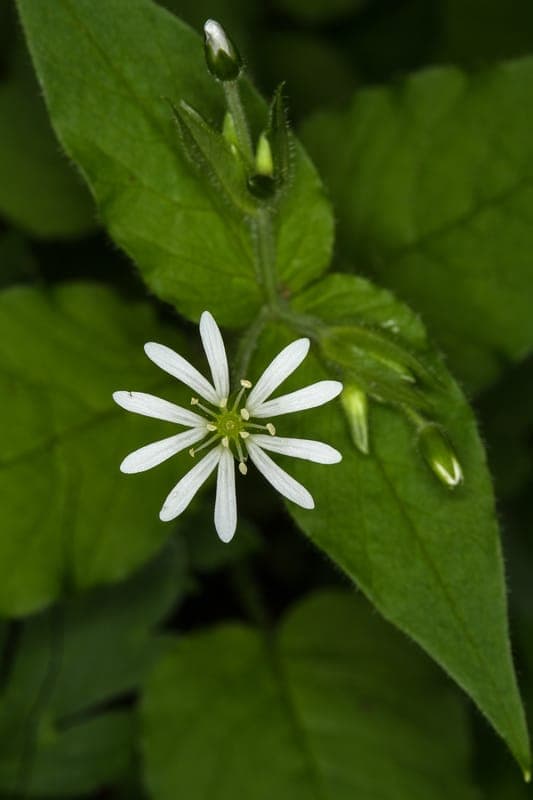
The plant grows as a compact, spreading herb, typically reaching heights of 20 to 40 centimeters. Thin, green stems are often hairy and bear opposite, lance-shaped leaves. Flowers are small and white, appearing in loose clusters from May to July. These delicate blooms consist of five split petals, giving the plant an elegant appearance.
Ideal Location
Wood stitchwort prefers dappled shade to full shade. This makes it ideal for woodland edges, under trees, and in dark corners of your garden. In full sun and dry conditions, the plant will not perform as well.
Soil
The soil should be moist and humus-rich. Provide nutrient-rich soil with plenty of organic matter, such as compost or leaf mold. The plant is not very particular about pH but prefers slightly acidic to neutral soil.
Diseño gratis
¿Quieres ver Wood stitchwort: complete guide en tu jardín? Crea un diseño gratis ahora.
Watering
Keep the soil consistently moist, especially during the growing season. Wood stitchwort tolerates wet feet well, so drought is worse than excess water. Water regularly, especially during dry periods. In winter, you can reduce watering to a minimum.
Pruning
Wood stitchwort requires minimal pruning. You can remove spent flowers to stimulate blooming. After the flowering period, you can prune leggy growth to keep the plant more compact.
Maintenance Calendar
In spring, apply compost and remove old leaves if necessary. During the growing season, weed regularly and monitor moisture. After flowering, remove self-sown seedlings if you do not want self-seeding. In autumn, leave fallen leaves as winter protection.
Winter Hardiness
Wood stitchwort is fully hardy throughout northern Europe. The plant can withstand severe frost without extra protection. Above-ground parts may die back, but the root system will survive the winter.
Companion Plants
Wood stitchwort grows well with other woodland plants such as Hepatica, Maianthemum dilatatum, and Veronica hederifolia. Combined with ferns and moss, it creates a natural woodland atmosphere.
Conclusion
Wood stitchwort is a beautiful woodland plant for those seeking subtle beauty in a shady garden. Thanks to its minimal requirements and elegant growth and flowering, this plant deserves a place in every woodland garden. For more information and inspiration, visit gardenworld.app/en.
¿Quieres ver Wood stitchwort: complete guide en tu jardín? Crea un diseño gratis ahora.
Sube una foto, elige un estilo y obtén un diseño fotorrealista con lista de plantas en menos de un minuto.
Más de 10.000 jardines diseñados
Sin tarjeta de crédito


Plantas similares
Dianthus karami: complete guide
Dianthus karami
Dianthus karami is a rare Lebanese mountain pink with fringed pink blooms on limestone cliffs, ideal for rock gardens and troughs.
Sicilian pink: complete guide
Dianthus siculus
Discover Dianthus siculus, an elegant purple bloomer from Sicily. Cultivation, June-September flowering and garden combinations.
Alpine mouse-ear chickweed: complete guide
Cerastium pedunculatum
Full growing guide for Cerastium pedunculatum: ideal location, soil, watering, winter hardiness, and companion plants for rock gardens.