
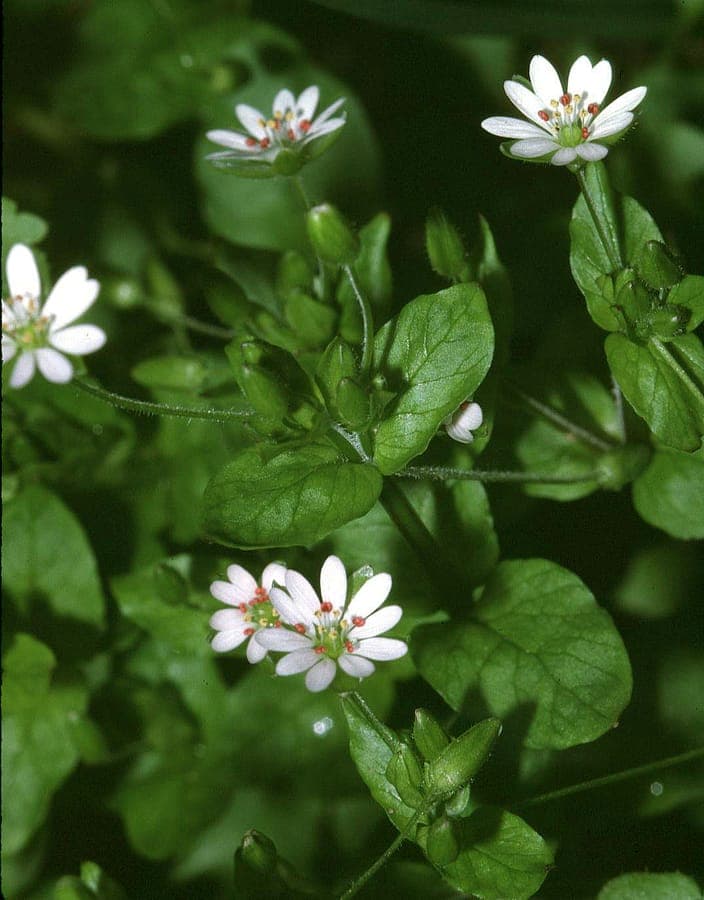
de:Benutzer:Fornax / Public domain, via Wikimedia Commons
Greater chickweed: complete guide
Stellaria neglecta
¿Quieres ver Greater chickweed: complete guide en tu jardín?
1 minuto, sin tarjeta de crédito
Overview
Greater chickweed (Stellaria neglecta), also called hedgerow chickweed or larger stitchwort, is a lush herbaceous plant from the Caryophyllaceae family. This plant naturally grows in Europe through temperate East Asia and North Africa in moist woodlands and woodland edges. The plant reaches 20-50 centimeters in height and forms an attractive groundcover with distinctly large white flowers.
Stellatia neglecta is a highly valuable alternative to the much finer-flowered Stellaria media. The larger flowers and more substantial appearance make this plant better suited for decorative garden use, while still offering the same versatility.
Appearance and bloom time
Greater chickweed is recognized by its distinctly larger flower structure than its relatives. The leaves are bright green, oval to elliptic, approximately 1-2 centimeters long, and grow opposite each other along fine stems.
Flowers appear from March through October in white clusters. Unlike Stellaria media, the flowers of Stellaria neglecta are considerably larger, up to 1 centimeter across. Each flower has five deeply divided petals. The flowers are often promoted by warmer periods.
After blooming, seed pods form that split open to release seed. The plant grows dense and compact and remains neat without much pruning.
Ideal location
Greater chickweed thrives best in locations with partial shade to half-shade. The plant also accepts full sun in temperate climates. In warm, dry environments, half-shade provides better growth and prevents premature bolting.
The plant is ideal for woodland edges, wet ditches, and under shrubs. In mixed borders, it functions well as a foreground plant. The plant is also suitable for larger stone gardens and along watercourses.
Ensure the location has good air circulation without strong winds. A place with reasonable moisture availability during the growing season is ideal.
Soil requirements
Greater chickweed grows best in moist to wet, well-draining soil. The plant tolerates both acidic and neutral soils (pH 6.0-7.5). A soil profile with much organic material is ideal.
When planting, compost or peat substitute can be mixed into the soil. This plant does not tolerate dry periods well. However, drainage must be sufficient to prevent waterlogging in winter.
Nutrient requirements are moderate. Heavy fertilization is not necessary and can even be harmful. A light annual application of compost in spring suffices.
Diseño gratis
¿Quieres ver Greater chickweed: complete guide en tu jardín? Crea un diseño gratis ahora.
Watering
Greater chickweed must receive regular water during the growing season. The soil should be kept moist but not waterlogged. Very dry periods should be avoided.
In container culture, regular watering is essential. Check daily whether the soil is moist. However, ensure water does not stagnate in the pot.
In ground culture, a layer of organic mulch (2-3 centimeters) helps promote moisture retention and limit moisture fluctuations.
Pruning
Greater chickweed requires virtually no pruning when grown in the right environment. After summer flowering, spent flower stems can be removed for neater appearance.
In spring, older plants can be carefully cleaned by removing dead stem material. This is best done in March-April.
Deadheading during the flowering period can limit flowering promotion. It is better to allow seed formation or remove only very wilted parts.
Maintenance calendar
March-April: Clean plant material from winter. Add nutrient-rich compost. Check moisture availability.
May-June: Observe the first flowering. Ensure regular watering. Weed carefully.
July-August: Enjoy full bloom. Check moisture needs. Seed will disperse naturally.
September-October: Fall blooming possible. Manage moisture. Add mulch.
November-December: Minimal maintenance. Plant covers itself with dead leaf material.
January-February: Prevention of water loss through freezing is important.
Winter hardiness
Greater chickweed is fully winter hardy to -15 degrees Celsius and suitable for the UK and Northern Europe. The plant overwinters without protection. In very severe winters, above-ground parts may die, but roots usually survive and produce new shoots in spring.
The plant can self-seed, ensuring continuous coverage. This self-seeding mechanism makes it a very reliable groundcover.
The canopy of autumn and winter foliage provides protection against extreme frost.
Companion plants
Greater chickweed combines well with other moisture-loving plants. Ferns such as male fern fit well. Ivy can also be used as a climbing plant over the chickweed.
In wet places, it grows well alongside water plants. Carex species create interesting texture contrasts. Small heathers can be planted alongside.
In natural plantings, combine with low structural plants such as creeping juniper. Chickweed provides interesting contrast in gardens with much stonework.
Closing thoughts
Greater chickweed is a valuable plant for moist, woodland-like gardens. The attractively large flowers and dense growth habit make it a better choice than many related species.
On gardenworld.app you can use greater chickweed in wet zones and woodland edges. Also on gardenworld.app you will find ideas for moisture-loving plant combinations.
With regular moisture availability and proper placement, greater chickweed forms a beautiful, long-lasting groundcover.
¿Quieres ver Greater chickweed: complete guide en tu jardín? Crea un diseño gratis ahora.
Sube una foto, elige un estilo y obtén un diseño fotorrealista con lista de plantas en menos de un minuto.
Más de 10.000 jardines diseñados
Sin tarjeta de crédito


Plantas similares
Dianthus karami: complete guide
Dianthus karami
Dianthus karami is a rare Lebanese mountain pink with fringed pink blooms on limestone cliffs, ideal for rock gardens and troughs.
Sicilian pink: complete guide
Dianthus siculus
Discover Dianthus siculus, an elegant purple bloomer from Sicily. Cultivation, June-September flowering and garden combinations.
Alpine mouse-ear chickweed: complete guide
Cerastium pedunculatum
Full growing guide for Cerastium pedunculatum: ideal location, soil, watering, winter hardiness, and companion plants for rock gardens.