
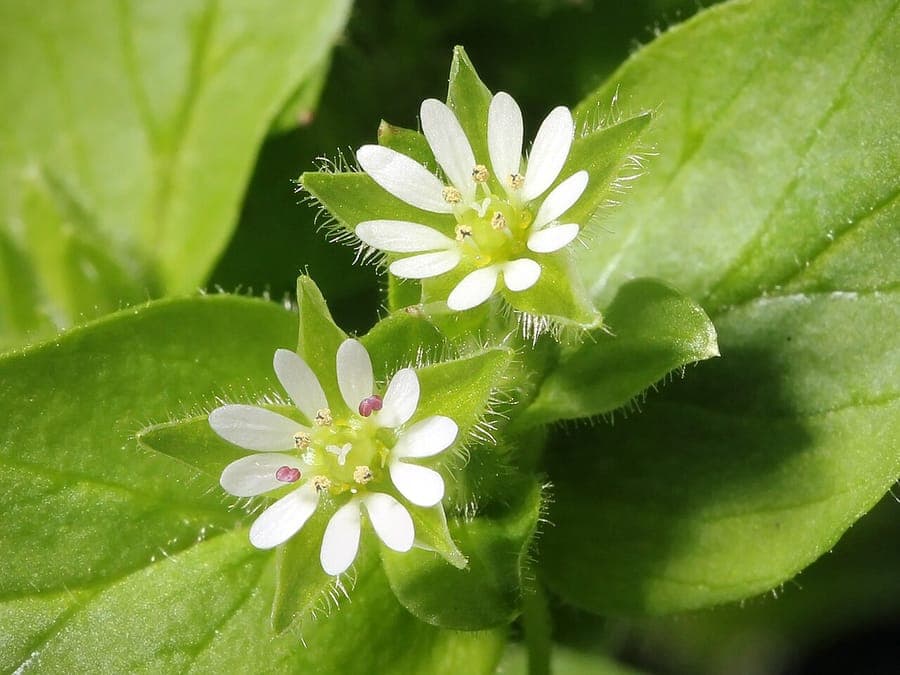
Kaldari / CC0, via Wikimedia Commons
Common chickweed: complete guide
Stellaria media
¿Quieres ver Common chickweed: complete guide en tu jardín?
1 minuto, sin tarjeta de crédito
Overview
Common chickweed (Stellaria media), also called mouse-ear chickweed or stitchwort, is a highly versatile herb from the Caryophyllaceae family. This herb naturally grows throughout Eurasia and North Africa in moist places. It typically reaches 10-40 centimeters in height and forms a soft, leafy plant with small white flowers.
Common chickweed is a traditional food herb that has been used by people and animals for centuries. The leaves are soft, juicy, and mildly peppery in flavor. The herb grows extremely quickly and can be harvested multiple times per year, making it perfect for food production in small spaces.
Appearance and bloom time
Common chickweed is easily recognized by its soft, succulent stems and oval leaves. The leaves are bright green, approximately 1-2 centimeters long, and grow opposite each other along the stems. Noteworthy is the row of small hairs along the stems.
Flowers appear almost year-round in small white clusters. Each flower has five deeply divided petals that give a star-like appearance. The flowers are only a few millimeters across. After pollination, small seed pods form.
The plant grows extremely fast and can reach harvestable size within 4-6 weeks from seedling. This makes it ideal for continuous harvesting or as a green manure between other crops.
Ideal location
Common chickweed grows best in locations with partial shade to full sun. The plant accepts virtually all light levels. In very warm climates, partial shade provides better growth and prevents premature bolting.
The plant can be grown both in open ground and in pots and containers. For continuous harvest, multiple pots or seed trays can be used started at different times.
Ensure the location is protected from strong winds, which can damage the delicate leaves. A place with reasonable air circulation helps prevent fungal conditions.
Soil requirements
Common chickweed grows best in nutrient-rich, moist soil with good organic matter content. The plant tolerates both acidic and neutral soils. A pH between 6.0-7.5 is ideal. The soil must not dry out.
Ripe compost or peat substitute material can be mixed into the soil for better moisture retention. For container culture, a mixture of garden soil and compost (1:1) works well.
Heavy potash fertilization is not necessary, but nitrogen promotes rapid growth and leaf production. Half-strength plant food is much better than full strength.
Watering
Common chickweed must be watered regularly and evenly. The soil should remain moist but not waterlogged. During the growing season, daily checks should be made for water needs.
In dry periods, common chickweed can wilt quickly if water is lacking. Be careful to water in early morning or late evening to prevent moisture problems.
In container culture, regular watering is essential. Check soil moisture daily and ensure the pot has good drainage holes.
Diseño gratis
¿Quieres ver Common chickweed: complete guide en tu jardín? Crea un diseño gratis ahora.
Pruning
Common chickweed is harvested rather than pruned. Regular harvesting stimulates more growth. Snip the young leaf tops with scissors or pick with your fingers when the plant is approximately 10-15 centimeters tall.
In this way, you can harvest the plant 3-4 times per growing season. Always leave a few leaves at the bottom of the plant so it can continue to grow.
Although common chickweed self-seeds readily, you can prevent seed formation by harvesting regularly. This also helps to produce young, tender leaves continuously.
Maintenance calendar
February-March: Plant seed in prepared soil or pots. Set warm if starting indoors.
April-May: First harvest when plant is 10-15 centimeters tall. Plant successive crop for continuous supply.
June-July: Regular harvesting stimulates more growth. Water well during warm periods.
August-September: Follow same harvesting schedule. Plant fall crop in early September.
October-November: Later season harvesting possible under glass or in sheltered location.
December-January: Minimal cultivation in warm climates; in cold areas, common chickweed can be replanted in spring as an annual.
Winter hardiness
Common chickweed is only winter hardy to around -5 to 0 degrees Celsius. It typically behaves as an annual or short-lived plant. In mild winters, the plant can persist and even self-seed.
In cold regions, you can grow common chickweed year-round under glass, or reseed in spring. The plant grows so quickly that complete harvests are possible even in short growing seasons.
Self-seeding is normal and can be used to maintain a continuous supply of common chickweed.
Companion plants
Common chickweed combines well in vegetable plots with other herb crops. It grows well next to spinach and arugula due to similar growing conditions. Common chickweed is however very competitive and can crowd out other seedlings.
As a green manure between other crops, it grows well and enriches the soil with organic matter. It dies back quickly in winter, which is useful.
In herb gardens, common chickweed can be planted with parsley and dill, although separate beds are better.
Closing thoughts
Common chickweed is an exceptional plant that offers many practical benefits. Whether you grow it for food, as green manure, or simply out of curiosity, common chickweed deserves a place in your garden or kitchen.
On gardenworld.app you can include common chickweed in herb spirals and food production systems. Also on gardenworld.app you will find ideas for intensive vegetable and herb cultivation in small spaces.
With regular harvesting and simple care, common chickweed produces food all season long.
¿Quieres ver Common chickweed: complete guide en tu jardín? Crea un diseño gratis ahora.
Sube una foto, elige un estilo y obtén un diseño fotorrealista con lista de plantas en menos de un minuto.
Más de 10.000 jardines diseñados
Sin tarjeta de crédito


Plantas similares
Dianthus karami: complete guide
Dianthus karami
Dianthus karami is a rare Lebanese mountain pink with fringed pink blooms on limestone cliffs, ideal for rock gardens and troughs.
Sicilian pink: complete guide
Dianthus siculus
Discover Dianthus siculus, an elegant purple bloomer from Sicily. Cultivation, June-September flowering and garden combinations.
Alpine mouse-ear chickweed: complete guide
Cerastium pedunculatum
Full growing guide for Cerastium pedunculatum: ideal location, soil, watering, winter hardiness, and companion plants for rock gardens.