
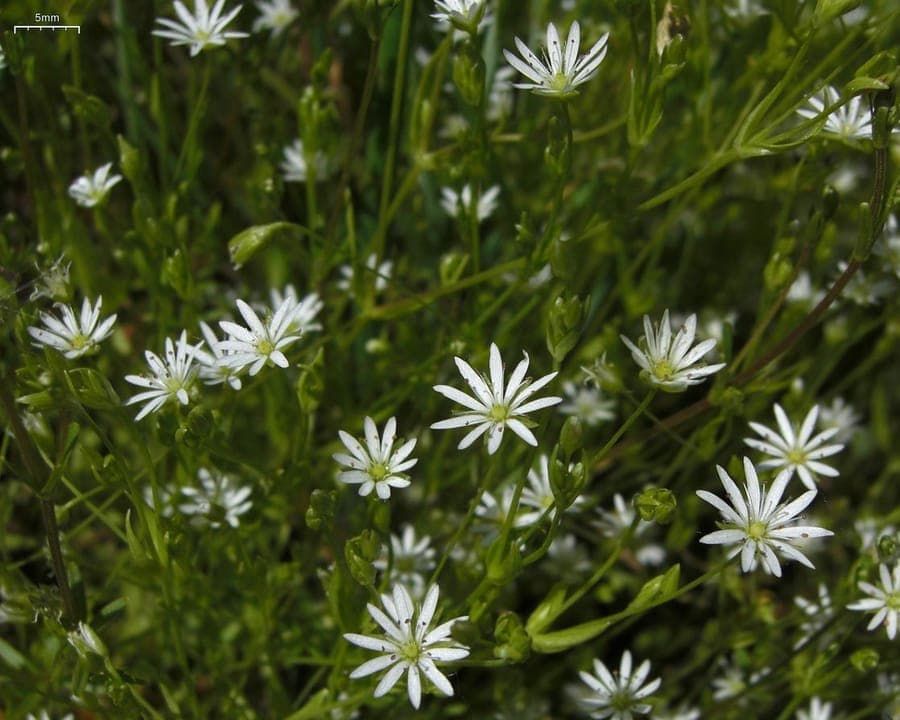
pellaea / CC BY 2.0, via Wikimedia Commons
Longleaf starwort: complete guide
Stellaria longifolia
¿Quieres ver Longleaf starwort: complete guide en tu jardín?
1 minuto, sin tarjeta de crédito
Overview
The Longleaf starwort, scientifically Stellaria longifolia, is a slender herbaceous plant from the carnation family (Caryophyllaceae). This plant is widespread across much of the northern hemisphere - from North America to Europe and Asia. It is known for its fine, lance-shaped leaves and tiny white star-shaped flowers that appear in late spring and summer.
The Longleaf starwort is a frost-hardy herb that grows in wet, moist soils. The plant reaches 10-40 cm in height and forms loose, branched stems with numerous flowers. Although small and inconspicuous, this plant offers delicate elegance to alpine gardens and moist corners.
Appearance & bloom
The plant has narrow, lance-shaped leaves that grow in pairs along the stems. These leaves are dark green and have a fine texture. The stems are slender and branched, giving an airy appearance.
White flowers appear from May to July, small but numerous. Each flower is only 4-5 mm across and has five split petals forming a star shape. The flowers are followed by tiny seed pods that self-seed and perpetuate naturally.
Ideal location
Place the Longleaf starwort in a spot with half-shade to shade. The plant grows best in moist environments without strong midday sun. In southern zones, partial light can prevent plants from drying out.
The plant prefers moist, cool locations. Wet meadows, mountain edges, and waterside plantings are ideal. Protection from extreme heat and drought is important.
Diseño gratis
¿Quieres ver Longleaf starwort: complete guide en tu jardín? Crea un diseño gratis ahora.
Soil requirements
The Longleaf starwort grows well in moist, well-drained soils. The plant thrives in both sandy and clay soils as long as they are moist. A neutral to slightly acidic pH (6.0-7.0) is ideal.
Organic matter improves soil structure and moisture retention. In dry soils, plenty of compost should be added.
Watering
Water regularly so the soil never dries out completely. The plant prefers soil that is moister than normal. In hot periods, daily watering may be needed. Drip irrigation is ideal.
The plant is suited to boggy spots where other plants don't grow. However, waterlogging must be avoided.
Pruning
Pruning is not necessary for this plant. The plant grows naturally compact. Remove dead parts in spring. Since the plant self-seeds, you can harvest seed before it disperses.
Maintenance calendar
Spring: Remove dead foliage. Sow seed in moist soil. Summer: Water regularly. Enjoy the flowers. Fall: Collect seed if desired for next year. Winter: Minimal care.
Winter hardiness
The Longleaf starwort is very hardy to USDA zone 3-4. It survives temperatures to -35 degrees Celsius. The plant is very frost-resistant and needs no winter protection.
Companion plants
Combine with other moisture-loving plants like Veratrum, Filipendula, and other alpine flora. The delicate flowers contrast nicely with larger foliage sculptures.
Closing
The Longleaf starwort offers fine, delicate flowers for moist gardens. This plant thrives where others don't and adds natural elegance to alpine gardens and waterside plantings. With minimal care, this plant flowers year after year.
Visit gardenworld.app for more inspiration about alpine plants and moisture-loving plants. Discover more garden designs and planting advice at gardenworld.app.
¿Quieres ver Longleaf starwort: complete guide en tu jardín? Crea un diseño gratis ahora.
Sube una foto, elige un estilo y obtén un diseño fotorrealista con lista de plantas en menos de un minuto.
Más de 10.000 jardines diseñados
Sin tarjeta de crédito


Plantas similares
Dianthus karami: complete guide
Dianthus karami
Dianthus karami is a rare Lebanese mountain pink with fringed pink blooms on limestone cliffs, ideal for rock gardens and troughs.
Sicilian pink: complete guide
Dianthus siculus
Discover Dianthus siculus, an elegant purple bloomer from Sicily. Cultivation, June-September flowering and garden combinations.
Alpine mouse-ear chickweed: complete guide
Cerastium pedunculatum
Full growing guide for Cerastium pedunculatum: ideal location, soil, watering, winter hardiness, and companion plants for rock gardens.