
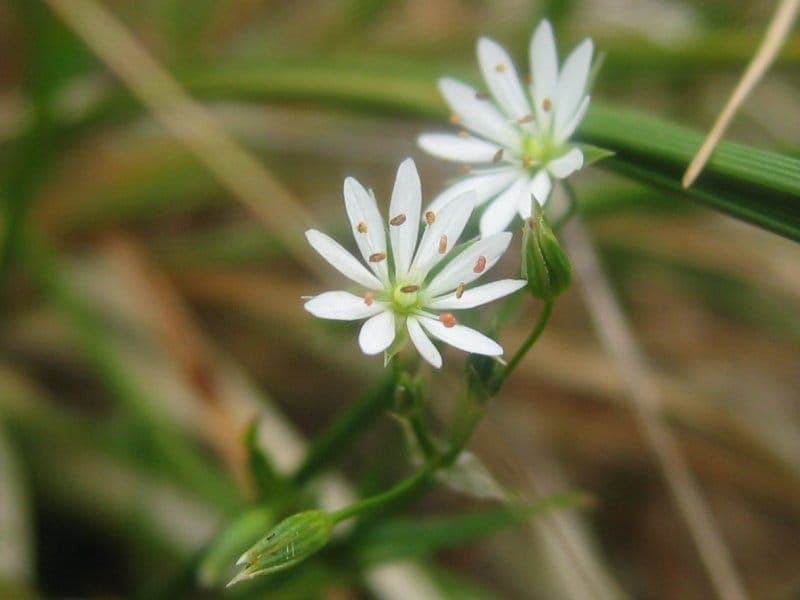
Kristian Peters -- Fabelfroh 07:15, 26 September 2006 (UTC) / CC BY-SA 3.0, via Wikimedia Commons
Grass-leaf starwort: complete guide
Stellaria graminea
¿Quieres ver Grass-leaf starwort: complete guide en tu jardín?
1 minuto, sin tarjeta de crédito
Overview
Grass-leaf starwort (Stellaria graminea) is a delicate herbaceous plant from the Caryophyllaceae family. This plant naturally grows in grassy woodlands and grasslands in Europe through Siberia to the Himalayas. The plant reaches only 15-30 centimeters in height and forms an elegant carpet of fine foliage and white flowers.
Stellatia graminea is an undervalued plant that offers much interest in half-shaded zones of the garden. The fine, grassy foliage provides elegant contrast with other plants, while the numerous white flowers in May and June attract small insects.
Appearance and bloom time
Grass-leaf starwort is easily recognized by its fine, grassy leaves. The leaves are narrow lance-shaped and about 1 centimeter long. They grow opposite each other along fine stems. The plant forms a dense, compact growth that does not exceed 30 centimeters in height.
Flowers appear from May through August in small white clusters. Each flower has five deeply divided petals, giving a characteristic star-like shape (hence the name Stellaria, derived from stella - star). The flowers are approximately 0.5 centimeters in diameter.
After flowering, small seed pods form that open carefully to release fine seed. The plant reaches its full beauty around May-June when the flowers are at their peak.
Ideal location
Grass-leaf starwort thrives best in locations with partial shade to half-shade. The plant also grows in full sun, but in warm, dry areas will benefit from half-shade.
The plant is ideal for planting along woodland edges, wet meadows, and under shrubs. In mixed borders, the plant can be used as a foreground plant for larger structural plants. The plant fits well in natural gardens.
Ensure the location has good opportunities for moisture management, as this plant prefers moist soil. A location without significant drying is therefore ideal.
Soil requirements
Grass-leaf starwort grows best in moist to wet, well-draining soil. The plant tolerates both acidic and neutral soils (pH 6.0-7.5). A soil profile containing much organic material is ideal.
When planting, compost or peat substitute can be mixed into the soil to improve moisture capacity. This plant does not tolerate drying out well. However, drainage must be sufficient to prevent waterlogging in winter.
Nutrient requirements are moderate. Heavy fertilization is not necessary; rather, this can lead to excessive foliage at the expense of flowering. A light application of compost in spring is sufficient.
Diseño gratis
¿Quieres ver Grass-leaf starwort: complete guide en tu jardín? Crea un diseño gratis ahora.
Watering
Grass-leaf starwort should receive regular water, especially in the first year. The soil should be kept moist during the growing season, but not soggy or waterlogged. Very dry periods should be avoided.
In container culture, regular watering is essential. Check daily whether the soil becomes wetter; if the surface feels dry, water immediately. However, ensure water does not stagnate in the pot.
In ground culture, a layer of organic mulch (2-3 centimeters) helps promote moisture retention and limit moisture fluctuations.
Pruning
Grass-leaf starwort requires virtually no pruning. After flowering, spent flower stems can be removed to maintain a neater appearance. This sometimes stimulates re-flowering.
In spring, older plants can be carefully tidied by removing dead stem material. This is best done in March-April after the danger of frost.
Deadheading during the flowering period (May-June) can extend the flowering duration by preventing seed formation.
Maintenance calendar
March-April: Clean winter debris. Add moisture-rich compost. Check moisture availability.
May-June: Enjoy the flowers. Perform deadheading to extend flowering. Ensure regular watering.
July-August: Check moisture needs. Seed can disperse naturally.
September-October: Manage moisture in dry autumns. Add mulch.
November-December: Minimal maintenance. Plant covers itself with fallen leaves.
January-February: Prevention of drying through freezing is important.
Winter hardiness
Grass-leaf starwort is fully winter hardy to -20 degrees Celsius and suitable for all of the UK and Northern Europe. The plant overwinters without protection on average. In very severe winters, the above-ground parts may die, but roots usually survive.
The plant is a biennial or short-lived perennial and can self-seed to regenerate. This ensures continued coverage in the planting area.
The canopy of autumn and winter foliage provides self-protection against extreme frost.
Companion plants
Grass-leaf starwort combines well with other small, grassy groundcovers. Sedge species (Carex) work well with the plant due to similar texture enhancement. Small fuchsias can be planted alongside for more color.
The plant fits well in mixed plantings with other spring bloomers such as forget-me-nots and anemones. Ivy can be used as a climbing plant over the starwort.
Moss-like plants can also be used in combination. Natural groundcover combinations work well with this plant.
Closing thoughts
Grass-leaf starwort is an elegant, delicate plant that has much to offer those who appreciate subtle beauty. The fine leaf texture and delicate white flowers make it a valuable addition to shady corners.
On gardenworld.app you can use grass-leaf starwort as a foreground plant in mixed borders. Also on gardenworld.app you will find ideas for natural plant combinations with small groundcovers.
With regular moisture availability and correct placement, grass-leaf starwort forms a reliable, attractive cover.
¿Quieres ver Grass-leaf starwort: complete guide en tu jardín? Crea un diseño gratis ahora.
Sube una foto, elige un estilo y obtén un diseño fotorrealista con lista de plantas en menos de un minuto.
Más de 10.000 jardines diseñados
Sin tarjeta de crédito


Plantas similares
Dianthus karami: complete guide
Dianthus karami
Dianthus karami is a rare Lebanese mountain pink with fringed pink blooms on limestone cliffs, ideal for rock gardens and troughs.
Sicilian pink: complete guide
Dianthus siculus
Discover Dianthus siculus, an elegant purple bloomer from Sicily. Cultivation, June-September flowering and garden combinations.
Alpine mouse-ear chickweed: complete guide
Cerastium pedunculatum
Full growing guide for Cerastium pedunculatum: ideal location, soil, watering, winter hardiness, and companion plants for rock gardens.