
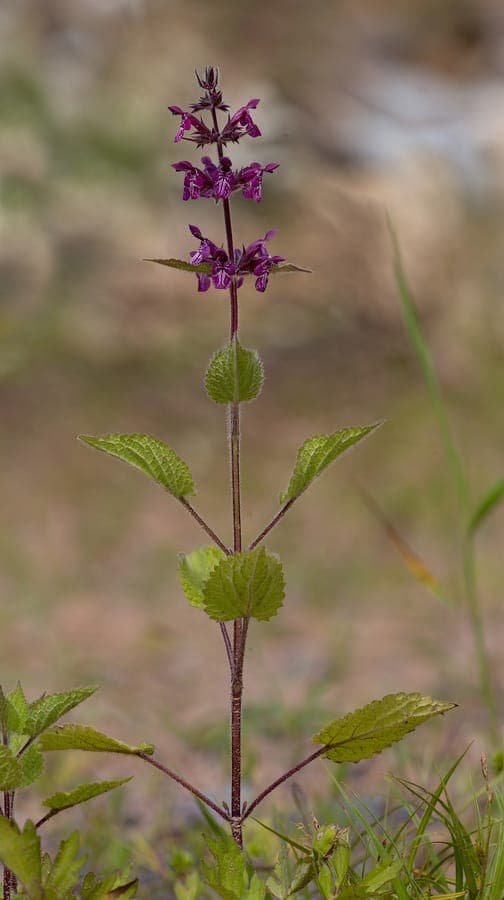
Andreas Trepte / CC BY-SA 2.5, via Wikimedia Commons
Hedge woundwort: complete guide
Stachys sylvatica
¿Quieres ver Hedge woundwort: complete guide en tu jardín?
1 minuto, sin tarjeta de crédito
Overview
Hedge woundwort (Stachys sylvatica), also called Woodland hedge-nettle or Wald-Ziest in German, is an attractive herbaceous plant from the mint family. This plant naturally grows throughout Europe and into West Asia in partial-shade woodlands and along water margins. The plant typically reaches 30-60 centimeters in height and produces abundant flowers throughout the summer.
Stachys sylvatica is an excellent choice for gardeners seeking a low-growing plant that attracts bees and butterflies. The flowers appear in rich purple-pink tones and form distinctive flower spikes along the stems. This makes the plant both practical as a groundcover and visually appealing in shady garden corners.
Appearance and bloom time
Hedge woundwort is easily recognized by its characteristic leaves and flowering pattern. The leaves are green, oval to lance-shaped, and have a rough texture. They grow opposite each other along the stem and release a distinctive scent when rubbed, setting this plant apart from other Stachys species.
Flowers appear from June through September in dense flower spikes. Each flower has four stamens and the typical two-lipped form characteristic of the mint family. The flower color ranges from pink to purple. This extended flowering period makes hedge woundwort a valuable plant for the summer season in the garden.
The plant forms a dense growth habit that functions well as groundcover. The stems are hairy and red-purple at the base. As the growing season progresses, the foliage can take on a red-purple tint, especially when exposed to bright light.
Ideal location
Hedge woundwort thrives best in partial shade to full shade locations. In heavy shade, the plant may produce fewer flowers. The plant tolerates full sun but benefits from partial shade in warm climates to prevent drying out.
In the garden, place hedge woundwort near other shade-loving plants such as ferns, ivy, and other woodland plants. The plant grows well along woodland edges, under shrubs, and beside water features. It is an ideal plant for difficult locations where other species struggle.
It is important that the location has sufficient air circulation to prevent fungal issues. Ensure water does not stagnate around the foliage, especially during rainy periods.
Soil requirements
Hedge woundwort is not fussy about soil conditions but grows best in moderately moist to moist soil. The plant tolerates both acidic and neutral soils (pH 7.0-7.5). Well-draining soil is important to prevent root rot.
The plant thrives in normal garden soil enriched with humus. With heavy clay soils, we recommend working in sand or compost for better drainage. Fresh compost or organic material worked into the planting hole promotes establishment and growth.
Nutrient requirements are moderate. An annual application of compost in spring is usually sufficient. Heavy fertilization leads to excessive foliage and fewer flowers, so this should be avoided.
Diseño gratis
¿Quieres ver Hedge woundwort: complete guide en tu jardín? Crea un diseño gratis ahora.
Watering
Newly planted specimens need regular watering during dry periods, especially during the first growing seasons. Once established, hedge woundwort is reasonably drought-tolerant, although regular water promotes better flowering.
During severe drought, water the plant at least once per week thoroughly. However, hedge woundwort does not tolerate waterlogged soil. Ensure good-draining soil and avoid waterlogging, especially in winter.
When grown in containers, keep the soil regularly moist but not wet. Check that the top centimeter of potting soil is dry before watering again.
Pruning
Hedge woundwort can be cut back after flowering in September or October. This promotes more compact growth and helps maintain a neater appearance. Cut back about one-third to one-half of the length.
During the growing season, you can remove spent flowers to encourage further blooming. This process is known as deadheading. Cut just below the flower spike without damaging the foliage below.
With older plants, you can apply harder pruning in spring (March-April) to stimulate rejuvenation. Cut back to approximately 10 centimeters height.
Maintenance calendar
March-April: Clean the plant of dead stems from winter. Apply compost and cut back hard if rejuvenation is needed.
May-June: Check regularly for watering needs. Remove weeds around the plant.
July-September: Enjoy the flowers. Remove spent flower spikes. Ensure adequate water during dry periods.
October-November: Cut back the plant after flowering. Optionally cover with a layer of organic mulch for winter protection in severe winters.
December-February: Minimal maintenance. Check for moisture buildup after heavy rainfall.
Winter hardiness
Hedge woundwort is fully winter hardy to -15 degrees Celsius. The plant is suitable for all of the UK and Northern Europe and overwinters without protection. In very severe winters, the above-ground parts may die back, but the roots usually survive and produce new shoots in spring.
In extremely cold regions with temperatures below -20 degrees Celsius, a layer of mulch (5-8 centimeters) can carefully be applied in November to protect the roots.
The plant usually does not die back completely to ground level in mild climates, so you will find leaf remains in winter. These can be carefully removed in spring.
Companion plants
Hedge woundwort combines well with other shade-loving plants. Ferns such as male fern and lady fern form good combinations. Ivy can also be used as a climbing plant in combination with hedge woundwort.
The plant works well with other low-growing groundcovers such as creeping juniper. Hydrangeas can be added to hedge woundwort for more structure.
Hedge woundwort also grows well with other Stachys species, although you should watch for self-seeding. Combine with Helleborus for winter interest and Carex for grassy texture.
Closing thoughts
Hedge woundwort is a versatile plant that offers both functional and visual benefits. The attractive purple flowers attract beneficial insects, while compact growth solves the buttercup problem in difficult shade areas.
On gardenworld.app you will find inspiration for designing shade gardens with hedge woundwort as one of the basic plants. You can also access specific designs on gardenworld.app for shady corners.
With minimal maintenance and maximum flower power, hedge woundwort is a welcome addition to any garden.
¿Quieres ver Hedge woundwort: complete guide en tu jardín? Crea un diseño gratis ahora.
Sube una foto, elige un estilo y obtén un diseño fotorrealista con lista de plantas en menos de un minuto.
Más de 10.000 jardines diseñados
Sin tarjeta de crédito


Plantas similares
Apple mint (Mentha x villosa): complete guide
Mentha x villosa
Meet apple mint (Mentha x villosa): a fruity-scented kitchen herb with woolly leaves, perfect for tea and mojitos.
Salvia peyronii: complete guide
Salvia peyronii
Discover Salvia peyronii, a rare Lebanese mountain sage. Growing tips, hardiness, and companion planting for a Mediterranean gravel garden.
Bigleaf mint (Mentha x rotundifolia): complete guide
Mentha x rotundifolia
Discover bigleaf mint: cultivation, care tips, and garden uses. Learn how to grow this aromatic herb with soft, hairy leaves.