
Unknown authorUnknown author / Public domain, via Wikimedia Commons
Sorbus scopulina: complete guide
Sorbus scopulina
¿Quieres ver Sorbus scopulina: complete guide en tu jardín?
1 minuto, sin tarjeta de crédito
Overview
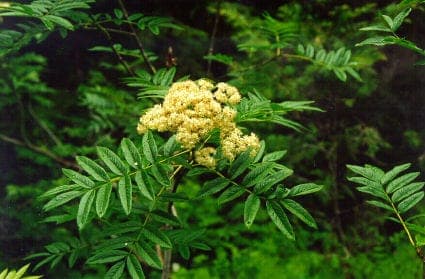
Sorbus scopulina, commonly known as Greene's mountain ash or cascade mountain ash, is a graceful tree from the Rosaceae family. This plant originates from North America, particularly from mountainous and subalpine regions of western North America. The tree is characterized by its white flowers and bright red fruit. This is an excellent plant for cold climates and mountainous gardens.
Greene's mountain ash is a hardy, ornamental tree that attracts many insects and birds. The tree is popular in gardens where durability and wildlife food are important.
Appearance and bloom
Sorbus scopulina grows as a multi-stemmed tree to shrub with moderate growth rate. The tree reaches heights of 4 to 8 meters under ideal conditions. The leaves are compound, consisting of 9 to 15 leaflets, and turn beautiful yellow to orange in fall. The flowers are white to cream-white and appear in broad, flat flower clusters in May to June.
After flowering, numerous red to orange-red fruits develop. These fruits persist on the tree for extended periods and provide abundant food for birds in fall and winter. The fruits are approximately 5-8 millimeters in size.
Ideal location
Sorbus scopulina thrives best in full sun to partial shade locations. At least 4-6 hours of sunlight daily is ideal. The tree tolerates some shade, though full sun promotes more optimal growth and flower production.
The tree is very cold-loving and grows better on cold mountainsides and in temperate climates. The tree is also very winter-hardy and tolerates frost well.
Soil quality
Sorbus scopulina thrives on varied soils, from acidic to neutral. A pH of 5.5 to 7.0 is ideal. The tree prefers well-draining soil and does not tolerate waterlogged conditions well. A well-draining, moderately fertile soil is optimal.
The tree also grows well in mountainous, stony soils and can tolerate stony, poor soils. Adding organic matter helps growth in very poor soils.
Diseño gratis
¿Quieres ver Sorbus scopulina: complete guide en tu jardín? Crea un diseño gratis ahora.
Watering
Sorbus scopulina tolerates well once established. Water regularly the first years after planting. The tree tolerates drought reasonably well once root system is established.
Water during dry periods in the growing season. In open ground, extra watering is usually not needed except during prolonged droughts. Container-grown trees need more regular watering.
Pruning
Minimal pruning is usually necessary. Remove dead or damaged branches in spring. Shape can be adjusted by removing large branches.
The tree grows naturally in a pleasing form, so much pruning is not needed. Only crooked or crossed branches should be removed.
Maintenance calendar
March to April: Spring maintenance. Remove dead wood. Check for pests.
May to June: Flowering period. Water regularly during dry periods. Feeding can be applied.
July to September: Fruit development. Water regularly. Feeding can be given.
October to February: Winter dormancy. No care needed. Fruit persists for bird feeding.
Winter hardiness
Sorbus scopulina is very winter-hardy and can tolerate temperatures down to -30 degrees Celsius. This makes it an ideal plant for cold regions. The tree tolerates long, cold winters very well.
Even in very harsh winters where many other trees suffer damage, this tree usually remains healthy. The tree needs no winter protection.
Companion plants
Sorbus scopulina combines well with other hardy trees and shrubs. White-flowering plants such as Crabapple and Hawthorn form beautiful combinations. Blue-flowering plants such as Delphinium and Veronica form attractive contrasts.
In bird gardens, it combines well with other bird-feeding plants. The red fruits attract many birds, making it a valuable plant for bird watching.
Closing
Sorbus scopulina is a preferred choice for cold climates where winter hardiness is important. With beautiful white flowers and abundant red fruit, this is a highly ornamental and functional tree for bird gardens. With minimal maintenance care and great winter hardiness, this is a perfect low-maintenance element for mountainous and cold regions. Visit gardenworld.app for more information about hardy trees. Consider this beautiful mountain ash for your garden design on gardenworld.app!
¿Quieres ver Sorbus scopulina: complete guide en tu jardín? Crea un diseño gratis ahora.
Sube una foto, elige un estilo y obtén un diseño fotorrealista con lista de plantas en menos de un minuto.
Más de 10.000 jardines diseñados
Sin tarjeta de crédito


Plantas similares
Siberian crab apple: complete guide
Malus x robusta
Complete guide to the Siberian crab apple (Malus x robusta): location, soil, pruning, winter hardiness and the best companion plants for your garden.
Chinese flowering crabapple (Malus x spectabilis): complete guide
Malus x spectabilis
Meet the Chinese flowering crabapple (Malus x spectabilis): a classic spring bloomer with carmine buds and pink blossom.
Potentilla crassinervia: complete guide
Potentilla crassinervia
Potentilla crassinervia, the Corsican cinquefoil, grows wild on Corsica and Sardinia's peaks. Discover how to grow this hardy alpine rock garden gem.