
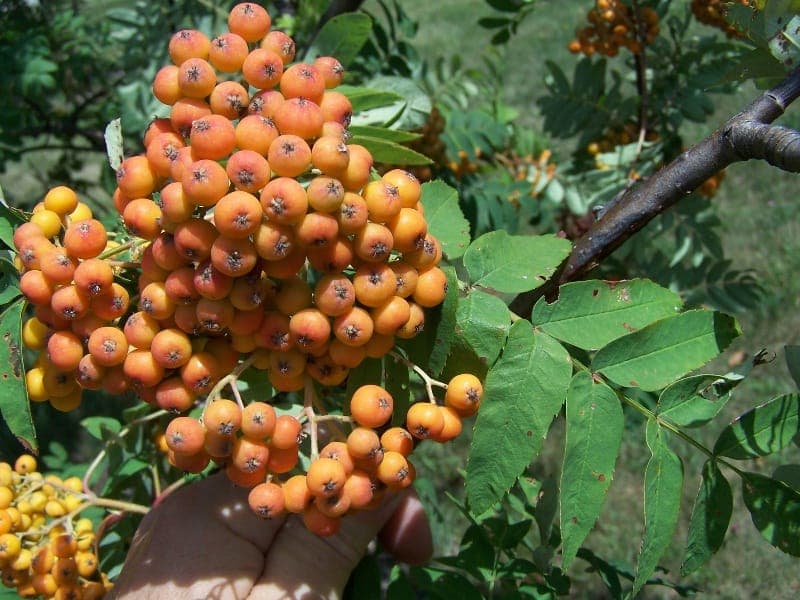
Bruce Marlin / CC BY-SA 2.5, via Wikimedia Commons
American mountain-ash: complete guide
Sorbus americana
¿Quieres ver American mountain-ash: complete guide en tu jardín?
1 minuto, sin tarjeta de crédito
Overview
The American mountain-ash (Sorbus americana) is an impressive tree from eastern Canada and the United States. This member of the Rosaceae family is known for its white spring flowers and especially its stunning orange berries in autumn. The tree naturally grows in mountainous areas, which is why it's also called mountain-ash.
This tree is a perfect choice for those who want to enjoy visual beauty throughout the season. From delicate spring flowers to brilliant fall colors and bird food, Sorbus americana offers many benefits for the home garden designer. It attracts birds and contributes to local biodiversity.
Appearance and bloom
In spring (May-June), the American mountain-ash displays beautiful white flowers that cluster in dense bunches. This inflorescence attracts numerous pollinators. The compound leaves are finely toothed and green, with lovely fall coloring into red-orange.
The most characteristic feature, however, is the orange to red-orange berries that ripen in August-September. These berries often remain on the tree well into winter, providing food for birds when other food is scarce. The tree reaches a height of 6 to 10 meters with an upright growth habit.
Ideal location
The American mountain-ash thrives best in a sunny to partly shaded location. For optimal blooming and berry production, however, full sun is recommended. The tree is fairly wind-resistant and can handle cold well. Use it as a specimen tree, in small groves, or as part of a mixed tree row.
The tree is also a good choice for somewhat wilder, natural gardens. Plant it where you can observe bird activity in fall and winter. Ensure adequate space around the tree for optimal growth.
Soil
Sorbus americana grows best on well-draining soil with a pH between 5.3 and 6.8. This means acidic soils are ideal. The tree can adapt to various soils, but prefers loose, organic soil with adequate nutrition.
Heavy clay or stagnant soils should be avoided. Add humus at planting to improve the soil. In early years, a layer of mulch around the stem helps retain moisture and regulate temperature.
Watering
During the first growing and establishment year (especially the first year), Sorbus americana needs regular moisture. Water your tree deeply and infrequently rather than lightly and often. This promotes strong root development.
Once established (after 1-2 years), the tree is fairly drought-tolerant and handles normal rainfall well. In very dry summers, supplemental watering may be needed, especially for young trees. Ensure water drains well to prevent root rot.
Diseño gratis
¿Quieres ver American mountain-ash: complete guide en tu jardín? Crea un diseño gratis ahora.
Pruning
The American mountain-ash generally needs little pruning. A natural growth form is usually most appreciated. However, remove dead, damaged, or diseased wood annually. If you want to keep the tree more compact, you can gently thin the top after flowering.
Avoid aggressive pruning as it can undermine tree structure. A well-maintained central leader ensures a strong, healthy crown.
Maintenance calendar
- March-April: Planting work. Tree begins to emerge from winter dormancy.
- May-June: Bloom period. Enjoy the white flower clusters.
- July-August: Berries form and begin to color. Regular watering if dry.
- September-October: Berries ripen to orange-red. Fall foliage colors. Bird activity increases.
- November-December: Berries remain hanging. Bird feeding likely at peak. Leaf drop complete.
- January-February: Winter time. Minimal maintenance. Prune dead wood.
Winter hardiness
Sorbus americana is very winter hardy and can easily tolerate temperatures down to -30 degrees Celsius. The tree is thus ideal for Dutch and German winters. No special frost protection is needed. The tree naturally grows in subalpine and boreal environments in North America.
Even in very harsh climates, the tree can grow without problems. This makes it ideal for gardeners in more northern regions.
Companion plants and combinations
The American mountain-ash combines nicely with other native North American or similar trees. Think American maple, white pine, and native birches. For a more mixed setting, it pairs beautifully with shrub producers like forsythia or magnolia.
In bird gardens, it works excellently as a central tree in combination with shrubs that provide insect food. The bird activity around the berries attracts robins, thrushes and other bird species.
Summary
The American mountain-ash is a fantastic tree choice for those who want to combine structure, seasonal interest, and bird-friendliness. With beautiful spring flowers, lovely fall colors, and orange berries that attract birds, this tree provides visual enjoyment year-round. Both functionally and aesthetically, it's a valuable addition to any landscape.
Want more insight into this and other tree species? Explore gardenworld.app for comprehensive plant guides and design your next garden with biologically proven plant choices.
¿Quieres ver American mountain-ash: complete guide en tu jardín? Crea un diseño gratis ahora.
Sube una foto, elige un estilo y obtén un diseño fotorrealista con lista de plantas en menos de un minuto.
Más de 10.000 jardines diseñados
Sin tarjeta de crédito


Plantas similares
Siberian crab apple: complete guide
Malus x robusta
Complete guide to the Siberian crab apple (Malus x robusta): location, soil, pruning, winter hardiness and the best companion plants for your garden.
Chinese flowering crabapple (Malus x spectabilis): complete guide
Malus x spectabilis
Meet the Chinese flowering crabapple (Malus x spectabilis): a classic spring bloomer with carmine buds and pink blossom.
Potentilla crassinervia: complete guide
Potentilla crassinervia
Potentilla crassinervia, the Corsican cinquefoil, grows wild on Corsica and Sardinia's peaks. Discover how to grow this hardy alpine rock garden gem.