
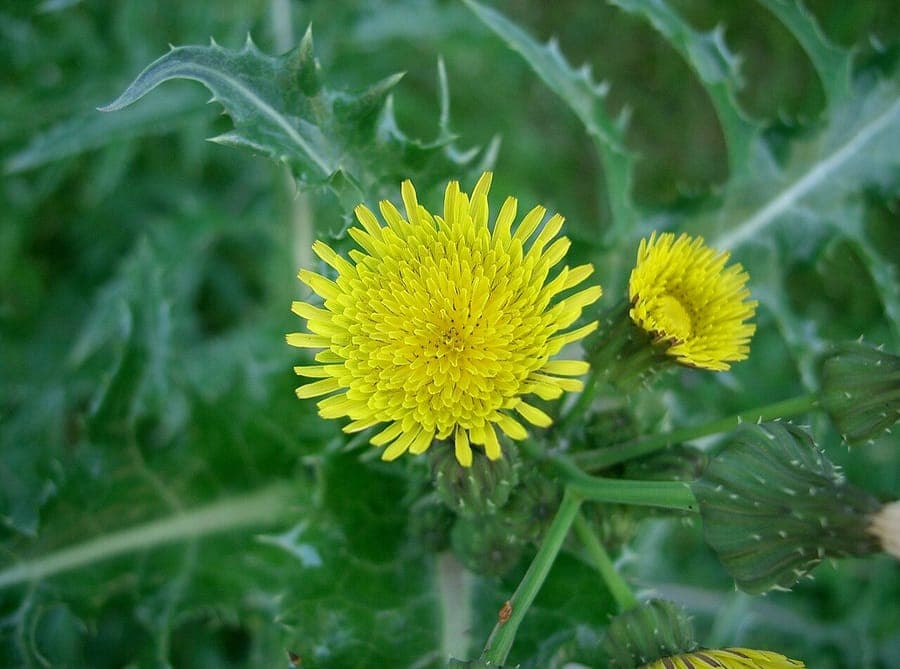
KENPEI / CC BY-SA 3.0, via Wikimedia Commons
Rough milk thistle: complete guide
Sonchus asper
¿Quieres ver Rough milk thistle: complete guide en tu jardín?
1 minuto, sin tarjeta de crédito
Overview
Rough milk thistle (Sonchus asper) is an annual plant with characteristic prickly leaves and golden flowers. This species naturally occurs from warm Europe to Africa and the Sahel. Despite its weed status, the plant has traditional medicinal applications and provides insect food. In gardens, this plant enables interesting experiments.
Rough milk thistle grows quickly and can crowd other plants. The plant is not winter-hardy and dies at frost. Control seed spread to prevent recolonization. The plant is easily removed by pulling.
Appearance and bloom cycle
Rough milk thistle grows 30-100 cm tall with upright, branching stems. Leaves are highly characteristic: glossy, deeply lobed with very sharp spines on leaf edges and veins. The sap is milky flowing from broken parts. The plant has a rough appearance hence the name.
Golden flowers appear May through October forming small clusters. Each floret measures roughly 1.5 cm wide and entirely golden. After flowering, seed heads form beautiful white plumes. Seeds spread by wind widely.
Ideal location
Rough milk thistle thrives in full sun with six hours daily sunlight. The plant is not soil-picky and grows even on marginal land. Part shade is less ideal but plant grows there too.
Use this plant in experimental corners or as weed observation. The plant unsuitable for formal borders. Grow in containers to control spread.
Soil requirements
Rough milk thistle grows on very diverse soils including contaminated ground. The plant is extremely robust and low-maintenance. Drainage not critical. Dry to moderately moist soils suit.
Weakly to moderately fertile soil appropriate. Plant grows even on very poor or contaminated ground.
Diseño gratis
¿Quieres ver Rough milk thistle: complete guide en tu jardín? Crea un diseño gratis ahora.
Watering
Rough milk thistle is very drought-tolerant once established. Plant grows well without supplemental water. Waterlogging does not harm the plant. In containers more regular watering needed.
Avoid waterlogging. Well-draining soil aids drainage.
Pruning
Rough milk thistle requires minimal pruning. After flowering, spent stems can be removed. This helps prevent seed development and natural spread. If plant self-seeds, seed can create weeds next spring.
Remove entire plant before seeds ripen to prevent spread.
Maintenance calendar
May: Seedlings start. Monitor young plants. June-August: Vigorous growth. Blooming begins. August-October: Flowering period. Prevent seed set. October-November: Seed ripening. Remove plant before seed set. November-December: Plant dies at frost.
Winter hardiness
Rough milk thistle is not winter-hardy and dies at frost. This is an annual plant so winter protection inappropriate. Plant dies naturally in November-December in temperate climate.
Companion plants
Rough milk thistle combines with:
- Other annuals (experimental mix)
- Other weeds (wildflower mode)
- Insect-friendly plants (bee support)
Most suited to experimental or wild corners.
Conclusion
Rough milk thistle is a rough, interesting experiment for those exploring wild gardening. The plant can become invasive so regular monitoring required. Visit gardenworld.app for more weed identification and management. Also available on gardenworld.app for advice. Grow in containers for control.
¿Quieres ver Rough milk thistle: complete guide en tu jardín? Crea un diseño gratis ahora.
Sube una foto, elige un estilo y obtén un diseño fotorrealista con lista de plantas en menos de un minuto.
Más de 10.000 jardines diseñados
Sin tarjeta de crédito


Plantas similares
Calendula stellata: complete guide
Calendula stellata
Complete guide to Calendula stellata, the star-flowered marigold from Sicily: location, soil, watering and companion planting tips.
Korean chrysanthemum: complete guide
Chrysanthemum x rubellum
Chrysanthemum x rubellum is a hardy autumn perennial with single pink to copper flowers from August to November. Care and combinations.
Helianthus divaricatus: complete guide
Helianthus divaricatus
Helianthus divaricatus is a North American woodland sunflower with yellow summer blooms, ideal for naturalistic borders and shady edges.