
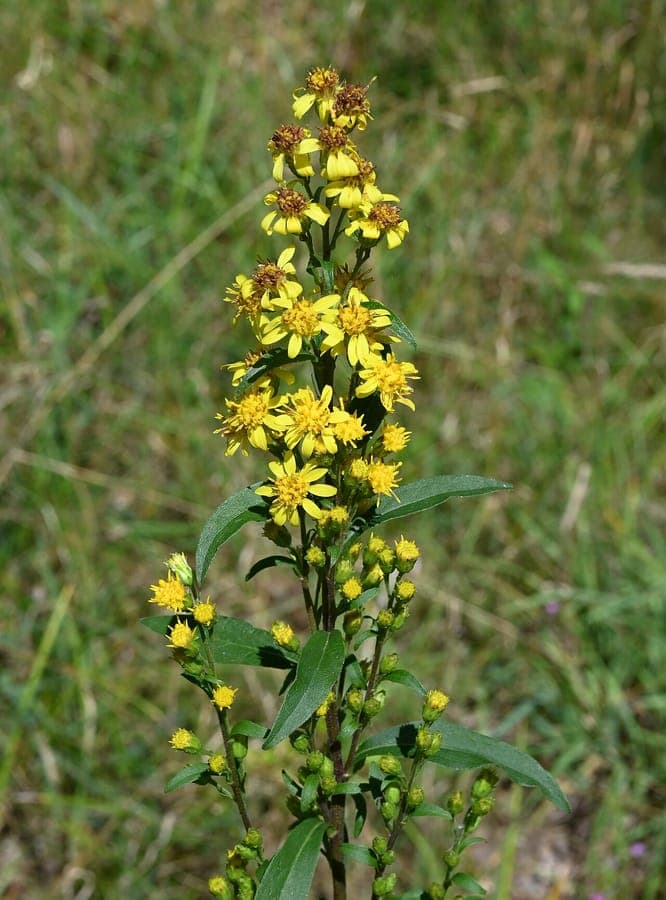
Krzysztof Ziarnek, Kenraiz / CC BY-SA 4.0, via Wikimedia Commons
European goldenrod: complete guide
Solidago virgaurea
¿Quieres ver European goldenrod: complete guide en tu jardín?
1 minuto, sin tarjeta de crédito
Overview
European goldenrod (Solidago virgaurea) is a native European perennial, distinct from North American species. This species grows 40-80 cm tall and remains compact compared to relatives. Natural distribution extends from West Europe to Central Siberia. In many European countries, this is the only native goldenrod species.
European goldenrod spreads slowly from seeds and underground roots but never forms invasive populations. The plant suits small gardens and front-border plantings due to its moderate height. The plant is completely winter-hardy and demands minimal maintenance.
Appearance and bloom cycle
This compact plant features upright, finely branching stems with many side shoots. Leaves are linear with matte green color and fine hairs. Stems remain mostly green with only light color changes.
Golden flowers appear in August-October forming compact, composed plumes. The flower clusters are narrower and more restrained than American species. Numerous insects visit the blooms. After flowering, tiny seeds disperse by wind.
Ideal location
European goldenrod performs best in full sun to part shade. Six hours daily sunlight is ideal but the plant tolerates light shade. In deep shade, growth becomes leggy.
Use this compact species in front borders, for foreground plantings in larger borders, or in small rock gardens. The plant suits containers and pots on terraces. The flowers work well for cutting.
Soil requirements
European goldenrod grows on diverse soils from sandy to heavy clay loam. Ideally pH 5.5-6.5 but the plant accepts neutral to weakly alkaline. Drainage is important.
Weakly fertile soil is ideal. Overly rich soil encourages floppy growth. Average garden soils suit without amendments.
Diseño gratis
¿Quieres ver European goldenrod: complete guide en tu jardín? Crea un diseño gratis ahora.
Watering
European goldenrod is drought-tolerant once established. Water regularly during the first growing season. Later, rainfall usually suffices, especially in mixed borders.
On very sandy soil, supplemental water during dry periods helps. Avoid waterlogging. Good drainage is essential.
Pruning
Minimal pruning needed. After fading in October-November, cut spent stems to 5 cm above ground. This creates neater appearance and promotes dense growth the following spring.
The plant already grows naturally compact, so tip pinching is unnecessary. Remove any excessively tall stems if desired.
Maintenance calendar
April-May: Growth begins. Plant remains small initially. June-July: Vigorous growth, reaches final height. August-October: Flowering and seed set. November: Remove spent flowers. December: Cut back to 5 cm.
Winter hardiness
European goldenrod is fully hardy throughout Europe to USDA zone 2 (-40°C). The plant overwinters completely underground. No winter protection needed.
The plant withstands frost, snow, and cold winds without issue. In milder climates, plants grow even larger.
Companion plants
European goldenrod combines well with:
- Asters (purple, pink forms) - bloom simultaneously
- Sedums (autumn tints)
- Chrysanthemums (colored forms)
- Low ornamental grasses
- Lavender (color contrast)
Particularly suited to mixed borders with other compact species.
Conclusion
European goldenrod is an authentic native choice for those wanting to support European wildflora. The compact growth makes this species ideal for small gardens. Visit gardenworld.app for more plant guides and gardening advice. Also find this species on gardenworld.app for detailed plant positioning. Some garden centers stock this native goldenrod.
¿Quieres ver European goldenrod: complete guide en tu jardín? Crea un diseño gratis ahora.
Sube una foto, elige un estilo y obtén un diseño fotorrealista con lista de plantas en menos de un minuto.
Más de 10.000 jardines diseñados
Sin tarjeta de crédito


Plantas similares
Calendula stellata: complete guide
Calendula stellata
Complete guide to Calendula stellata, the star-flowered marigold from Sicily: location, soil, watering and companion planting tips.
Korean chrysanthemum: complete guide
Chrysanthemum x rubellum
Chrysanthemum x rubellum is a hardy autumn perennial with single pink to copper flowers from August to November. Care and combinations.
Helianthus divaricatus: complete guide
Helianthus divaricatus
Helianthus divaricatus is a North American woodland sunflower with yellow summer blooms, ideal for naturalistic borders and shady edges.