
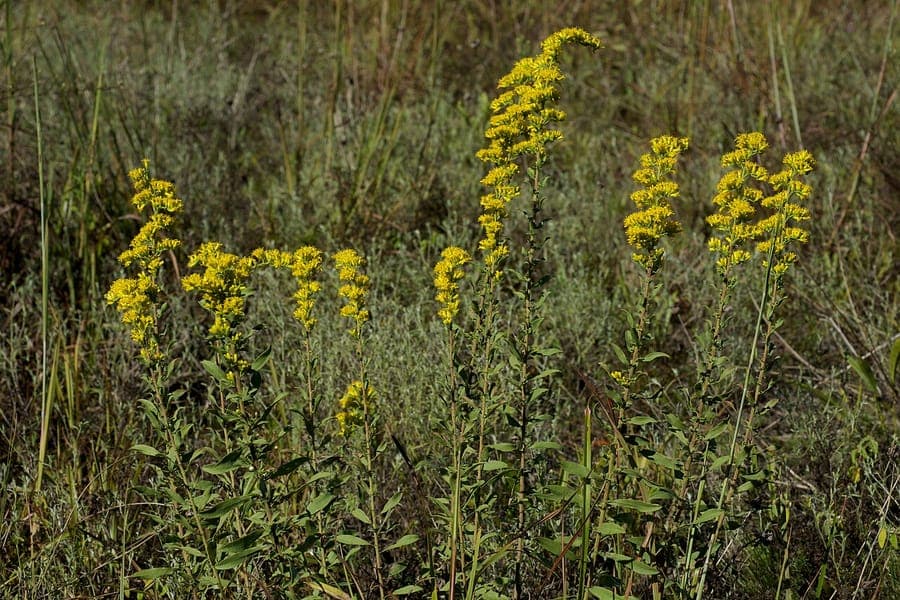
Eric in SF / CC BY-SA 4.0, via Wikimedia Commons
Old-field goldenrod: complete guide
Solidago nemoralis
¿Quieres ver Old-field goldenrod: complete guide en tu jardín?
1 minuto, sin tarjeta de crédito
Overview
Solidago nemoralis, also known as old-field goldenrod or gray goldenrod, is a fascinating perennial plant from the Asteraceae family. This species naturally occurs throughout much of North America, from Canada to the United States, particularly in the Midwest and East. The plant is renowned for its dense, clustered golden-yellow flowers that appear from August to October. This is an essential plant for fall gardens and natural landscapes.
Appearance and bloom
Solidago nemoralis grows as an upright plant that typically reaches 60 to 90 centimeters in height. The plant has grayish-green stems (justifying the name gray goldenrod) with fine, linear leaves. From August to October, the characteristic clustered, densely-packed yellow flower plumes appear. The flowers attract numerous pollinators and butterflies. The plant blooms prolifically and provides texture to fall gardens.
Ideal location
Old-field goldenrod thrives best in full sun. The plant prefers sunny, heat-receptive locations where it can bloom abundantly. Light shade is tolerated but may limit flowering. This makes it ideal for borders, terrace gardens, and wild corners where golden fall colors are desired. It also plants well in groups for dramatic effect.
Soil
This plant is highly adaptable to various soil types. Solidago nemoralis grows on dry to moderately moist soils and tolerates virtually all pH levels. The plant prefers neutral to slightly acidic soils. It is not fussy about nutrition, though moderate soils support the plant. Well-draining soils help prevent root rot in extremely wet winters.
Watering
Once established, old-field goldenrod is quite drought-tolerant. The plant can thrive with normal rainfall in temperate climates. Young plants in their first growing season can benefit from regular watering. Mature plants are usually self-sufficient, though watering during prolonged dry summers can be beneficial.
Pruning
Old-field goldenrod responds well to pruning. For compact forms, you can cut back plants in June to July to about half their height, which stimulates bushiness and more flowers. This also prevents plants from becoming too tall and sparse. After the first frost, dead stems can be removed in fall. Light cleanup in spring helps remove dead wood and disease.
Diseño gratis
¿Quieres ver Old-field goldenrod: complete guide en tu jardín? Crea un diseño gratis ahora.
Maintenance calendar
Spring (March to May): Remove dead stems from winter. Begin feeding. Summer (June to August): Growth and shaping. Cut back in June-July for compact form. Fall (September to October): Enjoy golden flowers throughout season. Provide water. Winter (November to February): Plant rests. Remove dead stems.
Winter hardiness
Solidago nemoralis is fully hardy and suitable for all Dutch and German climates. The plant withstands severe frost without damage. Heavy snow can bend branches, but the plant recovers in spring. This makes it a reliable choice for permanent garden plantings.
Companion plants
Old-field goldenrod combines beautifully with other fall colors. Try it with asters (especially purple and white varieties), Rudbeckia, Echinacea, and other summer bloomers. It also pairs well with ornamental grasses and perennials with copper or brown tones. For a native North American corner, add it to groupings with native summer flowers.
Extra Informatie voor Succes
Wanneer je deze plant aanplant, wees geduldig in het eerste seizoen. De plant heeft tijd nodig om sterke wortels te ontwikkelen. In het tweede en derde seizoen zul je een dramatische groei en bloei zien. Dit is volkomen normaal en toont aan dat de plant zijn energie-investeringen in ondergrondse structuren heeft compleet gemaakt. Regelmatige monitoring in het eerste seizoen helpt je eventuele problemen snel op te sporen. Let vooral op waterbehoefte en zorg dat de plant niet onder competitie van onkruiden lijdt.
Deze plant is ook uitstekend geschikt voor tuineigenaren die meer biologische, natuurlijke aanpakken prefereren. Het vereist geen chemische inputs en gedijt goed in geleintegreerde tuinsystemen. De plant trekt veel voordelige insecten aan die je tuin helpen beschermen tegen ongewenste plaaginsecten.
Solidago nemoralis is a golden addition for anyone seeking fall colors and extended season value. The golden flowers and gray stems provide texture and color when most gardens fade. Visitors to gardenworld.app will find this a valuable component for fall-centric designs. Explore gardenworld.app for more fall colors and wild plant possibilities.
Solidago nemoralis is a golden addition for anyone seeking fall colors and extended season value. The golden flowers and gray stems provide texture and color when most gardens fade. Visitors to gardenworld.app will find this a valuable component for fall-centric designs. Explore gardenworld.app for more fall colors and wild plant possibilities.
¿Quieres ver Old-field goldenrod: complete guide en tu jardín? Crea un diseño gratis ahora.
Sube una foto, elige un estilo y obtén un diseño fotorrealista con lista de plantas en menos de un minuto.
Más de 10.000 jardines diseñados
Sin tarjeta de crédito


Plantas similares
Calendula stellata: complete guide
Calendula stellata
Complete guide to Calendula stellata, the star-flowered marigold from Sicily: location, soil, watering and companion planting tips.
Korean chrysanthemum: complete guide
Chrysanthemum x rubellum
Chrysanthemum x rubellum is a hardy autumn perennial with single pink to copper flowers from August to November. Care and combinations.
Helianthus divaricatus: complete guide
Helianthus divaricatus
Helianthus divaricatus is a North American woodland sunflower with yellow summer blooms, ideal for naturalistic borders and shady edges.