
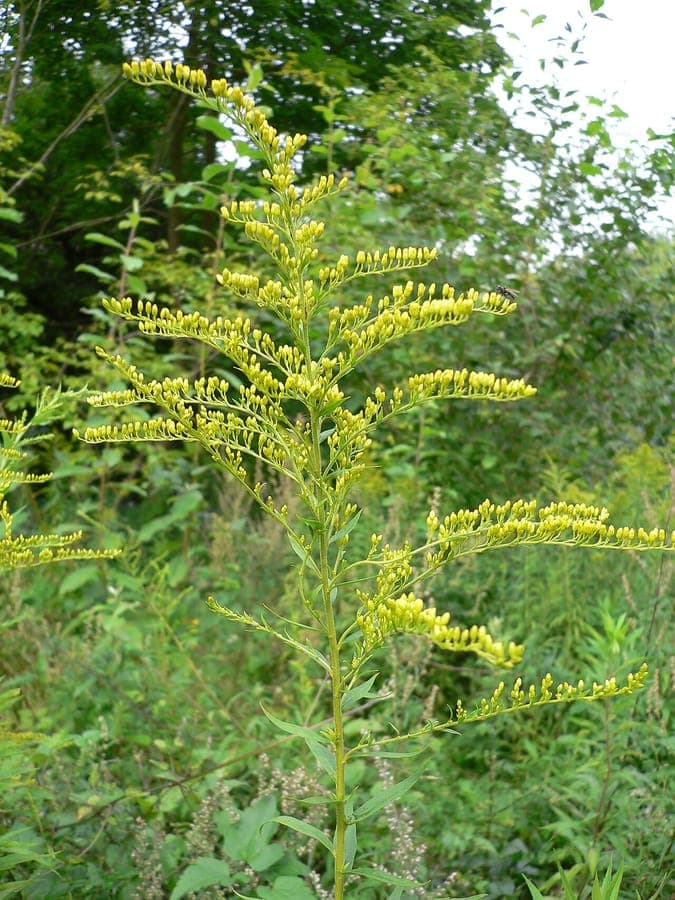
Georg Slickers / CC BY-SA 4.0, via Wikimedia Commons
Canadian goldenrod: complete guide
Solidago canadensis
¿Quieres ver Canadian goldenrod: complete guide en tu jardín?
1 minuto, sin tarjeta de crédito
Overview
Canadian goldenrod (Solidago canadensis) is a robust perennial that grows 60-150 cm tall, depending on location and conditions. This North American native has become a favorite in European gardens for its reliable golden-yellow flowers and exceptional value to pollinators. The plant naturally ranges from subarctic America to Mexico and thrives equally well in European climates.
Canadian goldenrod is non-toxic and completely unrelated to ragweed despite its common name. Many misconceptions surround this plant regarding allergies, but research shows it plays no role in pollen allergies. The plant spreads via seeds and underground runners, making it ideal for informal borders and wildlife areas. With a lifespan of many years, it forms stable clumps that return faithfully season after season.
Appearance and bloom cycle
The plant has an upright, branching growth habit with numerous stiff stems. Leaves are linear to lance-shaped with a matte green appearance. Stems frequently develop reddish tints, especially on mature plants. The overall form is airy yet substantial.
Flowers appear from late August and peak in September-October. The blooms form dense, plume-like panicles composed of hundreds of tiny golden-yellow florets. These flowers attract tremendous insect activity including bees, butterflies, and hoverflies. Seeds ripen in October-November and are distributed by wind.
Ideal location
Canadian goldenrod performs best in full sun to part shade, requiring at least 5-6 hours of direct sunlight daily for compact growth and abundant flowering. In deeper shade, plants become leggy and flower less profusely.
The plant is adaptable to most sites. Choose an open location with good air circulation to minimize fungal issues. Use it in mixed borders, wild gardens, or for cutting. The flower stems are durable as cut flowers, lasting 10-14 days indoors.
Soil requirements
Canadian goldenrod tolerates a wide range of soil types from sandy to loamy. Soil pH between 5.5-6.5 is ideal, though the plant adapts to neutral and weakly alkaline soils. Excellent drainage is essential as the plant resists waterlogged conditions.
Moderately fertile soil suits this plant best. Adding compost at planting helps, but excess fertility causes floppy growth with reduced flowering. The plant actually thrives on lean to moderately fertile soils.
Diseño gratis
¿Quieres ver Canadian goldenrod: complete guide en tu jardín? Crea un diseño gratis ahora.
Watering
Canadian goldenrod is reasonably drought-tolerant once established. During the first growing season, water regularly until roots are well-developed. Thereafter, rainfall usually suffices.
Supplement with water during extended dry periods, especially on sandy soils. Waterlogging is more damaging than temporary drought, so ensure good drainage. Container plants require more frequent watering.
Pruning
The plant requires minimal pruning. After flowering in November-December, cut back spent stems to about 5 cm above ground. This creates a tidier appearance and promotes dense growth the following spring.
Optionally, pinch stem tips in late May or early June to encourage branching and create more compact plants. This produces more flowers but slightly smaller blooms. Remove weak or overcrowded shoots throughout the season.
Maintenance calendar
March: First shoots emerge. Remove any dead foliage from previous year. May-June: Vigorous growth. Pinch tips if wanting more compact plants. August-October: Flowering period. Enjoy the golden blooms and insect activity. October-November: Seed ripening. Cut stems if you want to prevent self-seeding. December: Cut back to 5 cm for neat winter appearance.
Winter hardiness
Canadian goldenrod is fully hardy throughout Europe to USDA zone 2 (-40°C). The plant overwinters completely underground and re-emerges in March-April each year. No special winter protection is needed, even in severely cold climates.
The plant withstands frost, snow, and cold winds without complaint. In milder zones, growth is even more vigorous and blooming extends further.
Companion plants
Canadian goldenrod pairs beautifully with:
- Asters (purple, pink forms) - bloom simultaneously with striking color contrasts
- Sedums (textured foliage, autumn tints)
- Rudbeckias (yellow blooms, later flowering)
- Chrysanthemums (overlapping bloom times)
- Ornamental grasses (form contrast)
Avoid pairing with very vigorous growers that might overwhelm the goldenrod.
Conclusion
Canadian goldenrod is a dependable autumn bloomer for any garden. With minimal maintenance and maximum pollinator value, this plant deserves a place in every border. Visit gardenworld.app for more gardening advice and plant expertise. Also explore gardenworld.app for our garden planner featuring detailed plant positioning. Most garden centers stock this popular perennial.
¿Quieres ver Canadian goldenrod: complete guide en tu jardín? Crea un diseño gratis ahora.
Sube una foto, elige un estilo y obtén un diseño fotorrealista con lista de plantas en menos de un minuto.
Más de 10.000 jardines diseñados
Sin tarjeta de crédito


Plantas similares
Calendula stellata: complete guide
Calendula stellata
Complete guide to Calendula stellata, the star-flowered marigold from Sicily: location, soil, watering and companion planting tips.
Korean chrysanthemum: complete guide
Chrysanthemum x rubellum
Chrysanthemum x rubellum is a hardy autumn perennial with single pink to copper flowers from August to November. Care and combinations.
Helianthus divaricatus: complete guide
Helianthus divaricatus
Helianthus divaricatus is a North American woodland sunflower with yellow summer blooms, ideal for naturalistic borders and shady edges.