
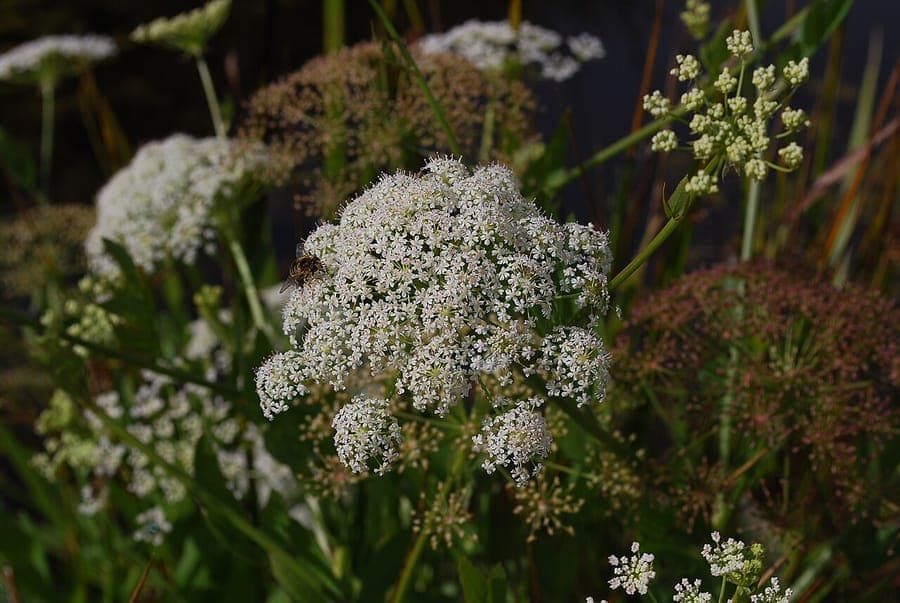
Jeremy Halls / CC BY-SA 2.0, via Wikimedia Commons
Great water-parsnip: complete guide
Sium latifolium
¿Quieres ver Great water-parsnip: complete guide en tu jardín?
1 minuto, sin tarjeta de crédito
Great water-parsnip (Sium latifolium) is an aquatic plant from the Apiaceae family, the same family as carrots and parsley. This aquatic plant grows naturally throughout Europe to Siberia and China. The plant is ideal for waterside areas, marshes and shallow water.
OVERVIEW
Great water-parsnip is a fascinating aquatic plant known for its broad, toothed leaves and abundant white flowers. The plant grows to about 60-100 centimeters and forms dense vegetation in water and marshy areas. The flowers appear from July to September as small white flowers in flat-topped clusters above water. The plant is a good forage plant for water willow and other aquatic animals.
APPEARANCE AND BLOOM
Great water-parsnip has elongated, doubly-pinnate leaves that are smooth and glossy. The leaves are dark green and have a fine texture. The stems are hollow and smooth. The flowers are small, white and appear in dense, flat clusters above the water. After flowering, small seeds form that are dispersed by water.
IDEAL LOCATION
Great water-parsnip thrives best in shallow water about 30 centimeters deep. The plant can also grow in wet, marshy soils. The plant loves full to partial sun. The plant can also grow in lightly shaded waters, though more sun leads to better growth.
SOIL
Great water-parsnip prefers muddy, nutrient-rich soil that is virtually always wet. The plant grows well in heavy clay soil and fine silt. The plant can adapt to a wide pH range of approximately 7.0 to 7.5. Rich soils with organic material support the best growth.
WATERING
Great water-parsnip is a naturally aquatic plant and requires water-saturated soil. The plant thrives in shallow still water or slowly flowing water. In gardens, you can plant the plant along waterbodies or in a marsh garden. Ensure the roots are always kept in water.
PRUNING
Great water-parsnip requires minimal pruning. You can remove spent flowers, though many gardeners leave them for decorative seed formation. The plant can be cut back in autumn by removing dead stems.
MAINTENANCE CALENDAR
Spring: Plant great water-parsnip in shallow waters or marshy zones. Ensure roots remain moist. Summer: Enjoy the white flowers as they appear. Provide adequate water levels. Fall: Remove spent portions. Winter: The plant dies off in very cold winters.
WINTER HARDINESS
Great water-parsnip is hardy in temperate climates. The plant can survive winters in deep waters where it can overwinter under ice. In very cold regions, the plant may die during extreme frosts.
COMPANION PLANTS
Great water-parsnip looks beautiful with other aquatic plants such as water mint, water iris and bank vegetation. It combines nicely with other white-flowering plants in waters.
CLOSING
Great water-parsnip is a fascinating aquatic plant ideal for marsh edges and waterside areas. With minimal maintenance requirements, it is perfect for water gardens. For more garden inspiration, visit gardenworld.app/en or gardenworld.app/en.
¿Quieres ver Great water-parsnip: complete guide en tu jardín? Crea un diseño gratis ahora.
Sube una foto, elige un estilo y obtén un diseño fotorrealista con lista de plantas en menos de un minuto.
Más de 10.000 jardines diseñados
Sin tarjeta de crédito


Plantas similares
Whorled carrot: complete guide
Daucus involucratus
Daucus involucratus is a Mediterranean umbellifer with white flower heads framed by lacy bracts. Growing this gravel garden gem.
Daucus muricatus: complete guide
Daucus muricatus
Daucus muricatus, the spiny wild carrot, grows wild on Mediterranean coasts. Discover sowing, June-July bloom, and wildflower meadow use.
Daucus pumilus: complete guide
Daucus pumilus
Daucus pumilus is a dwarf wild carrot relative with white lacy umbels, thriving on dunes and coastal rock in poor, fast-draining soil.