
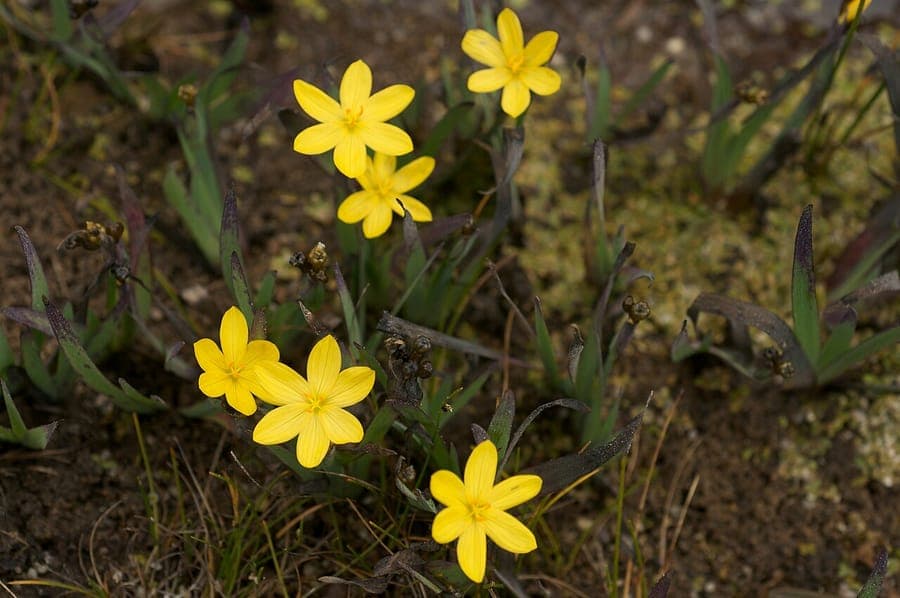
Eric Hunt / CC BY-SA 4.0, via Wikimedia Commons
Golden blue-eyed grass: complete guide
Sisyrinchium californicum
¿Quieres ver Golden blue-eyed grass: complete guide en tu jardín?
1 minuto, sin tarjeta de crédito
Overview
The Golden blue-eyed grass, scientifically Sisyrinchium californicum, is an elegant perennial from the iris family (Iridaceae). This North American native plant grows from California to British Columbia and is known for its fresh yellow flowers that appear in late spring and summer. The plant reaches a modest height of 20-45 cm, making it perfect for borders, rock gardens, and waterside plantings.
The Golden blue-eyed grass is a frost-hardy perennial that grows in USDA zones 5-10. It readily self-seeds and gradually forms expanding clumps. The slender, grass-like foliage gives the plant a light appearance, making it ideal for naturalistic borders.
Appearance & bloom
The Golden blue-eyed grass has narrow, linear leaves that grow in tufts. These leaves are dark green and can reach up to 30 cm long. The flowers are small, only 1-2 cm across, but very numerous and bright yellow.
Flowers appear from May to July, depending on location. They grow on thin stems that stand above the foliage. After blooming, small seed pods form that spread seeds naturally, enabling self-perpetuation. The foliage remains green year-round, forming an attractive shape.
Ideal location
Place the Golden blue-eyed grass in a spot with full sun to partial shade. The plant thrives best with 6 hours of sun daily. In warm climates, light afternoon shade can prevent leaf fading in the hottest hours.
The plant prefers moister locations over dry ones. In gardens with periodic high water tables, this plant feels at home. Protection from strong winds is not strictly necessary but prevents damage.
Soil requirements
The Golden blue-eyed grass grows well in moist soils. A soil with regularly moist conditions is ideal. The plant can even grow in shallow water and wetland areas and is often used at waterside plantings.
The soil can be poor in nutrients. Heavy, dense soils can be improved with sand and organic matter for better drainage. A pH of 5.5 to 7.0 is acceptable.
Diseño gratis
¿Quieres ver Golden blue-eyed grass: complete guide en tu jardín? Crea un diseño gratis ahora.
Watering
Water regularly so the soil remains moist. The plant thrives in moist conditions and can even tolerate brief periods of shallow water flooding. In very dry periods, supplemental watering may be needed.
Once established, supplemental watering is only needed in extreme droughts. In wet winters, drainage problems can develop, especially in clay soils.
Pruning
Pruning is simple for this plant. Remove spent flowers and seed pods after blooming for a neater appearance. However, many gardeners leave some seed pods for self-seeding.
Remove dead foliage in spring. Large, overgrown clumps can be carefully divided or thinned. This is best done in spring or fall.
Maintenance calendar
Spring: Remove dead foliage. Existing clumps can be divided. Plant new seedlings. Summer: Water as needed. Enjoy the flowers. Deadhead seed pods if desired. Fall: Collect seeds for next year. Prepare clumps for winter. Winter: Minimal care. Protect young plants from frost with mulch.
Winter hardiness
The Golden blue-eyed grass is very hardy to USDA zone 5. The plant survives temperatures to -30 degrees Celsius. In colder regions, mulch protection in first winters can help.
The plant is not sensitive to snow or frost damage. In wet winters, heavy soils can cause drainage problems.
Companion plants
Combine the Golden blue-eyed grass with other moisture-loving plants like Filipendula, Iris, and Astilbe. These combinations create beautiful water gardens.
In rock gardens, it fits well with other smaller perennials. Avoid aggressive growers that might overwhelm the delicate plant.
Closing
The Golden blue-eyed grass is a reliable, hardy perennial that thrives in scientifically moist gardens. With minimal care, this plant blooms year after year. Whether for formal gravel borders or natural waterside plantings, adding this plant means years of yellow beauty.
Visit gardenworld.app for more inspiration about perennials. Discover more garden designs and planting advice at gardenworld.app.
¿Quieres ver Golden blue-eyed grass: complete guide en tu jardín? Crea un diseño gratis ahora.
Sube una foto, elige un estilo y obtén un diseño fotorrealista con lista de plantas en menos de un minuto.
Más de 10.000 jardines diseñados
Sin tarjeta de crédito


Plantas similares
Iris tingitana: complete guide
Iris tingitana
Iris tingitana, the Morocco iris, is the bulb species behind the Dutch iris: early blue-violet blooms that need a sunny, well-drained position.
Iris hookeri: complete guide
Iris hookeri
Hooker's Iris is a compact North American native plant with blue flowers. Low-growing and moisture-loving water plant.
Siskiyou iris: complete guide
Iris bracteata
Complete guide to Iris bracteata, the Siskiyou iris: location, soil, bloom cycle, watering, pruning and companion plants for this rare Pacific Coast iris.