
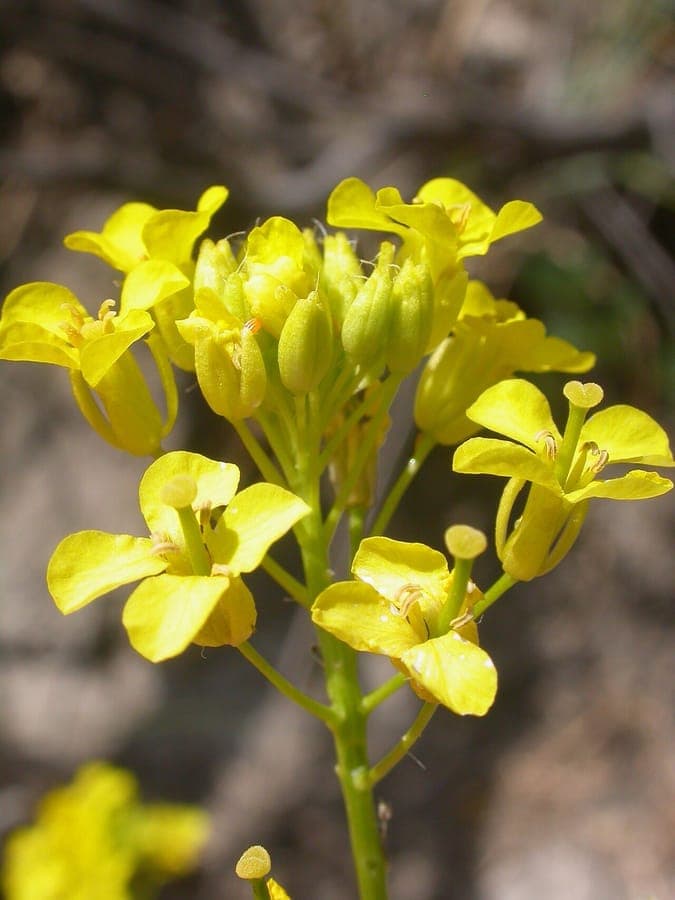
Matt Lavin / CC BY-SA 2.0, via Wikimedia Commons
London False Rocket (Sisymbrium loeselii): complete guide
Sisymbrium loeselii
¿Quieres ver London False Rocket (Sisymbrium loeselii): complete guide en tu jardín?
1 minuto, sin tarjeta de crédito
London False Rocket (Sisymbrium loeselii): complete guide
Overview
London False Rocket, scientifically known as Sisymbrium loeselii, is a fascinating biennial or short-lived perennial from the Brassicaceae family. The plant is named after German botanist Johannes Loesel. Its range extends from Central Europe through Siberia to the Himalayas. In many regions, it is a common weed in disturbed areas, roadsides, and fallow land. The plant is highly adaptable to cold climates and occurs at high latitudes. With yellow flowers and interesting seed pods, it makes a valuable addition to xeriscaping gardens and alpine landscapes.
Appearance and bloom
Sisymbrium loeselii is a rough-hairy plant with variable growth form, from compact rosettes to more upright forms reaching 40-60 centimeters tall. The plant is strongly hairy with characteristic roughness. Leaves are deeply pinnatifid with linear-shaped lobes. Blooming occurs from May to September with small yellow flowers in dense racemes. This long flowering period makes it excellent for bee garden designs. After flowering, thin seed pods develop up to 8 centimeters long, considerably longer than many related species. The seed pods are botanically interesting and give the plant strong architectural appeal.
Ideal location
London False Rocket grows optimally in full sun but tolerates partial shade better than many other Sisymbrium species. The plant can even thrive in semi-shaded locations. This makes it flexible for use in mixed borders and woodland-edge gardens. The plant grows well in sunny rock gardens, gravel gardens, and natural plant communities. It is very cold-tolerant and grows on cold, windy sites where many other plants cannot survive. This makes it ideal for alpine gardens and mountain landscapes.
Soil
London False Rocket is extremely tolerant of various soil types. The plant grows well on poor, sandy, and gravelly soils. Unlike many other Sisymbrium species, it can grow in wetter, clay-like soils. It grows in both acidic and alkaline soils. Well-draining soil is preferred, but the plant can tolerate moderately moist conditions. No soil preparation is usually necessary; this is a very adaptive plant regarding soil quality.
Diseño gratis
¿Quieres ver London False Rocket (Sisymbrium loeselii): complete guide en tu jardín? Crea un diseño gratis ahora.
Watering
Once established, London False Rocket is very drought-tolerant due to its deep root system. Young plants need regular water until well-established. Once mature, water is only needed during extremely dry periods. The plant tolerates wet periods better than many related species, which is useful in temperate climates. In arid regions, water during bloom for better flower duration. Excessive water can lead to weak growth and reduced flowering.
Pruning
Pruning is not essential for London False Rocket. Remove spent flowers regularly for continuous blooming. The plant can be cut back to 20-30 centimeters after blooming to stimulate a second bloom. If collecting seed, allow some seed pods to mature. The plant usually dies in autumn after seed production in cold climates, so aggressive pruning is unnecessary.
Maintenance calendar
APRIL-MAY: Check winter survivors; remove dead material. MAY-JUNE: Bloom begins; water young plants regularly. JUNE-JULY: Peak flowering period; bees active. JULY-AUGUST: Continuous bloom; possible second wave. AUGUST-SEPTEMBER: Seed maturation; harvest seed. OCTOBER-MARCH: Winter dormancy in cold climates.
Winter hardiness
London False Rocket is winter-hardy in zones 4-8 (to -25 degrees Celsius). The plant tolerates heavy frost without difficulty. In severe winters, young plants can be protected with mulch. It is probably the most cold-tolerant of all Sisymbrium species, making it ideal for boreal and alpine gardens. In mild climates, the plant can overwinter as a rosette with growth resuming in spring.
Companion plants
London False Rocket combines well with other alpine and cold-tolerant plants. It works well in Alpine borders with Thyme, Stonecrop, and Alpine Poppy. The plant attracts bees and functions well in bee garden designs alongside Lungwort, Hellebore, and Early Flowering Alliums. In xeriscaping, it combines well with other drought-stress-tolerant plants. Yellow flowers harmonize with purple and blue tones.
Closing remarks
London False Rocket is a robust, cold-tolerant plant ideal for alpine gardens and harsh climate environments. With its long flowering period and seed pod interest, it provides value throughout the growing season. This plant deserves more attention in modern garden designs. Seed is available from many suppliers and you can collect your own. With this complete guide, you are ready to successfully grow London False Rocket. Visit gardenworld.app/en for more information about alpine plant design.
¿Quieres ver London False Rocket (Sisymbrium loeselii): complete guide en tu jardín? Crea un diseño gratis ahora.
Sube una foto, elige un estilo y obtén un diseño fotorrealista con lista de plantas en menos de un minuto.
Más de 10.000 jardines diseñados
Sin tarjeta de crédito


Plantas similares
Brassica cretica: complete guide
Brassica cretica
Brassica cretica, the Cretan cabbage, grows wild on Aegean cliffs. Discover how to grow this drought-tolerant, yellow-flowered Mediterranean perennial.
Corsican cabbage: complete guide
Brassica insularis
Corsican cabbage is a rare Mediterranean rock cabbage with white flowers and blue-green leaves. Location, soil and winter protection.
Prostrate cabbage: complete guide
Brassica procumbens
Prostrate cabbage is a creeping North African cliff plant with yellow flowers. Discover location, soil type and winter protection.