
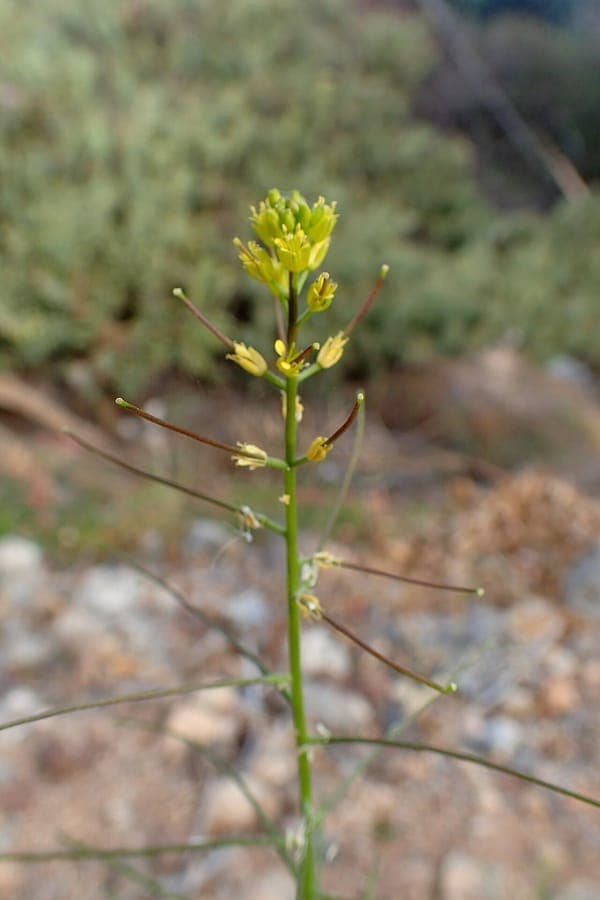
Krzysztof Ziarnek, Kenraiz / CC BY-SA 4.0, via Wikimedia Commons
Sisymbrium erysimoides: complete guide
Sisymbrium erysimoides
¿Quieres ver Sisymbrium erysimoides: complete guide en tu jardín?
1 minuto, sin tarjeta de crédito
Overview
Sisymbrium erysimoides, commonly known as smooth mustard or French rocket, is a useful plant from the Brassicaceae family. This plant originates from the Mediterranean to North Africa and the Middle East. The plant is characterized by its yellow flowers and fine, delicate leaf structure. This is an ideal plant for dry, warm gardens and Mediterranean landscapes.
The smooth mustard is a herbaceous annual plant that grows quickly and produces numerous small yellow flowers. The plant grows easily from seed and is very versatile in application.
Appearance and bloom
Sisymbrium erysimoides grows as a slender, upright plant with heights of 40 to 90 centimeters. The stems are delicate and sparsely branched. The leaves are finer than those of many other Sisymbrium species, linear and green in color. The flowers are small, bright yellow and appear in loose clusters along the stem.
The flowering period is long, usually from April to August. The flowers produce thin, elongated seed pods that are very characteristic. These seed pods are interesting structural elements in dry gardens.
Ideal location
Sisymbrium erysimoides thrives best in completely sunny locations. At least 6-8 hours of direct sunlight daily is essential. The plant does not grow well in shade and blooms minimally in partial shade. A warm, dry spot is preferred.
The plant can withstand warm sea breezes and tolerates salt air well. It is ideal for coastal gardens and warm, windy locations.
Soil quality
Sisymbrium erysimoides is very undemanding and grows well in poor, sandy soils. A pH of 6.5 to 8.0 is ideal. The plant can even grow on very poor, calcareous soils. Well-draining soil is essential; wet ground must be avoided.
The plant actually grows in practically any type of soil where moisture drainage is possible. No rich fertilization is needed or desired.
Diseño gratis
¿Quieres ver Sisymbrium erysimoides: complete guide en tu jardín? Crea un diseño gratis ahora.
Watering
Once established, Sisymbrium erysimoides is highly drought-tolerant. Minimal watering is needed outside the establishment phase. Water only during very dry periods after establishment. In containers water more regularly.
Young plants should receive regular watering until roots are established. After establishment, watering can be drastically reduced.
Pruning
Pruning is usually not necessary. Faded flowers can be removed to encourage further flowering, though this is not critical. After flowering, the plant can be removed and composted.
Leaving seed on the plant promotes next year's self-sowing. This also creates interesting seed formations.
Maintenance calendar
March to April: Sow seeds directly into ground or containers. Keep soil moist until emergence.
May to August: Water regularly until plants are established. Remove faded flowers. Collect seed if desired.
September to October: Remove spent plants. Harvest seed and store.
November to February: Winter dormancy. In warm regions, seed can germinate.
Winter hardiness
Sisymbrium erysimoides is an annual plant without strong winter hardiness. In temperate climates, it will not survive outdoors in harsh winters. In warm regions, it can exist as a short-lived biennial in mild winters.
In cold regions, the plant must be re-grown from seed each season. However, the plant grows very easily from seed.
Companion plants
Sisymbrium erysimoides combines well with other yellow-flowering plants such as Solidago. Purple-flowering plants such as Silene and Erodium form beautiful contrasts. Silver-white plants such as Artemisia and Santolina provide interesting texture contrasts.
In dry gardens, it combines well with other Brassicaceae species and drought-tolerant plants. It fits well in wild gardens and natural arrangements.
Closing
Sisymbrium erysimoides is a preferred plant for warm, dry gardens. With minimal watering needs and simple seed sowing, this is a perfect low-maintenance element for Mediterranean, dry and coastal gardens. Visit gardenworld.app for more information about drought-tolerant garden plants. Consider this elegant yellow rocket for your garden design on gardenworld.app!
¿Quieres ver Sisymbrium erysimoides: complete guide en tu jardín? Crea un diseño gratis ahora.
Sube una foto, elige un estilo y obtén un diseño fotorrealista con lista de plantas en menos de un minuto.
Más de 10.000 jardines diseñados
Sin tarjeta de crédito


Plantas similares
Brassica cretica: complete guide
Brassica cretica
Brassica cretica, the Cretan cabbage, grows wild on Aegean cliffs. Discover how to grow this drought-tolerant, yellow-flowered Mediterranean perennial.
Corsican cabbage: complete guide
Brassica insularis
Corsican cabbage is a rare Mediterranean rock cabbage with white flowers and blue-green leaves. Location, soil and winter protection.
Prostrate cabbage: complete guide
Brassica procumbens
Prostrate cabbage is a creeping North African cliff plant with yellow flowers. Discover location, soil type and winter protection.