
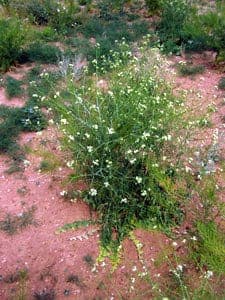
Lee Ferguson / Public domain, via Wikimedia Commons
Tumble mustard: complete guide
Sisymbrium altissimum
¿Quieres ver Tumble mustard: complete guide en tu jardín?
1 minuto, sin tarjeta de crédito
Overview
Tumble mustard, botanically known as Sisymbrium altissimum, is an interesting plant from the Brassicaceae family. This annual plant is renowned for its extreme adaptability to dry, sterile environments and its characteristic 'tumble' seed dispersal method. The plant now grows worldwide as an invasive species but also has interesting applications in sustainable gardens and ecological restoration. At gardenworld.app, you can understand this special plant and apply it usefully.
Tumble mustard is a often-cited example of plant adaptation to extreme environments and displays many interesting ecological and evolutionary properties.
Appearance & bloom cycle
Tumble mustard grows as an annual plant that typically reaches 30-100 cm in height. The stems are green, upright to spreading, often reddish-colored at the base, and more or less branched. When mature, the stems dry out and become brown and woody.
The leaves are dark green, very finely divided and pointed, approximately 5-10 cm long, giving the plant a fine, airy appearance. The leaves are also hairy.
The flowers are yellow, very small, approximately 5-7 mm in diameter, and grow in long, thin clusters. They appear typically from May to October, depending on climate and growing conditions. Because they are so small, they are less conspicuous than in other mustard species.
After pollination, very long, thin seed pods form, approximately 5-9 cm long, each containing 6-8 small seeds. These seed pods are very characteristic and give the plant its 'tumble weeds' name.
Ideal location
Tumble mustard grows best in full sun. The plant can grow in partial shade but is clearly sun-loving. The plant grows well on very warm, dry locations.
The plant grows almost everywhere and is very adaptable. It even thrives on extremely sterile, contaminated, or degraded terrain.
Soil & underground requirements
Tumble mustard makes very low demands on soil. It grows well on extremely nutrient-poor, heavy clay, sand, gravel, rocks, and even contaminated soils. The plant can grow on pH values of approximately 4.0 to 8.5. It is not particular.
The plant is very drought-tolerant and actually grows well on dry, sterile soils. In fact, it grows faster on poor soil because it faces less competition.
Diseño gratis
¿Quieres ver Tumble mustard: complete guide en tu jardín? Crea un diseño gratis ahora.
Watering
Tumble mustard is very drought-tolerant. Once established, it almost never needs extra water. The plant can grow in very hot, dry environments without supplemental watering. Overwatering can even cause problems.
For the first year, regular watering can help with faster growth, but it is not essential.
Pruning & maintenance
Tumble mustard requires no pruning. The plant grows naturally well. If you want to prevent it from spreading freely, you can remove seed pods before they ripen, but this is usually not necessary.
The characteristic seed dispersal through 'tumbling' occurs when the entire dried plant is lifted by strong wind and rolls along, continuously releasing seeds.
Maintenance calendar
- January - February (Winter): In mild climates, seed sowing can take place. In severe climates, wait.
- March (Early spring): Begin sowing in temperate climates.
- April - May (Spring): Continue sowing. Plants grow rapidly.
- June (Early summer): Flowering begins. Plant grows faster.
- July - August (Summer): Full bloom. No maintenance needed.
- September - October (Fall): Seeds ripen. Plant dries out.
- November - December (Fall - Winter): Plants die off. Seeds disperse.
Winter hardiness
Tumble mustard is not hardy in severe winters. It is a cold-sensitive plant and dies with frost. In temperate climates, it can self-seed in autumn, which germinates in spring.
In much warmer climates, tumble mustard can grow almost year-round.
Companion plants & ecological role
Tumble mustard grows well in rough terrain and contaminated soils alongside other hardy wildflowers. The plant is important in ecological restoration because of its rapid growth and ability to return nutrients to poor soils.
The plant serves as food for certain insects and birds, although it is not as valuable as native wildflowers for pollinators.
In permaculture systems, it can be used for rapid soil coverage and nutrient cycling on degraded terrain.
Conclusion
Tumble mustard is a fascinating plant that teaches much about plant adaptation. While it functions as an invasive species worldwide, it can also be beneficially used in ecological restoration and sustainable gardens on sterile terrain. For more inspiration and professional garden design, you can always consult gardenworld.app, where you can get expert help in planning your garden.
¿Quieres ver Tumble mustard: complete guide en tu jardín? Crea un diseño gratis ahora.
Sube una foto, elige un estilo y obtén un diseño fotorrealista con lista de plantas en menos de un minuto.
Más de 10.000 jardines diseñados
Sin tarjeta de crédito


Plantas similares
Brassica cretica: complete guide
Brassica cretica
Brassica cretica, the Cretan cabbage, grows wild on Aegean cliffs. Discover how to grow this drought-tolerant, yellow-flowered Mediterranean perennial.
Corsican cabbage: complete guide
Brassica insularis
Corsican cabbage is a rare Mediterranean rock cabbage with white flowers and blue-green leaves. Location, soil and winter protection.
Prostrate cabbage: complete guide
Brassica procumbens
Prostrate cabbage is a creeping North African cliff plant with yellow flowers. Discover location, soil type and winter protection.